Much at stake as Donald Trump and Xi Jinping meet at G20
- Written by Tony Walker, Adjunct Professor, School of Communications, La Trobe University
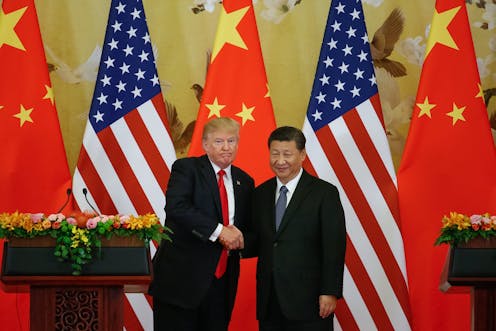
When US President Donald Trump meets his Chinese counterpart, Xi Jinping, on the margins of the G20 summit in Buenos Aires between November 30 and December 1, nothing less than a reasonably healthy global trading system and continued economic growth will be on the table.
It is one of the most significant meetings between two global leaders in the modern era.
It carries the kind of tension and gravity of the high-wire diplomacy between Ronald Reagan and Mikhail Gorbachev in the 1980s, which signalled the end of the Cold War and, as it happened, the disintegration of the former Soviet Union.
Or, before that, Richard Nixon’s visit to China in 1972, which resulted in the signing of the Shanghai Communique and an end to decades of hostility between the United States and China.
Read more: The risks of a new Cold War between the US and China are real: here's why
World markets unnerved by an evolving trade conflict between the world’s two largest economies will take their cues from this encounter between an unpredictable US president and a Chinese leader who will not want to be seen to yield ground. Or, to give it an oriental description, lose face.
This is a fractious moment in world economic history.
Billions of dollars in global equity markets will rest on a reasonable consensus in the Argentine capital. The two sides will reach for a compromise that will enable relative stability to be restored to an economic relationship that is threatening to unravel.
Since a ragged outcome, or even failure, is in no-one’s interests, it is hard to believe Washington and Beijing will not seek to calm legitimate concerns about the risks of a full-blown trade war and its impact on global growth.
US-China trade tremors are already having an impact on growth projections for 2018-2020.
In its latest World Economic Outlook, the International Monetary Fund reports the world economy is plateauing, partly due to trade tensions and stresses in emerging markets.
The IMF has scaled back its global growth projections from its July Outlook forecast for 2019 to 3.7% from 3.9%. It has marked down US growth by 0.2 percentage point to 2.5%, and China by a similar margin to 6.2%.
However, if trade disruptions persist, fallout will become more serious in 2020 with global growth projected to be down by 0.8%, and with it US and China growth down significantly.
Trade wars have consequences, including risks of a global recession.
All this invests the Trump-Xi encounter with more-than-usual significance. A bad outcome will heighten risks of an accelerating global slowdown.
In the lead-up to the G20, American and Chinese officials have been preparing the ground, with the Chinese side anxious to reduce tensions following a November 1 phone call between the two presidents.
But it is less clear that Washington is willing to ease pressure on China to liberalise further a foreign investment environment, seek ways to reduce a trade gap and make more conspicuous efforts to tone down concerns about Chinese pilfering of its intellectual property.
In a media briefing in Beijing, Chinese officials underscored China’s desire for a reasonable outcome in Buenos Aires. Wang Shouwen, a vice commerce minister, said:
We hope China and the US are able to resolve their problems based on mutual respect, benefits and honesty.
However, Trump is continuing to threaten further increases in tariffs on US$200 billion of Chinese imports now set at 10% but due to increase to 25% from January 1. He told The Wall Street Journal this week:
The only deal would be China has to open up their country to competition from the United States.
Trump also threatened to slap tariffs on an additional US$267 billion worth of Chinese imports if negotiations with Xi are unsuccessful:
If we don’t make a deal, then I’m going to put the US$267 billion additional on [at a tariff rate of either 10% or 25%].
This next batch of Chinese imports might include laptops and Apple iPhones, which are among China’s biggest exports to the US.
Further complicating the possibility of a satisfactory negotiation in Buenos Aires is a lingering dispute between the US and China over reforms to the World Trade Organisation to strengthen its dispute resolution and appeal mechanisms.
The US also objects to China’s continued description as a “developing country” under WTO rules. This includes provisions that are favourable to Chinese state-owned enterprises.
A collapse in efforts to reform the WTO would strike another blow at a multilateral trading system that is under more stress than at any time since globalisation gathered pace in the 1990s.
The US-China trade conflict, which is threatening to become a full-blown trade war with unpredictable consequences, cannot be separated from a more general deterioration in relations.
These were given expression last month by Vice President Mike Pence in a speech to the Hudson Institute, in which he lambasted China in a way that prompted talk of a new cold war.
Pence accused China of deploying:
… an arsenal of policies inconsistent with free and fair trade, including tariffs, quotas, currency manipulation, forced technology transfers, intellectual property theft and industrial subsidies handed out like candy. These policies have built Beijing’s manufacturing base, at the expense of its competitors – especially the United States.
The US trade deficit with China reached US$375 billion last year – nearly half the US global trade deficit.
None of this augurs well for a constructive resolution of US-China differences at the G20, although you might hope Trump’s approach would be tempered by concerns about the economic consequences of a conspicuous failure.
What seems most likely, given the stakes involved, is for officials from both countries to be tasked with responsibility for addressing a range of American concerns, with the aim of resetting the relationship.
This would seem to be a best-case scenario.
In the meantime, officials working on the draft of a final communique will be struggling to satisfy competing demands from G20 participants for clear-cut statements on protectionism and climate change.
These have been staples of such communiques since the G20 was formed ten years ago amid a global financial crisis.
Read more: In the economic power struggle for Asia, Trump and Xi Jinping are switching policies
Washington is reportedly resisting an explicit call to fight protectionism. It is also demanding a watering down of the G20’s commitment to the Paris Agreement on climate change.
Consensus on these issues is proving elusive, further undermining efforts to address global challenges.
This underscores a dramatic shift in the global geopolitical environment since Trump gained office.
At the 2016 G20 summit in Hangzhou, world leaders agreed on a “rules-based, transparent, non-discriminatory, open and inclusive multilateral trading system with the World Trade Organisation playing the central role in today’s global trade”.
On climate, the G20 committed itself “to complete our respective domestic procedures in order to join the Paris Agreement”.
Two years later, a “rules-based” trading system is being shredded and the Paris Agreement is at risk of unravelling. These are troubled times, not helped by an American pullback from the stabilising role in global affairs it has played since the second world war.
Authors: Tony Walker, Adjunct Professor, School of Communications, La Trobe University
Read more http://theconversation.com/much-at-stake-as-donald-trump-and-xi-jinping-meet-at-g20-106774