

Australia, it's time to talk about our water emergency
- Written by: Quentin Grafton, Director of the Centre for Water Economics, Environment and Policy, Crawford School of Public Policy, Australian National University
The last bushfire season showed Australians they can no longer pretend climate change will not affect them. But there’s another climate change influence we must also face up to: increasingly scarce water on our continent.
Under climate change, rainfall will become more unpredictable. Extreme weather events such as cyclones will be more intense. This will challenge water managers already struggling to respond to Australia’s natural boom and bust of droughts and floods.
Thirty years since Australia’s water reform project began, it’s clear our efforts have largely failed. Drought-stricken rural towns have literally run out of water. Despite the recent rains, the Murray Darling river system is being run dry and struggles to support the communities that depend on it.
We must find another way. So let’s start the conversation.
 It’s time for a new national discussion about water policy.
Joe Castro/AAP
It’s time for a new national discussion about water policy.
Joe Castro/AAP
How did we get here?
Sadly, inequitable water outcomes in Australia are not new.
The first water “reform” occurred when European settlers acquired water sources from First Peoples without consent or compensation. Overlaying this dispossession, British common law gave new settlers land access rights to freshwater. These later converted into state-owned rights, and are now allocated as privately held water entitlements.
Some 200 years later, the first steps towards long-term water reform arguably began in the 1990s. The process accelerated during the Millennium Drought and in 2004 led to the National Water Initiative, an intergovernmental water agreement. This was followed in 2007 by a federal Water Act, upending exclusive state jurisdiction over water.
Under the National Water Initiative, state and territory water plans were to be verified through water accounting to ensure “adequate measurement, monitoring and reporting systems” across the country.
This would have boosted public and investor confidence in the amount of water being traded, extracted and recovered – both for the environment and the public good.
This vision has not been realised. Instead, a narrow view now dominates in which water is valuable only when extracted, and water reform is about subsidising water infrastructure such as dams, to enable this extraction.
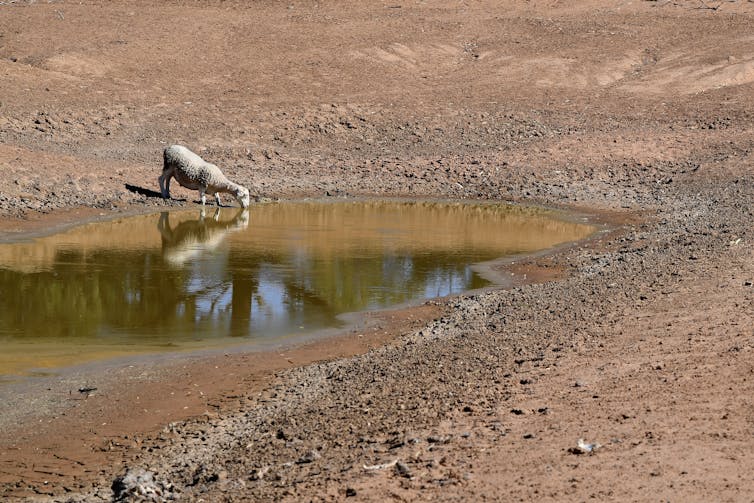 The National Water Initiative has failed.
Dean Lewins/AAP
The National Water Initiative has failed.
Dean Lewins/AAP
Why we should all care
In the current drought, rural towns have literally run out of fresh drinking water. These towns are not just dots on a map. They are communities whose very existence is now threatened.
In some small towns, drinking water can taste unpleasant or contain high levels of nitrate, threatening the health of babies. Drinking water in some remote Indigenous communities is not always treated, and the quality rarely checked.
In the Murray-Darling Basin, poor management and low rainfall have caused dry rivers, mass fish kills, and distress in Aboriginal communities. Key aspects of the basin plan have not been implemented. This, coupled with bushfire damage, has caused long-term ecological harm.
How do we fix the water emergency?
Rivers, lakes and wetlands must have enough water at the right time. Only then will the needs of humans and the environment be met equitably - including access to and use of water by First Peoples.
Water for the environment and water for irrigation is not a zero-sum trade-off. Without healthy rivers, irrigation farming and rural communities cannot survive.
A national conversation on water reform is needed. It should recognise and include First Peoples’ values and knowledge of land, water and fire.
Our water brief, Water Reform For All, proposes six principles to build a national water dialogue:
- establish shared visions and goals
- develop clarity of roles and responsibilities
- implement adaptation as a way to respond to an escalation of stresses, including climate change and governance failures
- invest in advanced technology to monitor, predict and understand changes in water availability
- integrate bottom-up and community-based adaptation, including from Indigenous communities, into improved water governance arrangements
- undertake policy experiments to test new ways of managing water for all
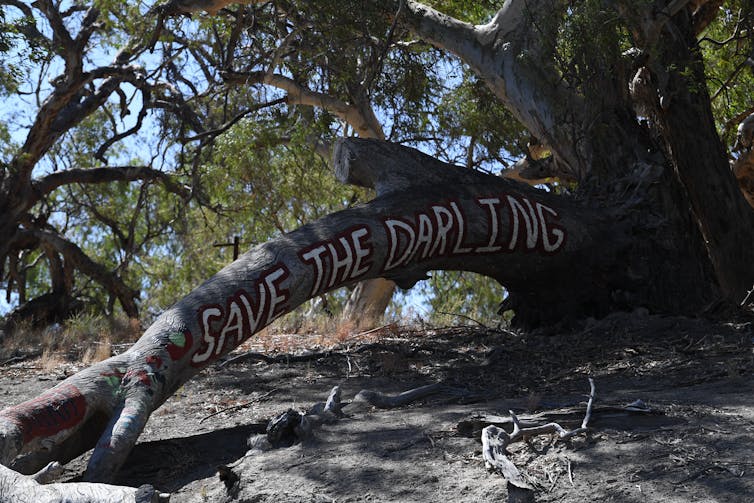 The Darling River is in poor health.
Dean Lewins/AAP
The Darling River is in poor health.
Dean Lewins/AAP
Ask the right questions
As researchers, we don’t have all the answers on how to create a sustainable, equitable water future. No-one does. But in any national conversation, we believe these fundamental questions must be asked:
who is responsible for water governance? How do decisions and actions of one group affect access and availability of water for others?
what volumes of water are extracted from surface and groundwater systems? Where, when, by whom and for what?
what can we predict about a future climate and other long-term drivers of change?
how can we better understand and measure the multiple values that water holds for communities and society?
where do our visions for the future of water align? Where do they differ?
what principles, protocols and processes will help deliver the water reform needed?
how do existing rules and institutions constrain, or enable, efforts to achieve a shared vision of a sustainable water future?
how do we integrate new knowledge, such as water availability under climate change, into our goals?
what restitution is needed in relation to water and Country for First Peoples?
what economic sectors and processes would be better suited to a water-scarce future, and how might we foster them?
Water reform for all
These questions, if part of a national conversation, would reinvigorate the water debate and help put Australia on track to a sustainable water future.
Now is the time to start the discussion. Long-accepted policy approaches in support of sustainable water futures are in question. In the Murray-Darling Basin, some states even question the value of catchment-wide management. The formula for water-sharing between states is under attack.
Read more: It's official: expert review rejects NSW plan to let seawater flow into the Murray River
Even science that previously underpinned water reform is being questioned
We must return to basics, reassess what’s sensible and feasible, and debate new ways forward.
We are not naive. All of us have been involved in water reform and some of us, like many others, suffer from reform fatigue.
But without a fresh debate, Australia’s water emergency will only get worse. Reform can – and must – happen, for the benefit of all Australians.
The following contributed to this piece and co-authored the report on which it was based: Daniel Connell, Katherine Daniell, Joseph Guillaume, Lorrae van Kerkoff, Aparna Lal, Ehsan Nabavi, Jamie Pittock, Katherine Taylor, Paul Tregoning, and John Williams
Authors: Quentin Grafton, Director of the Centre for Water Economics, Environment and Policy, Crawford School of Public Policy, Australian National University
Read more https://theconversation.com/australia-its-time-to-talk-about-our-water-emergency-139024


















