

Indigenous voices are speaking loudly on social media but racism endures
- Written by: Bronwyn Carlson, Professor, Indigenous Studies, Macquarie University
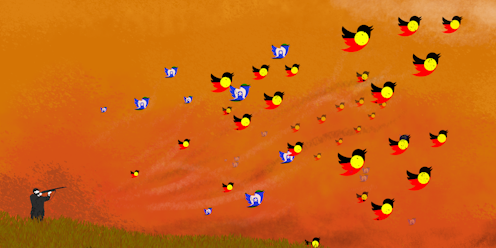
Social media are a vital resource for Indigenous Australians, connecting them to community and culture, helping identify those at risk of suicide or self-harm, and offering a powerful outlet for political activism. But racism is a major problem for Indigenous people online.
A new report, Social Media Mob: Being Indigenous Online, unpacks the complex role social media play in the lives of Indigenous Australians. The research, conducted via qualitative interviews and an online survey, found the most popular social media platforms for participants were Facebook (for family and community posts) and Twitter (for more political activities). Younger people also used Snapchat and Instagram.
Many said social media allowed them to feel more connected to their Indigenous identity — particularly those affected by historical disconnections from community and culture. More than 80% of participants said they openly identify as Aboriginal and/or Torres Strait Islander on social media. As one said:
My Aboriginality is the focal point of my identity both in society and online. Specifically, on Facebook, my photos and page, groups and friends all highlight my Aboriginality.
However, more than half of respondents said they were “selective” about what they had posted online, for fear of attracting racist or violent responses. Over 50% said that sometimes they chose not to identify as Indigenous online. As one participant explained: “It’s sometimes safer to not identify as Aboriginal due to discrimination and prejudice.”
Read more: 12 deadly Indigenous Australian social media users to follow
In the survey, 88% of respondents said they had seen examples of racism towards Indigenous people on social media. Most common was the doubting of identity and the use of memes depicting Indigenous people in a derogatory manner, often in the guise of a joke.
More than a third of respondents had personally been subjected to racism, 21% had received threats by other users on social media and 17% indicated these had impacted their “offline” lives.
Some respondents reported being questioned over whether they were “really Indigenous”, with critics drawing on stereotypical ideas — particularly about skin colour. As one put it:
I am not too open about my Indigenous background on social media sites because I am light skinned and have found that people pass judgment and make assumptions.
Despite this, Indigenous people highlighted many positives to social media. These have become a significant avenue for both seeking and providing help, in areas such as employment, legal services, education, wellbeing and, perhaps most urgently, for those at risk of self-harm and suicide.
Indigenous suicide rates consistently rank among the highest in the world. In our research, 48% of respondents said social media made them feel more likely to be able to identify someone at risk of self-harm or suicide. Indeed several had followed up on social media posts by asking friends, family or police to check in physically on someone.
I remember one young man was writing some, well, it seemed quite suicidal thoughts on that [Facebook]. So, it ended up a bunch of us actually rallying together to make sure that police were sent around and went to that person’s place and it was all OK.
Social media also enabled some participants to reach out for help on issues relating to mental health. These kinds of online practices suggest social media offer a potentially effective platform for developing culturally appropriate suicide interventions and prevention programs.
Read more: Indigenous suicide rates in the Kimberley seven times national average
While Indigenous Australians remain under-represented politically, 79% of our respondents indicated they were politically active online. Social media have profoundly redistributed power of communication, with mainstream media no longer having such a strong hold on the public narrative.
Recent Indigenous-led and social-media-driven campaigns like #SoSBlakAustralia, which sought to stop the forced closure of Aboriginal communities in Western Australia, and #IndigenousDads demonstrate how Indigenous people use social media to make their voices heard. Both trended on social media and were creative strategies for resisting, subverting and challenging the political status quo.
Our research shows social media are “different” for Indigenous people. For instance, whereas young people often dismiss Facebook as a place where their parents gather, we found that younger Indigenous Australians are using it to connect to older relatives.
Facebook has also provided an avenue to reconnect for people displaced from their families by past government policies and practices. This may be an important process in the future also, given the numbers of Indigenous children in out-of-home care.
Indigenous people are also bound by cultural protocols and norms and are not necessarily free to post without consideration for the collective. This is particularly the case for issues related to death.
Despite legitimate concerns about the impact of social media in the wake of the Cambridge Analytica scandal, it’s important to acknowledge that these play a crucial role in the lives of many Indigenous Australians.
For Aboriginal and Torres Strait Islander populations, who globally tend to fare worse on many social metrics — income, education, life expectancy, political representation, cultural safety — social media can help facilitate vital networks of support, care and knowledge.
Authors: Bronwyn Carlson, Professor, Indigenous Studies, Macquarie University


















