

only urgent intervention can save New Zealand's media
- Written by Wayne Hope, Professor of Communication Studies, Auckland University of Technology
How many media analysts predicted it? In 2018 Australia’s Nine Entertainment absorbed Fairfax Media and its New Zealand subsidiary Stuff. Just under two years later chief executive Sinead Boucher bought Stuff from Nine for a dollar.
The bold move saved New Zealand’s largest newspaper publisher and online news site from uncertainty at best, closure at worst.
“Behold, Saint Sinead of Stuff”, wrote one observer, while pointing out what else would be needed: financial backing, government subsidies, and management of internal costs and debt.
Media commentators, public media lobbyists, journalists, Communications Minister Kris Faafoi and even Nine CEO Hugh Marks also praised Boucher’s proposals for staff shareholdings and an editorial independence charter.
But behind these signs of hope the Stuff initiative was emblematic of a rapidly disintegrating media system.
Here is the news: layoffs and closures
COVID-19 only accelerated the collapse. The national lockdown and forecast economic contraction have been commercially disastrous for all private media organisations. Redundancies and closures have gone viral.
In late March New Zealand Media and Entertainment (NZME), owner of the NZ Herald (the country’s largest daily paper) and nearly half the country’s commercial radio stations, closed its sports operation and shed 25 full-time staff.
Read more: Another savage blow to regional media spells disaster for the communities they serve
A week later German-owned Bauer Media abruptly closed its New Zealand branch, folding such venerable current affairs and popular titles as the Listener, Woman’s Weekly, North & South and Metro.
A fortnight later NZME announced 200 more redundancies – 15% of its workforce. As Boucher announced her Stuff buyout, MediaWorks (owner of TV3 and the rest of New Zealand’s commercial radio stations) shed 130 staff.
Confronted by this unfolding catastrophe, the government finally announced a NZ$50 million emergency package. This included $21 million to offset TV and radio transmission fees for six months, $16.5 million to reduce contributions to the NZ On Air content funding agency for the financial year, and $11 million in targeted assistance for specific media companies.
But the response was late, partial and narrowly focused. COVID-19 has exposed a double crisis in New Zealand’s news media that short-term fixes do little to address.
A crisis over 30 years in the making
For decades the weakening sustainability of commercial media has damaged the viability of news reporting, journalistic enquiry and national media coverage. Meanwhile, underfunded public broadcasting has long battled to pay staff, create content and transition successfully to digital platforms.
These trends can be traced back to the 1980s. The restructuring of Radio New Zealand (RNZ) and Television New Zealand (TVNZ), the launch and subsequent sale of TV3, the privatisation of Telecom (1990) and the abolition of all restrictions on foreign media ownership (1991) set the scene for today’s crisis.
Transnational media conglomerates were allowed to colonise the national media scene. From 2007, listed and unlisted financial institutions (banks, hedge funds, private equity companies) acquired media holdings as short-term revenue streams. Concentration of ownership intensified.
At the same time, with the rise of Google and Facebook, television’s advertising share declined from 34% in 1988 to 21% in 2018. Before COVID-19, digital advertising was worth NZ$1 billion, about 40% of New Zealand’s entire advertising turnover. The pandemic’s economic shock has hit ad revenues even harder.
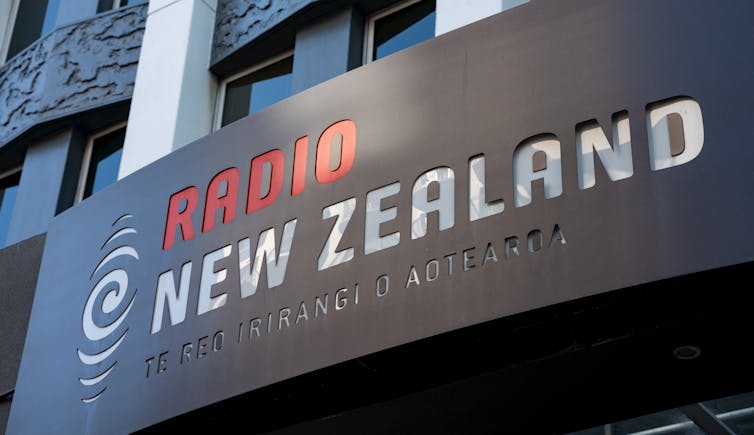 Underfunded for years, Radio New Zealand could now be part of the solution to a media crisis.
www.shutterstock.com
Underfunded for years, Radio New Zealand could now be part of the solution to a media crisis.
www.shutterstock.com
Print media were already haemorrhaging. From 2018 to 2019, every major newspaper lost circulation. NZME and Stuff continued to lay off staff, integrate newsrooms, delete print editions and close regional titles.
Stalling revenues, dashed profit expectations and fragile share prices persuaded major players that amalgamation was the answer. But this strategy failed. The Commerce Commission prevented attempted mergers between Sky TV and Vodafone, and NZME and Stuff, due to monopoly fears and the perceived risk to diversity of information sources.
There is a better way
So what is the answer? Nothing short of a full-blown news media reconstruction strategy.
First, the Stuff buyout deserves government support to complement private sector financial backing. A funding mechanism designed to foster public interest journalism at Stuff and other media organisations should be established.
Second, a national interest test for any overseas investment in New Zealand should apply to transnational media acquisitions. As media commentator Gavin Ellis has observed, “journalism [is] a strategic asset over which New Zealanders must have control”.
Third, existing government proposals for a TVNZ-RNZ merger within a new multi-platform entity need urgent development. The new organisation should insulate some of its operation from commercial pressures. A public service philosophy for the relevant stations, channels and platforms should be clearly stated and enshrined in legislation.
Read more: Google and Facebook pay way less tax in New Zealand than in Australia – and we're paying the price
Here, I would include an online magazine of arts, current affairs and popular culture to succeed the Listener. The organisation’s board must be independent and representative, with informal links to the Māori Television Service.
Finally, as communications expert and public media lobbyist Peter Thompson has proposed, the government should impose a digital services levy on the tech giants that have siphoned off domestic advertising revenue without investing in local content. This would help generate the revenue to fund public interest journalism initiatives.
We know what to do. Now is the time to reconstruct journalism and public media in Aotearoa-New Zealand.
Authors: Wayne Hope, Professor of Communication Studies, Auckland University of Technology

















