

Are your kids using headphones more during the pandemic? Here's how to protect their ears
- Written by Peter Carew, Lecturer, University of Melbourne
During the coronavirus pandemic, have your kids been using headphones more than usual? Maybe for remote schooling, video chats with relatives, or for their favourite music and Netflix shows?
We have to be careful about both the volume and duration of headphone use. Listening too loudly or for too long can do permanent damage to hearing. The good news is there are ways to prevent long-term harm relatively easily.
Read more: 5 reasons it's safe for kids to go back to school
Hearing loss in children may be increasing
Our hearing needs to be protected throughout life, because damage to hearing cannot be reversed. This is why we have workplace noise exposure standards and guidelines, which tell workers when to use protection such as earplugs or ear defenders.
Unfortunately though, hearing loss in children may be increasing. A study from last year, in which both of us were involved, reviewed the hearing of more than 3.3 million children from 39 countries across a 20-year period.
We found around 13% of children had measurable hearing loss by 18 years of age that may impact their ability to decipher sounds important for understanding speech. The study suggested hearing loss in kids is rising – but we don’t yet know why.
Not many studies have examined whether headphone use is directly linked to hearing loss in children. But in one study of 9-11-year-old Dutch children, where 14% had measurable hearing loss, around 40% reported using portable music devices with headphones. Could headphones be contributing? Possibly, but unfortunately we don’t know for sure, and more studies are needed.
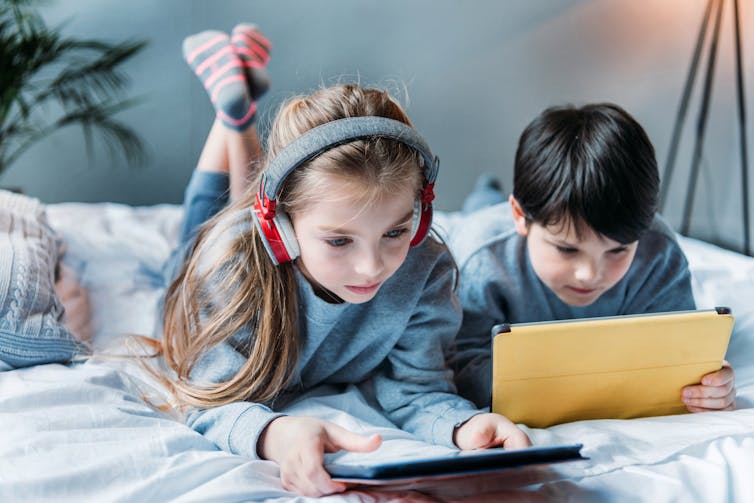 More studies are needed to determine if headphone use is causing a decline in kids’ hearing. But there are ways to mitigate the risks regardless.
Shutterstock
More studies are needed to determine if headphone use is causing a decline in kids’ hearing. But there are ways to mitigate the risks regardless.
Shutterstock
How do we know whether our children’s hearing is being affected?
Adults typically first notice a hearing problem by struggling to hear higher-pitched sounds clearly. Sounds may seem muffled, or the ears may feel “blocked”, or they may notice a ringing or buzzing sound, called tinnitus.
Read more: Even mild hearing loss as a child can have long-term effects on how the brain processes sound
Unlike adults, children won’t necessarily know how to describe these symptoms. Instead they may use terms they do know, like a bee buzzing, a whistle, or the wind blowing. Parents should treat any reported ear symptom as serious and get their child’s hearing tested. It’s best to visit a hearing clinic first, and then a GP if necessary, although this will depend on your location.
Excessive noise damages hearing
Our inner ear (cochlea) contains tiny hair cells, which change sounds we hear into electrical signals for our brain. These hair cells are finely tuned and are responsible for different pitches of sound, like keys on a piano.
Exposure to loud noise can damage these hair cells and perhaps the nerve that connects the cochlea to the brain. Repeated excessive noise exposure can lead to permanent hearing loss. Unfortunately, by the time someone experiences hearing problems, some irreversible damage has already happened.
What should we do to protect kids’ hearing?
The risk of hearing damage depends on both loudness and duration of sound exposure. Limiting both helps to reduce the risk of hearing damage.
Limiting loudness
We measure the loudness of sound in decibels (dB). But it’s important to note that the dB scale is logarithmic rather than linear. That means a 110dB sound (similar to a chainsaw) is actually much more than 10% louder than a 100dB sound. Parents can download free sound meter apps that help with understanding the volume of different environments and activities.
A more difficult task for parents is monitoring the loudness within their children’s headphones. Some headphones leak sounds out, while others insulate the sound into the ear. So a child using “leaky” headphones at a safe volume may appear to be listening to sounds that are too loud, but a child with tightly sealed headphones could be playing sounds at potentially damaging levels without parents noticing.
To understand their child’s specific usage, parents can:
listen to their child’s headphones to understand how loud sounds can become
check to see if children can hear you talk at a normal volume from an arm’s length away, over the sounds playing on the headphones. If they can, their headphone use is more likely to be at a safe volume.
There are headphones designed for children that limit the maximum loudness – usually to 85dB. While a limit is great, listening to 85dB sounds all day every day is not risk-free.
Noise-cancelling headphones are another option, albeit expensive. By reducing the intrusion of outside noise, it should mean children can keep headphone volume lower.
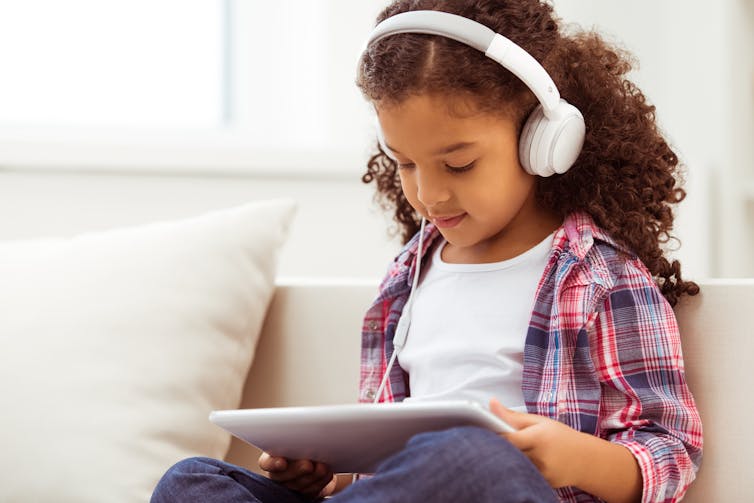 Parents can limit the loudness of headphones, as well as the duration of time spent listening with headphones.
Shutterstock
Parents can limit the loudness of headphones, as well as the duration of time spent listening with headphones.
Shutterstock
Managing duration
We should also monitor how long we’re exposed to sound. Everyday conversation is around 60dB, which will not be a problem regardless of the duration of exposure. However, guidelines say we can be exposed an 85dB sound (like a rubbish truck) for up to 8 hours at a time. But if the loudness of the sound is increased by just 3 decibels to 88dB, the sound energy is doubled, and safe exposure time would drop to just 4 hours. Operating a chainsaw at 110dB would then be limited to around 1 minute before damage is likely to occur.
Read more: Tinnitus: scale of hearing damage for music industry workers revealed
Exposure to noise is cumulative. Noise can also come from other sources in the child’s environment. Consider a child’s activities throughout a day. Parents should try to avoid consecutive noisy exercises, like headphone use, music practice, then noisy toys or games. Considering the total “doses” of sound in the day means parents should schedule some breaks to allow the ears time to recover.
Of course, parents should practise what they preach! Modelling responsible use of headphones and awareness of the enjoyment of being able to hear well into adulthood is key.
This article is supported by the Judith Neilson Institute for Journalism and Ideas.
Authors: Peter Carew, Lecturer, University of Melbourne

















