

'Forced' evictions eat away at a Manila community as developer spares the golf course next door
- Written by Redento B. Recio, Postdoctoral Research Fellow – Informal Urbanism (InfUr-) Hub, University of Melbourne
– Ricky sits at one of half-a-dozen entrances to the San Roque settlement in Metro Manila’s North Triangle district. Ricky (not his real name) is part of a large team that guards the settlement 24 hours a day with two specific tasks: to prevent the entry of any construction materials and to stop any building activity or repairs by residents.
San Roque is an informal settlement of about 30,000 people within walking distance of a major transport and shopping hub in Quezon City, in Manila’s north-east. While the settlement, which dates back to the early 1980s, is to be demolished for redevelopment, a golf course on state land across the road will remain untouched. The settlement gained global attention when 21 residents were jailed for protesting in April about a lack of promised aid amid a COVID-19 lockdown.
Read more: How Mumbai's poorest neighbourhood is battling to keep coronavirus at bay
The “plan” for the area is to build a new central business district for Quezon City. All forms of informality – settlements, street vendors and pedicabs – will be removed. The process has continued even through the pandemic.
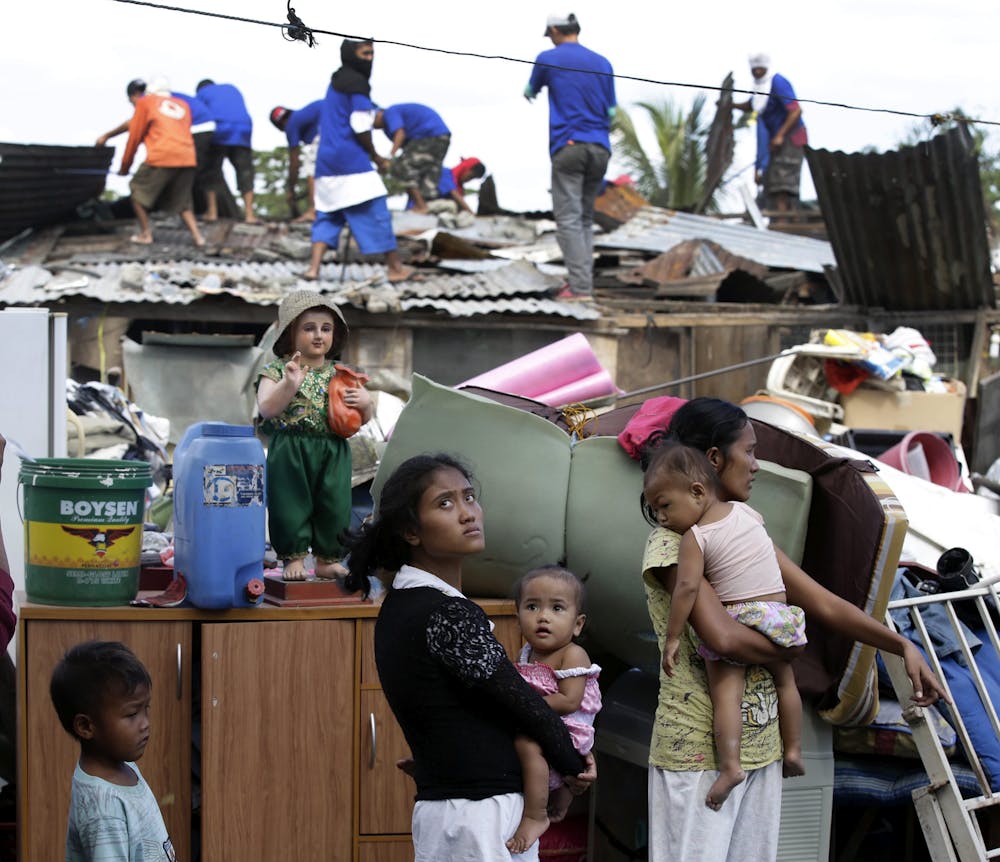 San Roque residents have been under siege for a decade. Here a demolition team tears down family homes in January 2014.
Dennis M. Sabangan/EPA/AAP
San Roque residents have been under siege for a decade. Here a demolition team tears down family homes in January 2014.
Dennis M. Sabangan/EPA/AAP
While the original land title is contested, the area falls under the jurisdiction of the National Housing Authority (NHA). The state has offered residents a path to secure tenure in the past, only to withdraw it. In 2009, the NHA signed a joint-venture agreement with Ayala Land, a developer of shopping malls, residential compounds and private cities.
Eviction house by house
Over the past decade, the Ayala-NHA alliance has engaged in incremental coercive eviction. Home owners are offered a small compensation package plus relocation to public rental housing if they demolish their house and clear and vacate the site. The community is now pock-marked with vacant sites.
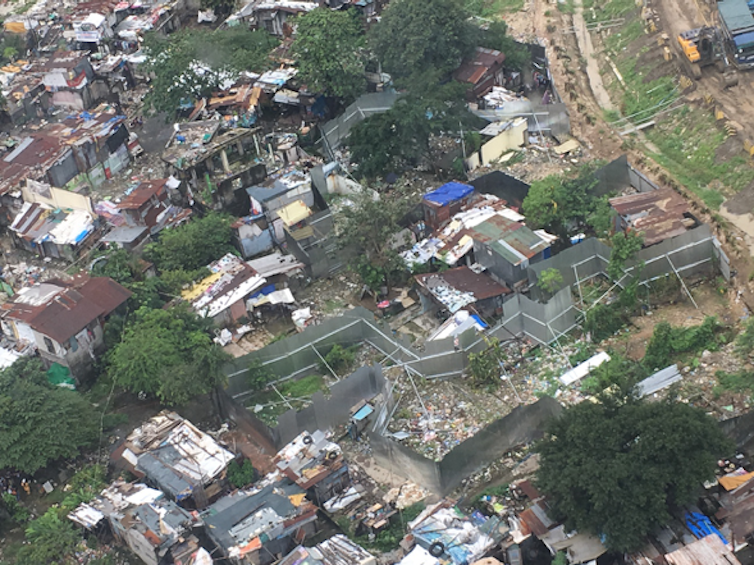 Houses are demolished and then fenced to prevent re-encroachment.
Redento Recio, Author provided
Houses are demolished and then fenced to prevent re-encroachment.
Redento Recio, Author provided
A census in 2009 counted about 9,000 households in San Roque. About 6,000 remain. Only about 2,000 of them qualify for relocation due to long-term residence and ownership.
The unqualified residents are the most vulnerable. If evicted, they will likely move to other informal settlements nearby.
Ayala Land claims to uphold the UN Sustainable Development Goals through developments that have a “positive impact on the community”. The NHA, in its charter to house the urban poor, is notionally committed to efficiency, social equality and justice.
The Quezon City mayor has agreed not to conduct “forced” evictions. She has called on the NHA to find a “win-win” solution.
Globally, forced eviction of informal settlements is now widely regarded as a violation of human rights, which mostly results in new encroachments. UN policy is to focus on on-site redevelopment.
Informal settlements emerge where people can make a living. San Roque residents work as labourers, street vendors, informal transport operators, security guards – low-paid jobs that make the city work. When the state cannot build much-needed housing, residents build it themselves.
Read more: Street vendors' self-help strategies highlight cities' neglect of how the other half survive
A plan that puts golf before people
The relocations involve a long-term rental or mortgage agreement for a 24-square-metre dwelling of relatively poor quality and design. The housing is up to two hours away from San Roque. Along with losing the main asset they have invested in over many years, residents will lose access to jobs and income, and the social networks that help them cope with the daily grind of poverty.
Many will be left with rent and mortgage obligations they can’t afford. Little wonder some residents succumb to the coercion, demolish their houses, take the compensation and later return to rent rooms in other informal settlements.
From an urban planning perspective, moving the poor to cheap land on the urban fringe simply makes an already dysfunctional transport system worse.
Some will argue no other land is available for the market-led residential towers, shopping malls, casinos and walkable parks for the growing middle class. Yet just across the street from San Roque is an 18-hole golf course on NHA-controlled state land that is ripe for redevelopment.
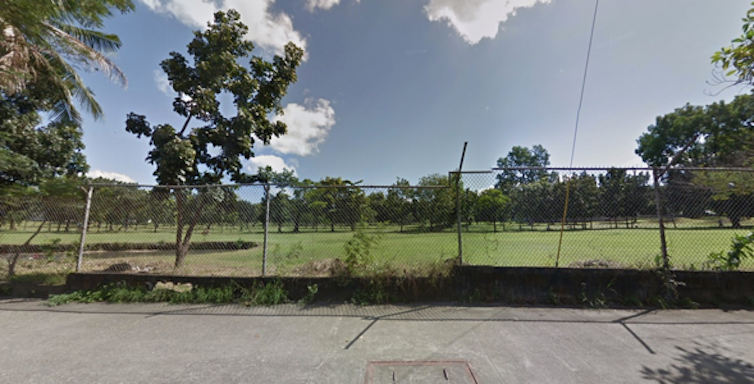 Why displace the urban poor when an 18-hole golf course occupies state land just across the road?
Kim Dovey
Why displace the urban poor when an 18-hole golf course occupies state land just across the road?
Kim Dovey
Read more: What sort of 'development' has no place for a billion slum dwellers?
This is neither rational urban planning nor the result of villains in smoke-filled rooms. It is more about a lack of imagination and political will.
Most agents of this planning process are trapped within a system where “sustainability” and “social inclusion” are a facade. This is the ugly face of neoliberal planning: market-led development becomes its own justification and the state is left to socialise the cost.
Bring in cheap labour, but remove their homes
The role of Ayala guards in San Roque highlights the paradox of this approach. Flows of capital are at once generating work for the urban poor and stimulating the growth of settlements they are trying to erase. The massive construction projects require huge reserves of cheap labour in the very districts where affordable housing is being demolished to make way for those projects.
Ricky, the Ayala guard, is one of the residents who doesn’t qualify for relocation. He came to Manila over two years ago, escaping the violence in Mindanao. San Roque offered cheap rental housing and work. His job is to paralyse any form of upgrading and so help to erase his own neighbourhood.
This is forced eviction made to appear consensual. Indeed, it looks legitimate from a middle class and elite perspective. Their livelihoods and lifestyles depend fundamentally on the supply of cheap labour. Yet, by displacing the urban poor, shopping malls and enclaves protect the middle class from everyday encounters with urban poverty. They can ignore the contradictions that saturate the city.
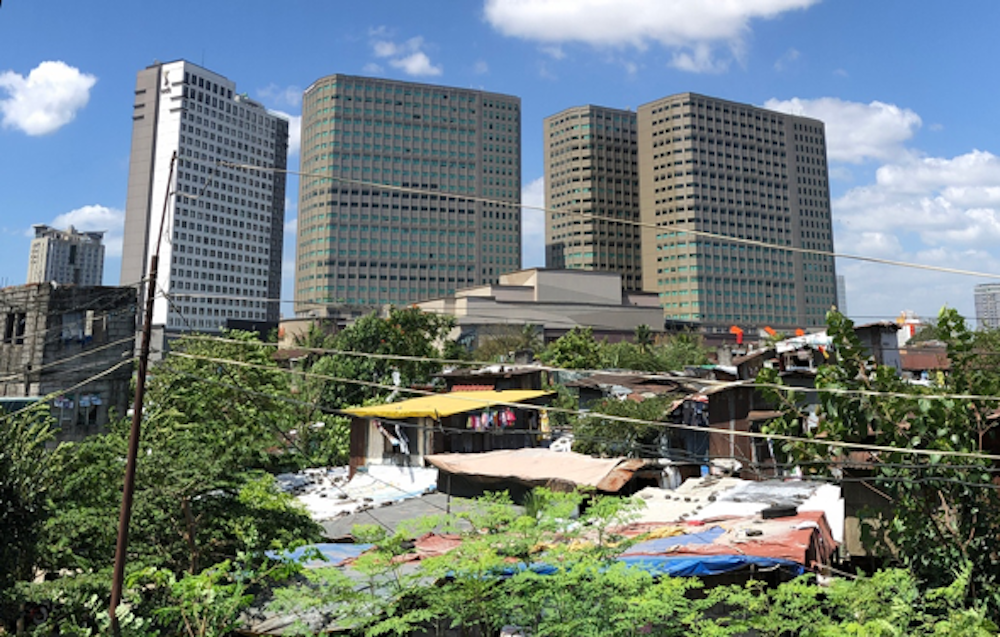 A hotel, shopping mall and commercial offices tower over San Roque.
Kim Dovey, Author provided
A hotel, shopping mall and commercial offices tower over San Roque.
Kim Dovey, Author provided
Read more: The urban poor have been hit hard by coronavirus. We must ask who cities are designed to serve
There is an alternative
San Roque has become divided between residents who believe they can resist and retain their livelihoods and those who feel they should take the relocation package before they are forcibly removed with nothing.
Every demolition weakens this community. However, the reduced density also makes on-site redevelopment more possible with NHA funding plus good design and planning. The Save San Roque Alliance – a group of architects, educators and artists – organised grassroots workshops that produced a community development plan for affordable housing and community infrastructure. After a ten-day intensive study project, urban design and planning students from the University of Melbourne have also offered design ideas.
Effective on-site upgrading is clearly possible. The missing element is a commitment by planning authorities and Ayala to live up to the rhetoric of an inclusive and sustainable city.
Read more: So coronavirus will change cities – will that include slums?
Authors: Redento B. Recio, Postdoctoral Research Fellow – Informal Urbanism (InfUr-) Hub, University of Melbourne

















