taking a wrecking ball to monuments – contemporary art can ask what really needs tearing down
- Written by Bronwyn Carlson, Professor, Indigenous Studies, Macquarie University
As the Black Lives Matter protests raged across the world, I was sent a post on Facebook that read,
Donald J Trump now lives at 1600 Black Lives Matter Plaza, NW, Washington, DC 20500.
The post referred to the mural painted in front of Lafayette Square. In bright yellow paint, the words “Black Lives Matter” stretched from sidewalk to sidewalk over two city blocks. The work was commissioned by DC’s mayor Muriel Bowser, who also renamed the area Black Lives Matter Plaza.
The artwork is a powerful symbol, made even more so because of its visibility and prominence in a public space – and local government endorsement. It will serve to remind everyone of this moment in history, including the violence perpetrated against protesters by police to clear the streets for a presidential photo opportunity in front of a church.
Contemporary art can be transformative, especially when located in public spaces. Historical monuments have the same kind of power. They are a physical reminder created to commemorate a person or event who is deemed worth remembering.
Now is the time to ask which monuments can withstand introspection and revision. Artists are opening those conversations – creatively and sometimes hilariously.
Tearing down history
Around the world, we have seen colonial monuments attracting the rage of protestors who don’t want to see the continual memorialising of men known for their violent and oppressive actions.
In Bristol in the UK, the statue of Edward Colston, a 17th century slave trader, was torn down, dragged through the streets, and thrown into the harbour. Colston was a member of the Royal African Company and responsible for enslaving approximately 80,000 men, women and children and forcibly removing them from Africa to the Americas. His statue is a tangible reminder their lives were considered insignificant.
In the US, statues of Christopher Columbus have been beheaded. Columbus, once celebrated for “discovering” the US, has in recent times been reviled for his brutality toward Native American people, with many states and cities replacing the annual Columbus Day with Indigenous People’s Day.
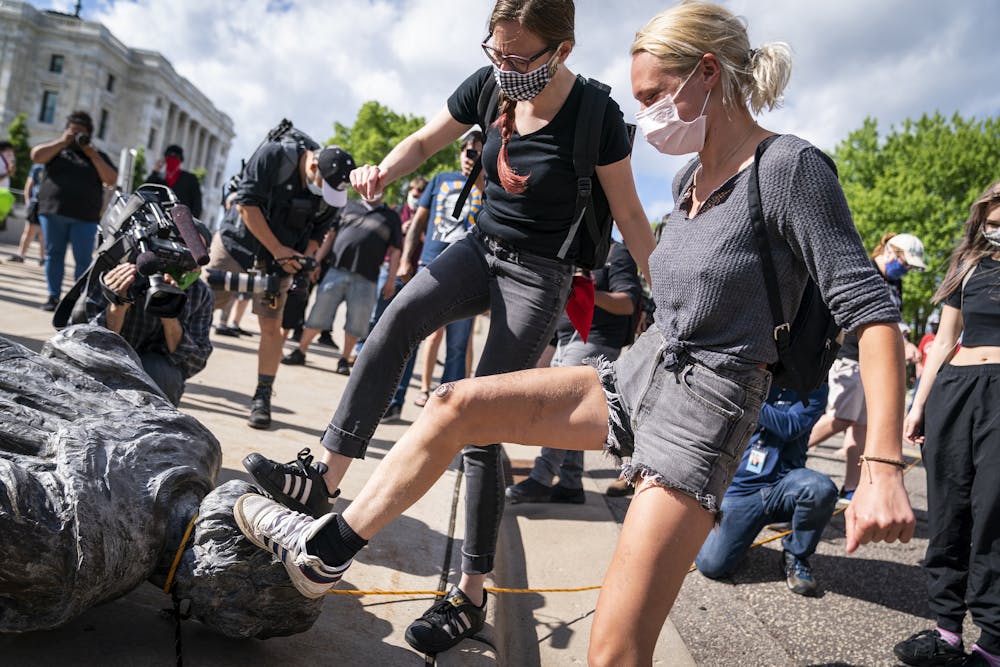 People kick the Christopher Columbus statue in front of the Minnesota State Capitol on Wednesday.
Leila Navidi/Minneapolis Star Tribune/TNS/Sipa USA
People kick the Christopher Columbus statue in front of the Minnesota State Capitol on Wednesday.
Leila Navidi/Minneapolis Star Tribune/TNS/Sipa USA
In the US, most of the targeted statues have been of Confederate memorials in cities across the south. The statue of Confederate General Robert E Lee will be removed from its prominent position in the centre of the town of Richmond, Virginia, with Governor Ralph Northam pledging the state will no longer preach a “false version of history”.
Australians are also questioning whether colonial monuments – standing prominently in towns and cities – should remain. The same question is being asked of past film and television productions. This week, Netflix removed four Chris Lilley programs from its library, some of which originally aired on the ABC, in which the comedian used “brown face” makeup and racial stereotypes to depict characters of colour.
Yesterday, Today show journalist and Gamilaroi/Gomeroi woman Brooke Boney broke down the tension behind the issue to her Channel 9 audience:
Does going through the archives and tearing down art that’s been made in the past really help us move forward? If I have children, I don’t want them to see and think that is how they fit into the world. But I’d also like to be able to show them how poorly our people were thought of and treated in the past.
Can we contemplate a horizon whereby narratives of nation are represented by less harmful and more truthful physical constructions? Their presence is not neutral. They masquerade as benign signifiers of nation building when, in fact, they are inscribed with a violent history that reminds Indigenous people of their dispossession and enduring trauma.
Swinging through
Enter Tony Albert, a politically-minded artist provoked by stereotypical representations of Aboriginal people, and hailed as one of our most exciting contemporary Australian artists. His previous works have used drawing, painting, photography and installation. He’s also incorporated a collection of “Aboriginalia” – retro and household kitsch objects depicting Aboriginal people and their culture.
His new artwork, titled You Wreck Me, is a video that invokes the mythology of the trickster, here to relay important moral and life lessons. The work brings to the fore the ongoing discussions about memorialisation and nationalism through the lens of parody.
In the video, Tony Albert is painted up for ceremony while straddling an exercise ball in a comedic representation of Miley Cyrus’s infamous video clip, Wrecking Ball. Singing (badly) and swinging, he shatters statues of Captain James Cook.
So bad, it’s powerful. Tony Albert’s You Wreck Me has him swinging through colonial monuments.Artists like Albert are asserting their existence in contemporary Australia in myriad ways, including using humour to challenge the continual idolisation of the legacies of colonialism littering our public spaces.
Albert’s work comes at a time as many Indigenous and non-Indigenous people across Australia are calling for the removal of colonial monuments. There is a growing movement towards a more equitable and fair society.
Gamilaroi/Darug multimedia artist Travis De Vries presciently captured this in his 2019 digital print Cook Falling, Tear it Down. It showed a scene in Hyde Park, Sydney, with a group of Aboriginal people using a rope to pull down a statue of Captain Cook by the neck.
 Cook Falling, Tear it Down (2019) by Travis de Vries.
Travis de Vries
Cook Falling, Tear it Down (2019) by Travis de Vries.
Travis de Vries
Truth telling has been the focus of Indigenous and non-Indigenous relationships for some time as noted by the 2019 NAIDOC theme: VOICE. TREATY. TRUTH.
The colonial monuments speak to the erasure of our histories as noted by Stan Grant in 2017 when he said:
the monument of Captain Cook speaks to the emptiness, it speaks to our invisibility; it says that nothing truly mattered, nothing truly counted until a white sailor first walked on these shores.
Read more: Monumental errors: how Australia can fix its racist colonial statues
Deeper than monuments
I personally do not care if the colonial monuments are torn down. What I do know is that while this would be symbolically important, their removal will not remove the attitudes and institutional racism behind their creation.
The reason these debates are raging and the reactions from many non-Indigenous people are so vehement, is because their legacies still endure. Removing the statues will not automatically end the legacy.
I am also aware their removal would allow another kind of amnesia where the trauma and violence experienced by Aboriginal people could be “forgotten”. Other options are being debated – removing monuments and housing them in museums, creating parks where they can stand and be used for educational purposes.
Some have pointed to artworks like the huge yellow slogan in Washington DC and demanded more from leaders. “It’s not enough to have a pretty painting in the middle of the street; we need politics,” Mckayla Wilkes, an activist for criminal justice reform, told The New Yorker.
Just ignoring the issue is not an option, because it also ignores who has the right to determine which histories are able to be displayed in public spaces and continues to privilege one version of history while erasing the presence of Aboriginal people.
Authors: Bronwyn Carlson, Professor, Indigenous Studies, Macquarie University