

what is branch stacking, and why has neither major party been able to stamp it out?
- Written by Anika Gauja, Associate Professor, Department of Government and International Relations, University of Sydney
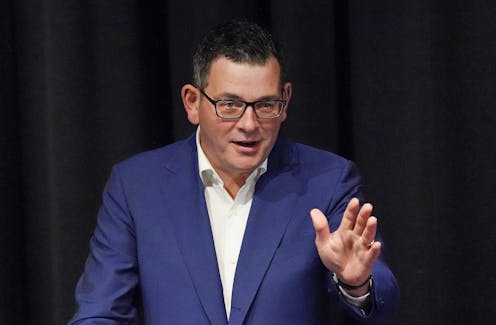
Less than 24 hours after The Age’s investigation into branch stacking in the Victorian branch of the Australian Labor Party (ALP) aired on 60 minutes, Adem Somyurek was sacked from Daniel Andrew’s cabinet. The allegations have been referred to police, and Somyurek now faces expulsion from the party.
What is branch stacking?
Somyurek is alleged to have engaged in the practice of “branch stacking”. This is where people who have no interest in joining a party are enrolled as members by having their memberships paid for by those seeking to influence the party. Some may know they’ve been signed up but not care or understand what has happened; others may not realise at all.
Through building up a base of members who otherwise have no commitment to the party, the practice allows the branch-stacker to manipulate important intra-party decisions that are taken at the local (branch) level.
One of the most important decisions branch members make is who to pre-select to run as the party’s candidate for public office. This is where we see the majority of branch-stacking activities occur – to channel those members’ votes towards a particular candidate.
Influence can then permeate further and further into the party as pre-selection is traded for political favours. It is often aligned with factional battles. It commonly involves the recruitment of people from non-English-speaking backgrounds, distributing money to pay for memberships and even the falsification of signatures of branch meeting attendance rolls where attendance at a minimum number of meetings is a requirement to vote.
How widespread is it?
Branch stacking has been a problem in both the major parties for decades, though it is more prominent in the ALP, intertwined with that party’s factional dynamics.
As pre-selection is such a high-stakes activity and a decision that is largely taken at the local level, it is no surprise it’s targeted for manipulation. It has persisted for so long because of the relatively small number of people who actually join political parties in Australia.
This means enrolling even a few members can have a disproportionate outcome on a pre-selection decision, given that so few people are involved in the process.
Pervasive branch-stacking in Queensland led to the establishment in 2000 of an inquiry by the Criminal Justice Commission (the Shepherdson Inquiry) into electoral fraud concerning several candidate selection contests conducted by the ALP during the 1980s and 1990s. The commission’s report resulted in the passing of legislation that party pre-selection contests be conducted according to the principles of free and democratic elections.
Oversight of this regime is entrusted to the Queensland Electoral Commission, which may enquire into and undertake audits of party preselection processes. Parties that breach these provisions are liable to deregistration and consequently lose public funding.
In 2019, the NSW Liberal Party was at the centre of a branch-stacking allegation involving pupils from Campion College, who were allegedly offered parliamentary jobs in return for recruiting members to the party.
In 2007, the outcome of the Liberal pre-selection for the federal seat of Cook was overturned following allegations of branch stacking. One of the unsuccessful candidates, David Coleman, now a minister in the Morrison government, even took the matter to the Supreme Court. This litigation, and others that have preceded it (notably the matter initiated by former South Australian Deputy Labor Leader Ralph Clarke), highlight just how serious and high-stakes a problem is it.
What are parties doing about it?
Branch stacking is not a condoned practice. Both the ALP and Liberal Party rules contain provisions that prohibit bulk memberships and paying the membership dues of others. The alleged activities of Somyurek clearly contravene these provisions, but the problem is one of party culture, detection and enforcement.
If political parties lack the necessary resources or incentive to enforce anti-branch stacking provisions, a system of electoral commission oversight – as was implemented in Queensland – may be one option.
Read more: NSW Liberals' factional battles stand in way of reform, but changes in participation demand it
This was recommended in NSW by two separate reports in 2014 by the Independent Commission Against Corruption (ICAC) and the Expert Panel commissioned by the NSW government to inquire into political finance reform. Both recommended that internal good governance and compliance be explicitly linked with public funding. Despite in principle commitment for this reform, there is has been no legislative movement in this area.
Another reform option might be to introduce American-style primary contests for candidate selection, which would arguably make branch stacking more difficult by widening the pool of participants.
However, as the controversy surrounding the election of Jeremy Corbyn as UK Labour leader aided by thousands of “registered supporters” in 2015 showed, even these more inclusive methods can face similar criticisms. In other words, one person’s mobilisation of potential voters can be another’s manipulation of electoral outcomes.
Changing the culture of political party pre-selections by opening them up to greater public view and scrutiny may be a further way of removing some of the conditions conducive to branch stacking. Pre-selections, and intra-party decisions more generally, remain largely secretive in Australian politics, despite the significant public importance of these events.
In the lead-up to the 2019 Australian federal election, for example, less than 10% of pre-selections conducted received media coverage as competitive events.
Understanding the importance of party decisions, publicly scrutinising these activities and bringing intra-party politics out from behind closed doors will improve transparency, participation and make it more difficult for branch stacking to continue in Australia’s political parties.
Read more: Revealed: how Australian politicians would bridge the trust divide
Authors: Anika Gauja, Associate Professor, Department of Government and International Relations, University of Sydney

















