

Too wet? Too cold? Too hot? This is how weather affects the trips we make
- Written by: Jonathan Corcoran, Professor, School of Earth and Environmental Sciences, The University of Queensland
What sorts of weather lead us to change our daily travel behaviour? How do we respond to scorching heatwaves, sapping humidity, snow and frost, strong winds, or torrential rain? International research shows weather is important in shaping our everyday movements.
The research evidence suggests that bad weather can lead to planned journeys being rescheduled, rerouted or cancelled. The consequences of these shifts in daily travel choices can include increases in traffic congestion and accidents, travel delays, mental stress, environmental pollution and general travel dissatisfaction.
Because people who travel by bike or walking are most likely to change travel plans in bad weather, some cities are responding with innovations such as heated bicycle lanes and sheltered walkways.
Read more: This is how Sydney's transport system has gone off the rails
Why do we care about the weather?
Firstly, how do we explain people’s common obsession with the weather? As Samuel Johnson put it:
It is commonly observed, that when two Englishmen meet, their first talk is of the weather; they are in haste to tell each other, what each must already know, that it is hot or cold, bright or cloudy, windy or calm.
Is this merely a keen (or indeed pathological) interest in the subject?
According to Kate Fox, these conversations are not really about the weather at all: weather-speak is a form of code, evolved to help Anglo-Australian people overcome their natural reserve and actually talk to one another. Weather-speak can be used as a greeting, as an ice-breaker, and/or as a “filler” subject.
But, beyond its use as a conversation prop and social bonding device, weather does play a major role in travel behaviour. And as the impacts of climate change unfold, the severity and frequency of extreme weather conditions are predicted to increase.
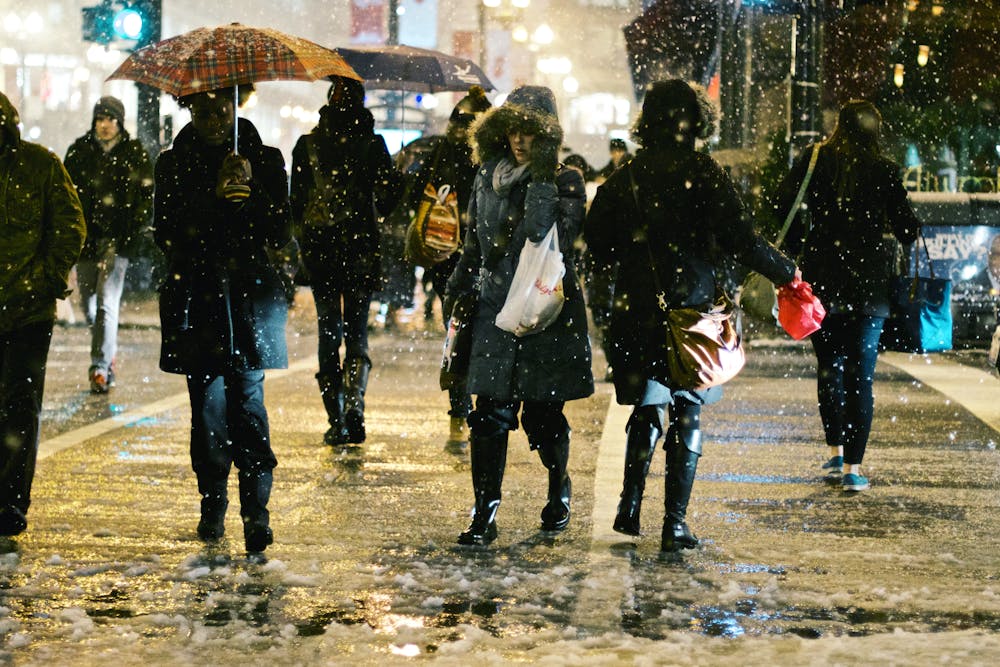 Walking across the street calls for caution during an icy winter storm in Chicago.
vonderauvisuals/Flickr, CC BY-NC-ND
Walking across the street calls for caution during an icy winter storm in Chicago.
vonderauvisuals/Flickr, CC BY-NC-ND
A better understanding of the dynamics of the relationship between weather and travel behaviour is thus essential in helping cities develop transport and planning responses appropriate to their conditions.
Read more: Here's what bike-sharing programs need to succeed
What do we know about the weather-travel relationship?
It’s complicated. Research on the weather-travel relationship has revealed that effects vary by mode of travel.
Active transport, such as walking and cycling, is the most vulnerable to variations in the weather. Arriving drenched is both uncomfortable and impractical, so we might drive rather than face this prospect. Wet weather forecasts are likely to trigger a travel mode shift as travellers opt for greater comfort and safety.
But the day of the week also affects these decisions. Inclement weather is more likely to reduce weekend and off-peak travel – the so-called discretionary trips – than standard weekday commute trips. Clearly, travel purpose plays a stronger role than weather.
Significant variation exists in the effects of weather on trip-makers with different individual characteristics and household composition. For example, commuters with children are less likely to alter their travel because of the weather. This is possibly due to their household responsibilities.
Geographic variations across the transit network have been observed too. Bad weather has more serious effects in areas with less frequent services and without protected bus and rail stops. Travellers in areas with more frequent services and well-designed shelters appear to be less sensitive to bad weather.
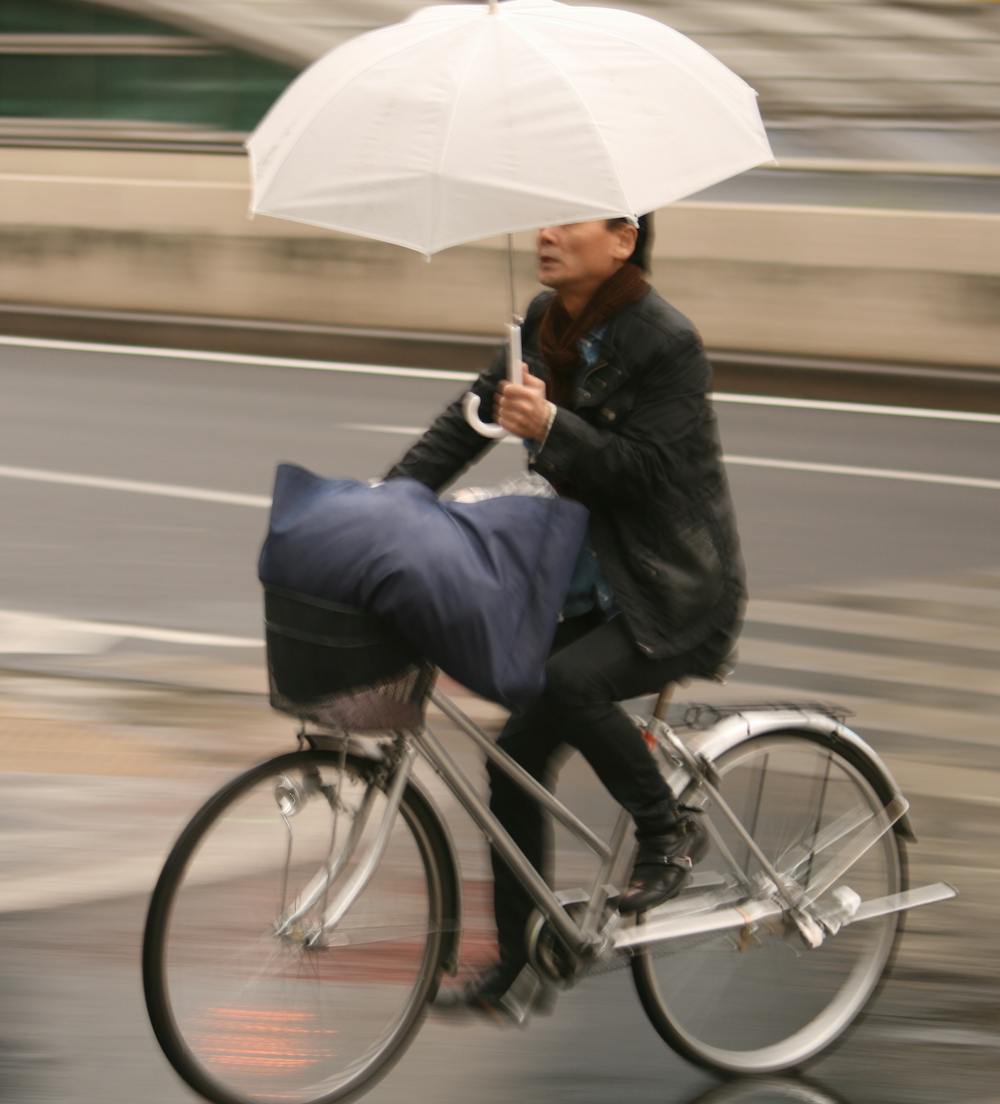 High-density cities appear to reduce the impacts of weather on active transport, with this cyclist braving the rain in Osaka.
Akuppa John Wigham/Flickr, CC BY
High-density cities appear to reduce the impacts of weather on active transport, with this cyclist braving the rain in Osaka.
Akuppa John Wigham/Flickr, CC BY
In areas with high population densities, the effect of weather also appears to weaken. This is particularly the case for active transportation such as cycling.
How we travel during inclement weather also involves more subtle changes. Trip chaining, or the process of stringing together multiple smaller journeys into a larger one, is reduced in complexity, particularly on rainy days.
In terms of “extreme” weather, not all types have the same effect. Heavy precipitation (snow or rain) and, to a lesser extent, extremely high or low temperatures appear to have a greater effect on travel behaviour than strong winds or high humidity.
Adapting to weather conditions
We cannot change the weather. But we can plan our transport systems to be more resilient and better shield us from the weather when we travel.
If we don’t do this, we will face the same crisis as Transport for London. Since its privatisation, its train services experience delays every autumn and winter due to “leaves on the line” and “the wrong type of snow”.
Read more: Why does a bit of snow plunge Britain into transport chaos?
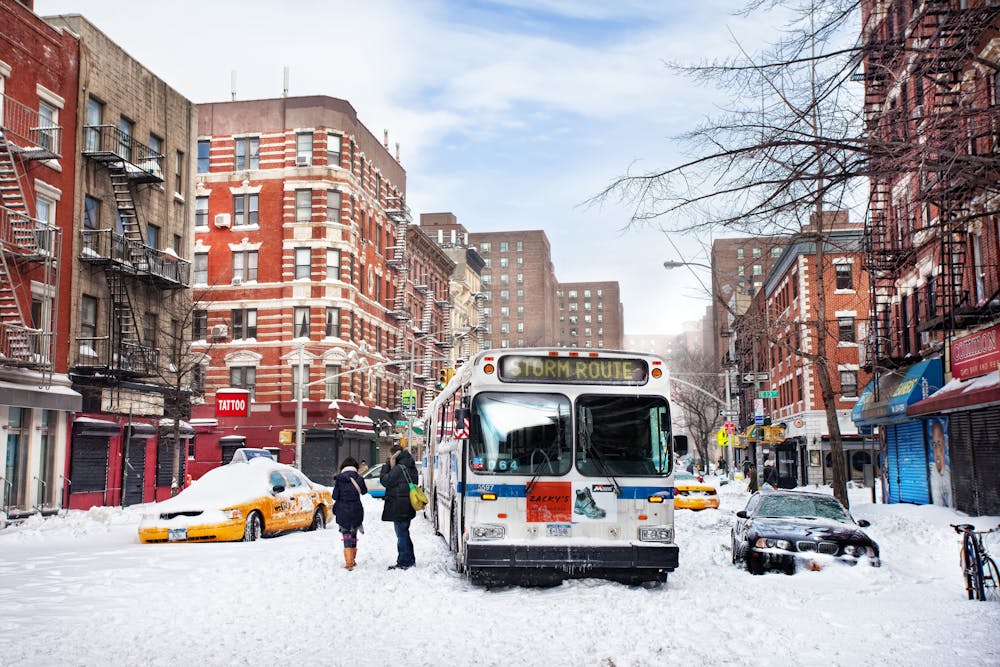 Heavy snow can stop traffic altogether, as in New York in winter 2010.
Chris Ford/Flickr, CC BY-NC
Heavy snow can stop traffic altogether, as in New York in winter 2010.
Chris Ford/Flickr, CC BY-NC
What kind of transport adaptations are available and work? The options range from offering passengers a more diverse choice of modes, to improving existing infrastructure. For example, making public transport stations more user-friendly could soften the impact of bad weather.
More seamless interchanges may have a strong effect, as commuters generally find modal transfers stressful. Temperature-controlled, covered or underground transfer stations would protect passengers while between modes of transport.
Active travel infrastructure is particularly important. Cities that are committed to supporting non-motorised transport have implemented or proposed bold policies.
We see examples of this around the world. Increasingly hot Madrid is covering itself in trees to assist pedestrians. Frosty Dutch cities are testing heated bicycle lanes. Arid Doha has floated the idea of cooled bicycle paths. And Singapore plans to expand the city’s network of sheltered walkways.
Projecting roofs and porticoes shield us from the hot sun or precipitation. Vegetation lessens the impacts of both cold wind in temperate and subpolar latitudes and hot sunshine elsewhere.
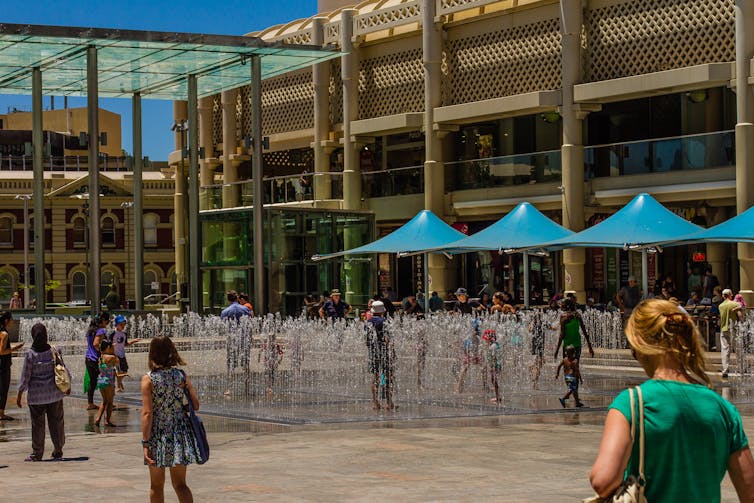 People out and about in the hot weather of Perth welcome shade and cooling fountains.
Traveller_40/Flickr, CC BY-NC-ND
People out and about in the hot weather of Perth welcome shade and cooling fountains.
Traveller_40/Flickr, CC BY-NC-ND
Beyond these incremental interventions, a fundamental rethink of our urban design approach is necessary. The key to limiting and adapting to the effects of weather on travel may well be the “30-minute city”. But this can only be achieved through high densities and mixed land use – concepts that have so far generated fierce resistance and NIMBYism in Australia.
Read more: '30-minute city'? Not in my backyard! Smart Cities Plan must let people have their say
Another word of caution. What works in one climate zone might not work in another. This is because human bodies and minds adjust and develop different expectations and tolerance to weather and temperature patterns. For example, the optimal temperature range for cycling is as broad as 4-40°C in continental climates, but as narrow as 15-32°C in subtropical climates.
Authors: Jonathan Corcoran, Professor, School of Earth and Environmental Sciences, The University of Queensland


















