

Why long-term environmental observations are crucial for New Zealand's water security challenges
- Written by Andrew Lorrey, Principal Scientist & Programme Leader of Climate Observations and Processes, National Institute of Water and Atmospheric Research
Brewster Glacier in New Zealand’s Southern Alps lost 13 million cubic metres of ice between March 2016 and March 2019 - almost the equivalent of the basic drinking water needs of all New Zealanders during that time.
Climate and glacier scientists monitor New Zealand’s ice and snow. Video produced by Rebekah Parsons-King and Stuart MacKay.Simultaneously, seasonal extremes for Auckland - New Zealand’s largest city - swung from the wettest autumn on record to one of the most severe multi-season droughts.
Water is arguably the most precious resource in New Zealand. These contrasting extreme events in two very different regions highlight the critical importance of long-term observations as we confront water security challenges.
Water extremes
2017 became the wettest autumn on record for Auckland when an “atmospheric river” drenched the city for several days. Within a month, ex-tropical cyclones dumped even more extreme rainfall.
Exceptionally high autumn rainfall (more than 200% higher than normal for many sites) during 2017 saturated soils and produced numerous slips. Sediment hampered water treatment for regional reservoirs that provide about 75% of the city’s water supply.
Fast forward to 2019, when one of the most significant multi-season droughts since the early 20th century started unfolding. Four Auckland sites we monitor show it was the driest summer in recent memory. The drought has continued, and water restrictions are currently in place.
The big wet versus the big dry in Auckland only three years apart gives us a taste of New Zealand’s water future - a higher likelihood of more frequent water extremes with stronger impacts.
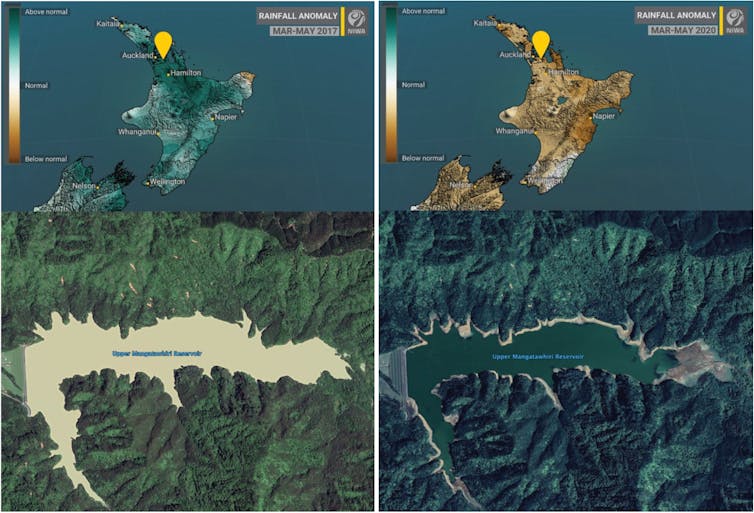 The stark contrast between extreme wet and dry conditions for the North Island (top) had significantly different impacts on Upper Mangatawhiri Reservoir (bottom). Both led to water conservation calls in Auckland.
Climate data and visualisation: NIWA ; Google Earth maps, Author provided
The stark contrast between extreme wet and dry conditions for the North Island (top) had significantly different impacts on Upper Mangatawhiri Reservoir (bottom). Both led to water conservation calls in Auckland.
Climate data and visualisation: NIWA ; Google Earth maps, Author provided
Shrinking ice
The Southern Alps tell a different story arising from climate extremes, where recent changes have been rapid, widespread and exceptional. The National Institute of Water and Atmosphere end-of-summer snowline mission – which has run nearly unbroken since the 1970s – provides valuable “time capsules” of glaciers and snowlines through a changing climate.
Read more: A bird’s eye view of New Zealand's changing glaciers
The long-term permanent snowline – the boundary between exposed glacial ice and recent snow – must sit below the mountain top for a glacier to exist. The 2018 Tasman Sea marine heatwave drove snowlines off the top of many peaks. Then, 2019 produced a second marine heatwave around northern New Zealand. Some small glaciers sustained so much damage during these extreme years that they are now on a path to extinction.
As if this wasn’t enough, ash and dust from Australian bushfires blanketed Southern Alps glaciers during the 2020 summer and increased the potential for seasonal melt.
New photogrammetry techniques that produce digital elevation models with annual glacier photos help to define the impacts from extreme years like the last three. We are extending these techniques to our historic image archive to construct a 4D vision of ice volume, which brings us closer to quantifying water volume loss and gain for individual glaciers.
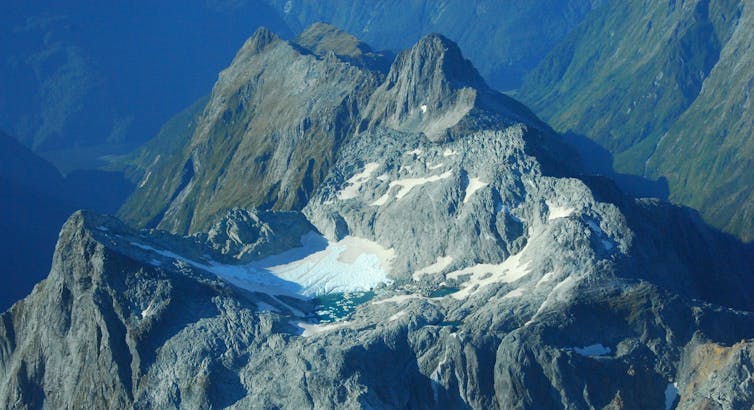 Rising temperatures, higher snowlines, glacial lake expansion and dust from Australian bushfires are pushing some South Island glaciers towards extinction.
Andrew Lorrey, Author provided
Rising temperatures, higher snowlines, glacial lake expansion and dust from Australian bushfires are pushing some South Island glaciers towards extinction.
Andrew Lorrey, Author provided
The recent ice loss from Brewster Glacier is only a small part of the frozen water volume stored in New Zealand’s Southern Alps. Since the first New Zealand glacier survey in the late 1970s, there’s been a long-term trend of glacial retreat through climate warming.
Southern Alps glaciers are estimated to have lost more than 30% of their volume - about 16 billion cubic metres of ice, or the equivalent of about 200 litres a day for each New Zealander over 40 years.
Read more: New Zealand’s Southern Alps have lost a third of their ice
While water loss from vanishing glaciers is deeply troubling, it is a reminder that more severe and immediate concerns can arise from long and intense seasonal droughts and changes to rivers in a warming world.
Past and present observations help prepare for the future
Long-term environmental observations help to inform national water security policy and water resource management. Our observations also underpin weather forecasts, seasonal climate predictions and climate change projections that cover a spectrum of advance warnings for extreme weather and climate impacts.
We need to grow environmental observations, but making and archiving them can be costly and difficult. Global support for their long-term stewardship once they are gathered is also at risk. As a result, small countries like New Zealand confront hard choices about which observations to make, what sites they come from, and how they are continued.
Amid the many COVID-19 announcements was an increase in funding for nationally significant databases and collections. This boost is a welcome signal for maintaining valuable scientific resources, including environmental observations, for future generations.
But ongoing support is needed to reduce attrition of our comprehensive evidence base. It would be even more risky to abandon long-term water and climate observations, and simply fly blind into an uncertain future.
Authors: Andrew Lorrey, Principal Scientist & Programme Leader of Climate Observations and Processes, National Institute of Water and Atmospheric Research

















