

Yes, we've seen schools close. But the evidence still shows kids are unlikely to catch or spread coronavirus
- Written by Allen Cheng, Professor in Infectious Diseases Epidemiology, Monash University
Brunswick East Primary School and Keilor Views Primary School in Melbourne have temporarily shut down after children from both schools tested positive to COVID-19, while a confirmed case in a year 2 student led to the closure of Sydney’s Lane Cove West Public School. A childcare centre in the Melbourne suburb of Essendon has also closed for cleaning after a child tested positive.
These cases, and others in young children, follow a handful of positive cases in teenage students in Sydney and Melbourne and may be prompting some to wonder whether it’s time to rethink reopening schools after lockdown.
The short answer is: no. The research still suggests that while children can be infected with COVID-19, it is uncommon. They also don’t seem to pass the disease on as efficiently as adults do, and cases of child-to-child infection are uncommon. And when children do get infected, they don’t seem to get very sick.
The temporary closure of schools (and at least one childcare centre) is evidence the system is working as it should — cases are being identified, contact tracing and deep cleans are underway and every effort is made to limit the spread.
Read more: Worried about your child getting coronavirus? Here's what you need to know
What we know about children and coronavirus
We still don’t know exactly why COVID-19 is much more common in adults than children. The COVID-19 virus (SARS-CoV-2) infects people by attaching itself to a receptor called the ACE2 enzyme, and differences in this receptor in children may be one reason why children are less susceptible.
A lot of the thinking around schools and COVID-19 in Australia is based on follow up of school cases by the National Centre for Immunisation Research and Surveillance (NCIRS). It was released in April but still reflects what is currently known about the virus and how it interacts with children and school settings.
The report found:
In NSW, from March to mid-April 2020, 18 individuals (9 students and 9 staff) from 15 schools were confirmed as COVID-19 cases; all of these individuals had an opportunity to transmit the COVID-19 virus (SARS-CoV-2) to others in their schools.
- 735 students and 128 staff were close contacts of these initial 18 cases
- no teacher or staff member contracted COVID-19 from any of the initial school cases
- one child from a primary school and one child from a high school may have contracted COVID-19 from the initial cases at their schools.
Data from the Netherlands also found “children play a minor role in the spread of the novel coronavirus”.
In younger children, a rare but severe complication called PIMS-TS has been described. However, these cases have occurred in areas where there is extremely high transmission of COVID-19 in the community.
A bigger concern around schools is how adults congregate. Schools now have some version of physical distancing in the staff room and on school grounds to limit the risk of transmission between adults. Parents are asked not to enter school grounds or congregate in close quarters at the school gate, although the fact that this is outdoors and not a long period of contact also helps reduce the risk.
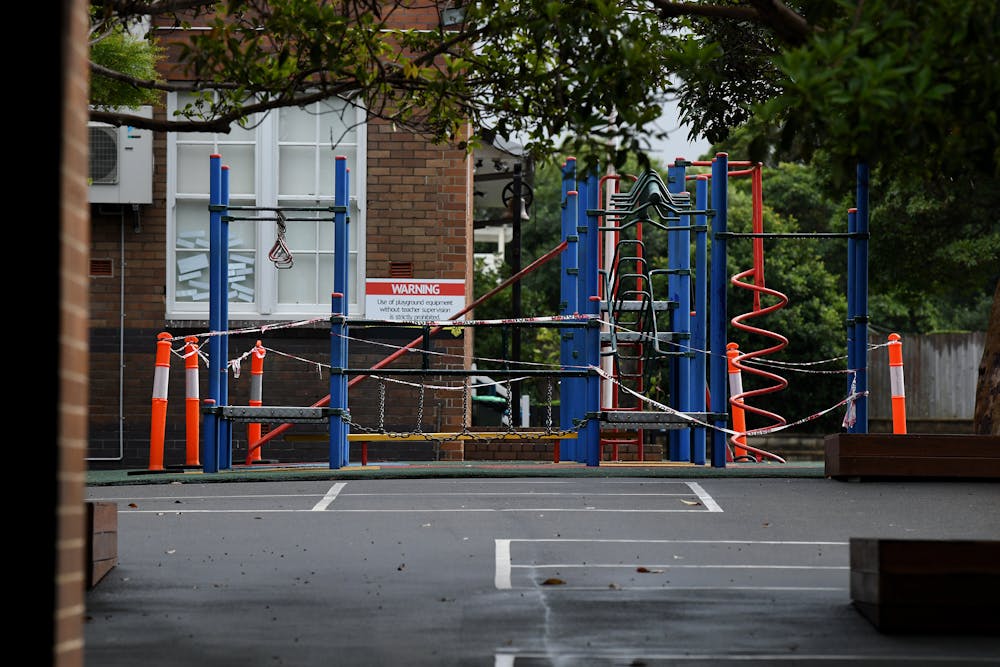 We still don’t know exactly why COVID-19 is much more common in adults than children.
BIANCA DE MARCHI/AAP
We still don’t know exactly why COVID-19 is much more common in adults than children.
BIANCA DE MARCHI/AAP
What about COVID-19 and high school students?
There have been several reports of cases in high schools both in Australia and abroad.
Older children in high school start to have similar risk to adults, although the risk of complications is still substantially lower than in the elderly. Importantly, kids in this age group are more able to physically distance and adhere to personal hygiene measures than primary school-aged kids.
At least one instance of a high school outbreak in Auckland was related to an event outside the classroom at which many adults were present. So it was less about transmission in the classroom and more related to a particular event.
Read more: Coronavirus or just a common cold? What to do when your child gets sick this winter
The system is working
It’s important that schools remain open. But precautions are still required: teaching children to maintain personal hygiene, enhanced cleaning, and making sure adults (teachers and parents) are appropriately distanced from each other.
The latest school cases are not unexpected, and don’t mean that school closures across the board are required. They show the system is working as it should — we are spotting cases early and intervening quickly to limit the spread.
When we do find COVID-19 cases in children, we don’t usually find cases of child-to-child transmission. But of course, we still need to go through the process of managing each case as it arises.
If there are ongoing cases in the community, it is likely that cases will continue to occur in students or teachers, and schools will need to have contingency plans for this.
Read more: Coronavirus or just a common cold? What to do when your child gets sick this winter
Parents need to make sure their children are well before sending them to school, and be prepared to get them tested and to keep them at home if they show any sign of illness. And of course, hammer home the message about hand washing.
Hand washing and physical distancing remain the very best things we can do to reduce the risk of COVID-19 spreading.
Authors: Allen Cheng, Professor in Infectious Diseases Epidemiology, Monash University

















