

South Australia's trial of England's year one phonics check shows why we need it
- Written by: Jennifer Buckingham, Senior Research Fellow, The Centre for Independent Studies; Associate Investigator, ARC Centre of Excellence in Cognition and its Disorders, Macquarie University
The proposal to introduce a phonics check — employed in schools in England towards the end of year one — into Australian schools has created considerable controversy. It has been said it would prove stressful to young children and is unnecessary, because phonics is already taught adequately in most Australian schools as part of the literacy curriculum.
Read more: Explainer: what is phonics and why is it important?
The South Australian government commissioned a trial of the utility of the phonics check last year. The results allay many of the reservations about the check and confirm the need for its introduction.
Many students have very low decoding ability after 18 months at school
The phonics check consists of 40 single words children read aloud to a teacher. There are 20 real words and 20 “pseudo words” — all of which can be read using phonic decoding. The pseudo words are included because they can’t be read from sight memory and are a purer test of phonics ability.
The headline data on student performance shows the majority of children in Reception (the first “foundation year” of school) and year one found the test items difficult. The average number of correctly read items was 11 out of 40 for Reception students and 22 out of 40 for year one.
Given the phonics check is designed for students in year one, it was expected Reception students would score low. This confirms the wisdom of the SA Department of Education and Child Development’s decision to expand the trial from the original design (Reception only) to include year one. But the year one performance was also low relative to their counterparts in England and the expectations of their teachers.
In England, student performance is reported against a “threshold score” of 32 out of 40. For the past two years, 81% of year one students in the UK achieved this score. Only 15% of children in the SA trial achieved at this level.
According to the trial evaluation report, teachers and leaders observed:
students did more poorly than expected, across the board. Numerous respondents reported feeling surprised and disappointed by the results based on students’ known reading abilities and results on the Running Record.
This is a clear indication existing assessments in these SA schools were not providing an accurate measure of students’ decoding abilities.
Read more: International study shows many Australian children are still struggling with reading
The distribution of scores in SA was very different to the distribution of scores in England. In SA, student scores were distributed on a bell curve. English student scores are skewed to the right of the distribution. This means most children in SA scored around the middle, whereas most children in England score at the higher end. In many English schools, 100% achieve the threshold score.
Four ways South Australia’s phonics check was different
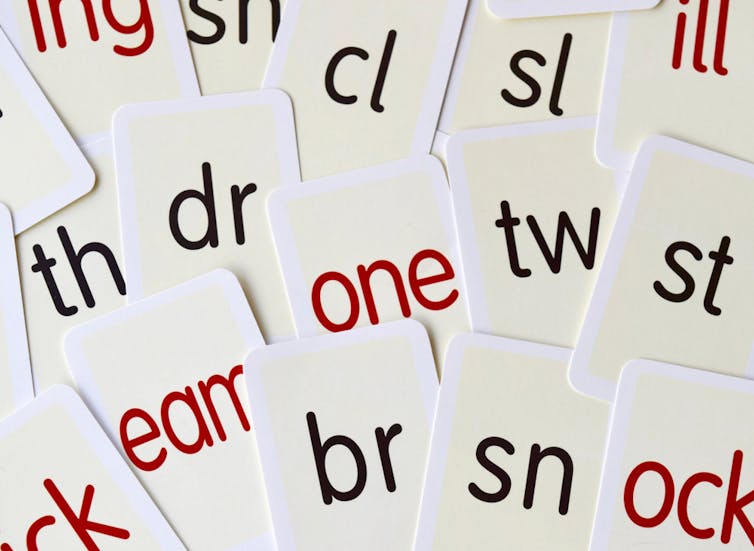 Teachers noted the font used in the trial check was different to the one usually used in SA schools.
Shutterstock
Teachers noted the font used in the trial check was different to the one usually used in SA schools.
Shutterstock
The phonics check trial in SA employed exactly the same word items used in England in 2016. But there were methodological differences in how the checks were conducted in SA and in England, which may cloud the comparability of the results obtained.
The sample. In SA, the group of 4,406 students in 56 schools who participated in the trial was from a self-selected sample of schools who volunteered. In England, all schools are required to administer the check annually. So, the SA sample may not be truly representative of the state as a whole, let alone of students Australia-wide.
The font. Teachers raised the issue that the font used in the check was different from the standard font used in SA schools. But by the end of year one, children will have encountered many different fonts in books and elsewhere. It’s unlikely this will have been a major factor influencing performance on the check.
Timing. In England, the check is given to students about a month before the end of year one (after nearly two years of initial instruction). But in the SA trial, the check was given earlier, in term three. The SA students had about a term less to learn letter sound correspondences, and this needs to be kept in mind.
The “stopping rule”. More significant was the decision to advise teachers to discontinue testing once a child had made three consecutive errors. This stopping rule has the potential to deflate scores on the check, because students who had been stopped might have gone on to answer few more questions correctly. The evaluation report also found the stopping rule was not consistently applied. It’s unlikely many children failing three items in succession would be able to achieve the threshold score of 32 items out of 40.
A stop rule is not part of the standard conditions used in England, although teachers do stop children if they are struggling. As many as 41% have been found to do this.
Students liked it
Teachers and leaders in the trial reported all students responded positively, including struggling readers, and they were engaged and interested. There were no reports of anxiety or stress for students. Teachers “universally” commented that students “loved the one-to-one time with the teacher”.
 Even students struggling with reading found value in the test.
Shutterstock
Even students struggling with reading found value in the test.
Shutterstock
Teachers and school leaders were overwhelmingly positive
The feedback from teachers and school leaders was encouraging and positive about all aspects of the administration of the check and the information it provided, including:
the sufficiency of training and support materials
the ease of administration
the length and duration of the check for young students
the engagement and effort of the students, and
the usefulness of the data it yielded on student reading abilities, for the purposes of guiding instruction and for identifying and supporting students who “may otherwise be slipping under the radar”.
The phonics check was reported to be a “good eye-opener for teachers”, and widely seen as complementing rather than duplicating existing assessments.
What should happen next?
In spite of the differences in methodology compared with the phonics check in England, it’s unlikely their combined effect could account for such a difference in performance between the two. SA’s results suggest there is little room for complacency about the state of phonics teaching in SA.
Almost all teachers in the trial said they taught phonics using either synthetic or analytic methods, reflecting the claim that Australian teachers already teach phonics. But there was no information to verify that phonics teaching is systematic or explicit, and these results clearly suggest they don’t teach it well enough.
The SA trial of the year one phonics check has been an important initiative. The evaluation report will be a valuable guide to changes that need to be made for a state-wide implementation.
Even more significantly, the trial has provided strong support for implementation of the year one phonics check across Australia. Or, at the very least, for other states and territories to conduct similar trials. It supports the findings of the expert panel for the Australian government, and has validated the arguments of advocates that the phonics check gives teachers vital information about decoding skills not gained from other systemic assessments, and is neither burdensome for teachers nor stressful for students.
Authors: Jennifer Buckingham, Senior Research Fellow, The Centre for Independent Studies; Associate Investigator, ARC Centre of Excellence in Cognition and its Disorders, Macquarie University


















