

Heading back to the office? Here's how to protect yourself and your colleagues from coronavirus
- Written by: Lisa Bricknell, Senior Lecturer in Environmental Health, CQUniversity Australia
One of the most profound ways the COVID-19 pandemic has affected our lives has been in the way we work. For people lucky enough to keep their jobs, and for those of us in professions where it’s possible, working from home has become the new normal.
Australia’s success in “flattening the curve” means restrictions are now being lifted. With this, many employers are bringing their staff back into the office, or at least contemplating doing so.
But as the current outbreaks in Victoria show, it’s dangerous to think we’re now safe from the threat of COVID-19.
So, what do we need to consider as we take those first tentative steps back into the office?
Read more: Coronavirus could spark a revolution in working from home. Are we ready?
First, how does the virus spread?
While there’s a lot we still don’t know about SARS-CoV-2, the coronavirus that causes COVID-19, we do know it spreads most effectively from person to person in droplet form. Infected people emit these droplets when they sneeze, cough, and even speak.
Those droplets can be transmitted directly through the air — say when an infectious person coughs in the direction of someone else close by — or they can settle on surfaces, where they can remain viable for hours.
The virus enters the body of a non-infected person through contact with mucous membranes in the nose, mouth or eyes and attaches to cells in the upper respiratory tract to establish infection.
 Many of us are keen to get back to the office.
Shutterstock
Many of us are keen to get back to the office.
Shutterstock
What does this mean for office workers?
In many workplaces, employees share a small office space, work in an open-plan office, or use “hot desks” that are shared between several different employees on different shifts.
Workers in these situations are often required to work for long periods in environments that make it hard to maintain the recommended 4m² distancing rule.
This combination — several hours spent in close contact — increases the risk of COVID-19 transmission. This is illustrated by an outbreak in an open-plan call centre in Seoul, where more than 43% of workers contracted COVID-19 during February and March.
Read more: Employers, schools, take note. Coronavirus 'clearance certificates' are a waste of everybody's time
Considerations for employers
First, each employee in a shared office should be able to have at least 4m² to themselves. If this isn’t possible, it would be a good idea to stagger staff or allow them to continue working from home for now.
Second, think about airflow. Small offices often have insufficient airflow to dilute the virus, and, if an infectious person is present, could end up with high concentrations of viral particles over the course of an hour or so.
Conversely, higher rates of airflow combined with poor ventilation can also lead to infection, as droplets can be carried further.
So where possible, increase ventilation and air exchange in open-plan workspaces. Increasing the ratio of fresh air intake to recirculated air can reduce the concentration of virus particles in air conditioned spaces. Even simply opening windows can reduce viral spread.
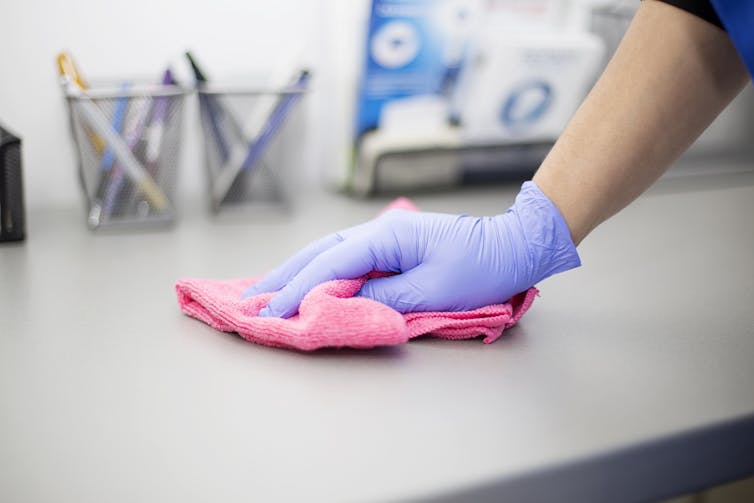 Ramping up cleaning practices is a must.
Shutterstock
Ramping up cleaning practices is a must.
Shutterstock
Third, cleaning protocols need to be increased. Where once a twice weekly visit from a contracted cleaner to vacuum the floors, empty the bins and quickly wipe over surfaces was considered sufficient, during COVID-19 you need to ensure a thorough daily clean of all surfaces.
Frequently touched surfaces, such as desks, light switches, door handles, phones, staircase railings, touch screens, keypads, taps and toilets should be given special attention and may require more frequent cleaning.
Read more: You better hope your work cleaner is one of the few who has time to do a thorough job
Fourth, if a worker becomes sick with respiratory symptoms, isolate them from other staff and arrange for them to go home. Advise them to get tested for COVID-19 and not return to work until they have a negative result.
Similarly, reinforce the message, “if you’re sick, get tested and don’t come to work”. Now more than ever, the culture of “soldiering on” while unwell puts others at risk.
Finally, you might also consider asking employees to wear face masks at work. Face masks are unlikely to protect the person wearing them but can limit the disease being spread by coughs and sneezes.
Considerations for employees
First, you should clean equipment like keyboards, phones and mice regularly, and definitely between each user if desks are shared. Simply wipe your desk and equipment with a domestic spray cleaner.
Second, the best protection against the virus is personal hygiene. Washing your hands with soap and water offers excellent protection against SARS-CoV-2. When you can’t wash your hands, use an alcohol-based hand sanitiser instead.
You should wash or sanitise your hands regularly throughout the day, especially any time you touch anything you suspect someone else has recently been in contact with.
 Both employers and employees can reduce the risk COVID-19 will spread in an office environment.
Shutterstock
Both employers and employees can reduce the risk COVID-19 will spread in an office environment.
Shutterstock
Third, maintain a distance of 1.5m from other people to protect yourself from airborne droplets.
Fourth, practise good respiratory hygiene by coughing and sneezing into a tissue or the crook of your elbow. This prevents viral particles spreading over surfaces and toward people around you.
Lastly, if you have any symptoms, don’t go to work. Get tested as soon as possible and stay at home until you receive the results.
Read more: As coronavirus restrictions ease, here's how you can navigate public transport as safely as possible
Authors: Lisa Bricknell, Senior Lecturer in Environmental Health, CQUniversity Australia


















