

the coronavirus and Joe Biden
- Written by: David Smith, Senior Lecturer in American Politics and Foreign Policy, US Studies Centre, University of Sydney
The US presidential election is being shaped by the two crises that have defined 2020 so far: the coronavirus pandemic and the national reckoning over police brutality and racism.
COVID-19 has infected millions of Americans and killed 125,000, while causing the worst economic crisis since the Great Depression. Camera phone footage of George Floyd’s brutal killing sparked America’s largest wave of protests at least since the 1960s.
The term “unprecedented” has been used widely to describe these events, but they are just the latest versions of the two oldest and biggest problems in American politics: government dysfunction and racial injustice.
The “winning” years
In 2016, Donald Trump presented appealingly easy solutions to these problems.
Untainted by government, he would “drain the swamp” of bureaucrats and his business acumen would fix problems that conventional politicians could not, from trade deficits to crumbling infrastructure. Harnessing racial resentment and a backlash against Black Lives Matter, Trump promised white Americans an end to the painful reckonings of the Obama years, instead offering them a fantasy of black gratitude for white success.
Read more: The backlash against Black Lives Matter is just more evidence of injustice
For three years, Trump crafted a re-election narrative around his “winning” approach, based mainly on an economy that was already booming by the time he became president. The partisan polarisation of the 2016 election continued into his presidency.
Trump’s approval rating has always been relatively low despite the strong economy, but it has also been resilient in the face of scandal. Trump faced few crises in this period not of his own making, although there was one that foreshadowed the disasters to come: Hurricane Maria, which devastated Puerto Rico in 2017.
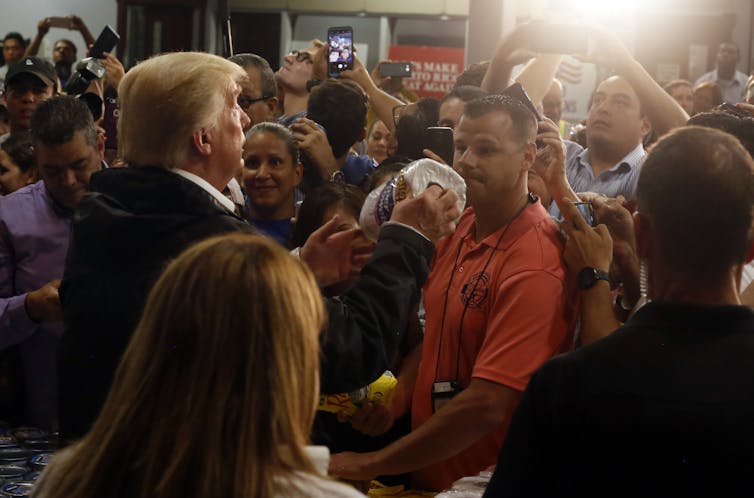 Trump hands out paper towels in Puerto Rico in the aftermath of Hurricane Maria.
AAP/EPA/Thais Llorca
Trump hands out paper towels in Puerto Rico in the aftermath of Hurricane Maria.
AAP/EPA/Thais Llorca
The federal government response to the hurricane was slow, uncoordinated and under-resourced. Trump showed little interest in it and took no responsibility for it. He briefly appeared on the island to congratulate himself and throw paper towels to residents. When the death toll was revealed to be nearly 3,000, revised up from initial reports of 64, Trump claimed Democrats made up most of the deaths “to make me look as bad as possible”.
Pandemic politics
The Puerto Rican tragedy was largely ignored and forgotten, but COVID-19 has replayed many of its themes on an even bigger scale.
There were bewildering government failures, despite the nation’s immense wealth and resources. There was an absence of coordination between different parts of the government. There was a visible disregard among some whites for non-white lives. And there were familiar claims by Trump that his opponents were exaggerating the scale of the crisis, this time to sink his re-election chances.
Even now, as experts stress the need for widespread testing, Trump complains that testing inflates coronavirus numbers, and says it should slow down.
You can’t fight a pandemic with racial slurs. After a very brief “rally round the flag” boost in polling, voter ratings of Trump’s handling of the pandemic have been poor, and are dropping.
Meanwhile, the kinds of experienced public servants Trump and his allies deride are enjoying much higher approval as Americans rediscover the virtues of scientific expertise.
Read more: Donald Trump blames everyone but himself for the coronavirus crisis. Will voters agree?
The pandemic itself may be less electorally consequential for Trump than its economic effects. It is very rare for presidents to win re-election during a recession.
Trump’s re-election hopes rest on a swift economic recovery, but that is unlikely while infections continue to surge, driven by attempts to reopen too quickly.
Black Lives Matter
The wave of Black Lives Matter protests following George Floyd’s killing in Minneapolis has damaged not just Trump’s electoral prospects, but the political order he represents.
For decades, conservatives have used the prospect of black unrest to scare white moderates, and Trump’s Nixonian rhetoric suggests he expected the same effect this time.
Instead, public opinion has solidified in support of the large, multiracial protests. The protests have changed minds, including white minds, about the systemic nature of racism in the United States. Racist backlashes may be less potent when there is a polarising white president in power.
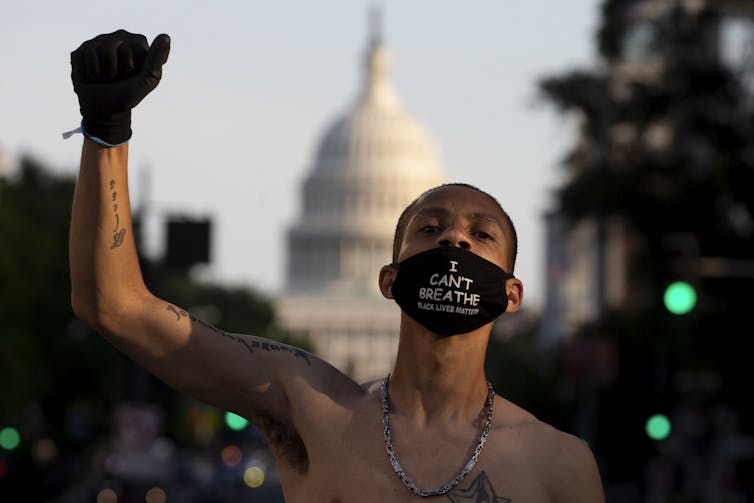 A protestor at a Black Lives Matter rally in Washington DC.
AAP/EPA/Michael Reynolds
A protestor at a Black Lives Matter rally in Washington DC.
AAP/EPA/Michael Reynolds
Trump has floundered in response to the protests. He has paid lip service to the cause of justice for George Floyd, but has shown more genuine sympathy for those who worry about being called racist.
Ultimately, he has retreated to his comfortable daydreams of black gratefulness. When announcing better-than-expected job numbers, Trump said:
Hopefully George is looking down right now and saying this is a great thing that’s happening for our country.
African American unemployment is actually getting worse, and Trump’s response to the protests is costing Republicans support across the country.
What about Biden?
Joe Biden has been much less visible than Trump during the pandemic, which so far is working well for his campaign. Trump seems desperate for a fight with Biden, and his campaign is reassuring nervous supporters that things will turn around when they get the chance to “define” Biden.
Biden is hard to paint as a radical. He has been quick to distance himself from proposals such as defunding police, and he has never supported “Medicare for all”, despite its popularity with the Democratic base and relevance during the pandemic. As president he would be unlikely to bring the kinds of lasting changes that most Democrats want to see.
This is why Trump and his allies cast Biden as “sleepy” and senile. They warn that he would easily be manipulated by radicals, and Trump is really running against the “far left”. So far, however, this approach has compelled Trump to talk a lot about his own physical and mental fitness.
Trump is a classically charismatic leader, whose hold on his supporters stems from their perception he is blessed with unique powers. This might be why Trump worries about any sign of weakness or change in his image – why he refuses to wear a mask, feels the need to physically prove himself, and is crushed by the sight of empty seats at a rally.
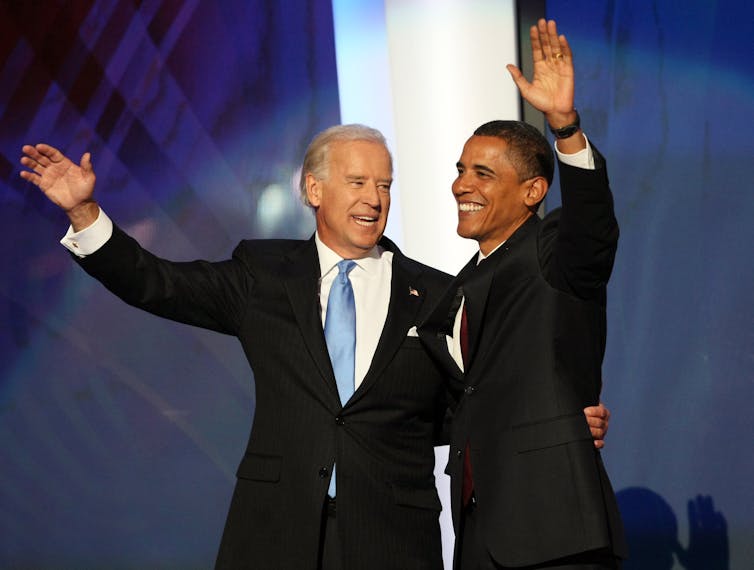 Joe Biden and Barack Obama at a Democratic virtual fundraiser in June.
AAP/Sipa USA/CNP
Joe Biden and Barack Obama at a Democratic virtual fundraiser in June.
AAP/Sipa USA/CNP
Biden, whose support stems from a perception that he is safe and familiar, having served as vice president in the Obama adminstration, chooses instead to display certain vulnerabilities. This helps explain his rising support among older Americans during the pandemic.
And in a year when race is a defining election issue, Biden has a vast advantage with African American and Hispanic voters, despite parts of his legislative record and his cringeworthy “you ain’t black” interview. He also owes his nomination to African American voters. As Juan Williams put it bluntly, “Joe Biden would be retired if not for the black vote”.
The polls look bad for Trump, but the race remains unpredictable
Averages of national polls currently show Biden leading Trump by between nine and ten points. Even without the pandemic, Trump was never going to have an easy contest against Biden.
Before he secured the nomination in March, Biden had an average lead of 5% in hypothetical poll match-ups with Trump, which is the likely reason Democrats settled on him as an alternative to Bernie Sanders.
Polls still show Trump’s supporters are a lot more enthusiastic about voting for Trump than Biden’s supporters are about voting for Biden, which could be important if voting becomes a health risk.
But enthusiasm for the Democratic candidate may not matter. The 2018 midterm was effectively a referendum on Trump, and the 2020 election will be an even more focused one.
There is reason to believe the race could tighten, if only because no candidate has won a presidential election by more than 9% since 1984, and partisan divisions have become a lot sharper since then. Many conservative-leaning Americans who are undecided about the election may return to Trump. Closer to the election, many pollsters will restrict their samples to people who they believe are likely to vote, rather than just able to vote. These likely voter screens may reveal Trump’s standing is stronger than it currently looks.
Of course, the election isn’t decided by a national popularity contest. Democrats are haunted by the 2016 election, in which Hillary Clinton got 2.8 million more votes than Trump but still lost the state-based electoral college. Currently, The Economist’s election forecast gives that scenario about a 10% chance of happening again.
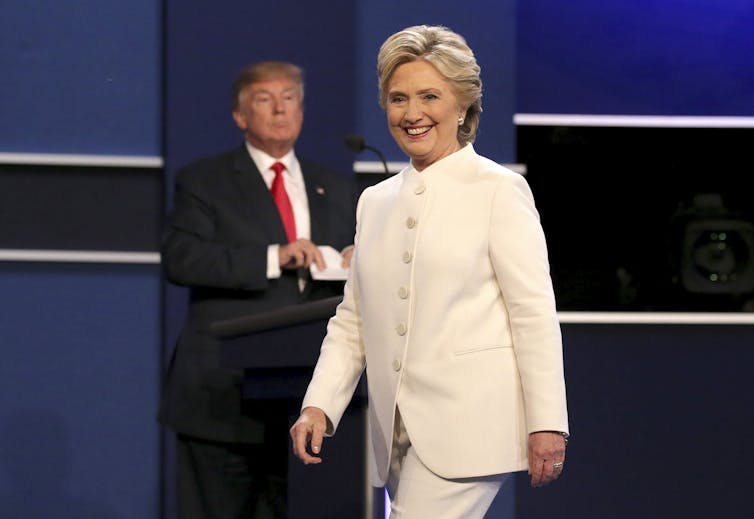 Democrats are haunted by the 2016 election, where Hillary Clinton won the popular vote but not the election.
AAP/EPA/Gary He
Democrats are haunted by the 2016 election, where Hillary Clinton won the popular vote but not the election.
AAP/EPA/Gary He
Everyone will be watching key swing states like Wisconsin, Michigan, Pennsylvania, Florida and North Carolina, as well as newly competitive states like Arizona and Minnesota.
Polls show Biden leading in most of these contests, but these leads are smaller and more volatile than his national lead. The quality of many state polls has also been questionable, raising the possibility they will repeat the same mistakes as last time.
Biden is discouraging complacency. Referencing a recent NYT/Siena poll that showed him leading Trump nationally by 14%, Biden tweeted:
COVID-19 has sabotaged the usual election-year registration drives that bring millions of new voters into the electorate, which could disadvantage Democrats who traditionally benefit from younger voters.
Coronavirus is also likely to cause increased mail voting. There is currently no evidence increased use of mail voting advantages one side over the other, and state officials from both parties have pushed to increase voting by mail. Mail voting could alleviate the electoral chaos recently seen in places like Georgia, where the pandemic kept election workers home and shut down polling places.
But mail voting brings its own problems. Most states currently do not have the infrastructure or rules to required to quickly process mail ballots, which means we may be unlikely to see a result on election night if the contest is close.
An uncertain result hinging on a prolonged mail ballot count could lead to the nightmare scenario of a disputed election outcome.
Would Trump accept defeat?
Trump already seems to be preparing to dispute the election. He has repeatedly claimed, with no evidence, that mail voting will facilitate massive voter fraud.
In March he said increased mail voting would mean “you’d never have a Republican elected in this country again”, and he recently tweeted:
These fraud claims have been repeatedly debunked, and Twitter was so worried about Trump attacking the electoral process that, for the first time, it flagged two of his tweets as misleading.
Trump may believe, with reason, that Republicans could benefit from in-person voting disarray on election day. Minority voters are far more likely than white voters to have to wait for long periods in lines at polling places.
In 2018, a federal court ruled for the first time since 1982 that Republicans could mount “poll watching” operations without prior judicial approval. This involves organising volunteers to challenge the eligibility of voters at polling places. Courts have previously found these tactics are used to intimidate and exclude minority voters, and they result in even longer delays. Republicans reportedly want to recruit 50,000 poll watchers for the 2020 election, including retired military and police officers.
But the purpose of Trump’s war on mail voting may simply be to delegitimise the election result in advance. He did this throughout 2016, saying the election would be “rigged” when it appeared he was set to lose. Even after he won, he claimed for years that he would have won the popular vote “if you deduct the millions of people who voted illegally”.
These claims have also been thoroughly debunked, including by Trump’s own lawyers.
Trump’s resistance to the factual possibility that he could lose has raised fears he might not accept a defeat. Biden, noting that military leaders criticised Trump’s handling of Black Lives Matter protests, has fantasised that the military would escort him from the White House if he tried to “steal the election”.
Extensive lawsuits are a more likely scenario than military intervention, but there is also the danger Trump’s supporters would not accept the legitimacy of a Biden victory.
Given Trump has often warned his supporters that their enemies will take away the Second Amendment (the right to bear arms), there is a possibility of a violent backlash, even if it only consists of isolated incidents.
At the same time, it is increasingly normal that large parts of the population dispute the legitimacy of the president. From Bill Clinton’s impeachment to George W. Bush’s contested victory; from Trump’s “birther” conspiracies about Obama to his own impeachment last year, refusals to accept the lawfulness of the presidency, on grounds real or imaginary, have become a standard part of America’s political repertoire.
A lot can happen in four months, as we’ve already seen this year. The outcome of this race is far from certain, but its ugliness is guaranteed.
Authors: David Smith, Senior Lecturer in American Politics and Foreign Policy, US Studies Centre, University of Sydney


















