

How Australia's supercomputers crunched the numbers to guide our bushfire and pandemic response
- Written by: Sean Smith, Professor and Director, NCI Australia, Australian National University
As 2020 began, Australia was stunned by the worst bushfires on record. Six months later we are weathering the coronavirus pandemic sweeping the globe.
This year, perhaps more than ever before, decision-makers, emergency services, health providers and threatened communities have needed fast, reliable information to understand what’s happening. And beyond that, they have needed high-powered modelling to get a sense of what is yet to come.
That’s where supercomputers come in. Australia’s high-performance research computing infrastructure is led by two centres: the National Computational Infrastructure (NCI Australia) in Canberra and the Pawsey Supercomputing Centre in Perth.
NCI Australia is home to Gadi, the most powerful supercomputer in the southern hemisphere, which can do in an hour what would take your average desktop PC around 35 years running flat out. The Pawsey centre hosts the Nimbus cloud, which is specially designed for data-intensive research work in cutting-edge fields such as space science.
Both centres operate around the clock every day of the year. Even without a crisis, they process unimaginable quantities of data to deliver analysis and forecasts for decision-makers across the nation. To take one example, NCI’s routine work for Digital Earth Australia helps to identify soil and coastal erosion, crop growth, water quality and changes to cities and regions.
Supercomputing behind the scenes
By their nature, high-performance research computers operate mostly behind the scenes. They provide infrastructure that is less visible but no less important than a ship or a telescope, and the expertise to help researchers use it.
When Australian government agencies need to make decisions to respond to a crisis like the bushfires or COVID-19, they draw on decades of Australian and international research backed by high-performance computing and data infrastructure.
Last summer, satellite images shocked the world with detailed and strangely beautiful views of swirls of bushfire smoke the size of global weather patterns. Our Kiwi colleagues woke to apocalyptic skies, tipped off beforehand by Australian and NZ collaborations with Japan’s Himawari-8 and -9 weather satellite mission.
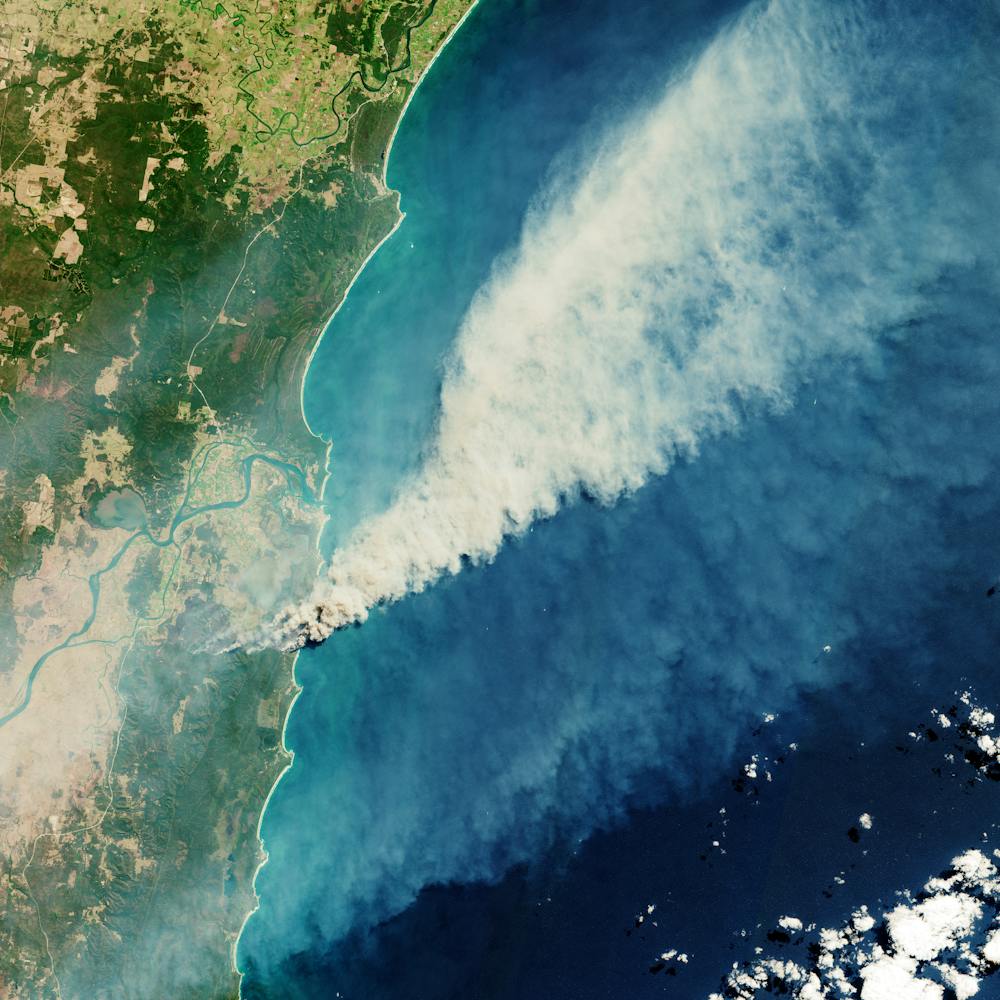 The Sentinel Earth-observing satellites provided a rich stream of data about the Australian bushfires in close to real time.
ESA / Copernicus, CC BY-NC-SA
The Sentinel Earth-observing satellites provided a rich stream of data about the Australian bushfires in close to real time.
ESA / Copernicus, CC BY-NC-SA
Research satellites like the European Sentinel-3 with a wider global view continued to track the plume as it circled the planet. NCI Australia hosts a regional data hub to support Europe’s Copernicus Earth observation program.
Read more: Australia's bushfire smoke is lapping the globe, and the law is too lame to catch it
Data-driven models running on supercomputers can provide earlier and more accurate warning of firestorms, floods, hailstorms, cyclones and other extremes. Better warnings give emergency services crucial hours that save lives and property.
Both national facilities are contributing resources to support researchers in Australia in the fight against COVID-19.
With the Gadi supercomputer, NCI is providing the equivalent of more than 4,500 years of computer time to support three research groups. Pawsey is providing access to more than 1,100 desktop’s worth of computing power on the newly deployed Nimbus cloud for researchers across five projects.
National infrastructure working at scale
The Australian Government’s National Collaborative Research Infrastructure Strategy (NCRIS) has invested A$70 million in each centre for upgrades to ensure the facilites can keep up with Australian research across all scientific domains. NCI’s Gadi supercomputer is about nine times more powerful than its predecessor, while the first phase of Pawsey’s upgrade has already delivered ten times more cloud storage and boosted network capabilities fivefold.
Reliable, collaborative facilities like NCI and Pawsey are essential to develop and improve immensely complex global and local models and prediction systems used by national and state governments.
The NCI and Pawsey systems support much more than climate and weather data and pandemic modelling. Other projects support gene sequencing, population mapping, transmission and containment modelling, and global economic predictions.
Scale, collaboration and speed
Scaling up our research computing capacity is important to meet the challenges of ever-growing amounts of research data. Collaboration makes it possible to access the best expertise. Speed is essential to meet the urgent demands of decision makers.
Supercomputers connected to massive data systems and supported by expert staff can yield crucial insights at scale, quickly enough to help our agencies identify and respond to crises. Faster processing also means researchers can identify and model trends that would otherwise go unnoticed, but which require early intervention.
Supercharging the relevant science can deliver real economic, environmental and public health outcomes. The need for informed crisis response does not look like it will go away any time soon.
Authors: Sean Smith, Professor and Director, NCI Australia, Australian National University


















