Did ancient Americans settle in Polynesia? The evidence doesn't stack up
- Written by Lisa Matisoo-Smith, Professor of Biological Anthropology, University of Otago
How did the Polynesian peoples come to live on the far-flung islands of the Pacific? The question has intrigued researchers for centuries.
Norwegian explorer Thor Heyerdahl brought the topic to public attention when he sailed a balsa-wood raft called the Kon-Tiki from Peru to Polynesia in 1947. His goal was to demonstrate such voyages were possible, supporting theories linking Polynesian origins to the Americas.
Decades of research in archaeology, linguistics and genetics now show that Polynesian origins lie to the west, ultimately in the islands of southeast Asia. However, the myth of migrations from America has lingered in folk science and on conspiracy websites.
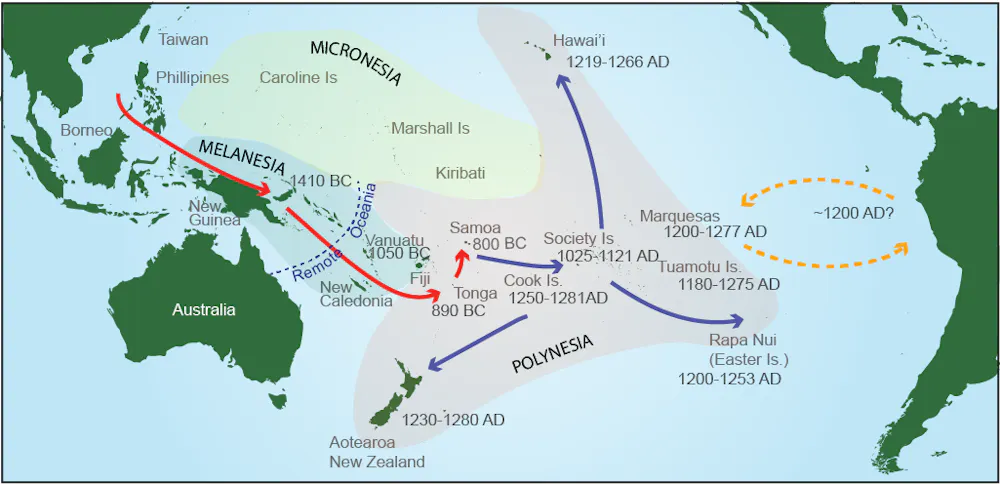 Pacific migrations: red arrows show expansion from island southeast Asia, blue arrows show Polynesian expansion, yellow arrows show proposed contact with the Americas.
Anna Gosling / Wilmshurst et al. (2011), Author provided
Pacific migrations: red arrows show expansion from island southeast Asia, blue arrows show Polynesian expansion, yellow arrows show proposed contact with the Americas.
Anna Gosling / Wilmshurst et al. (2011), Author provided
New evidence for American interlopers?
A new study published in Nature reports genetic evidence of Native American ancestry in several Polynesian populations. The work, by Alexander Ioannidis and colleagues, is based on a genetic analysis of 807 individuals from 17 island populations and 15 indigenous communities from South and Central America.
Other researchers have previously found evidence of indigenous American DNA in the genomes of the modern inhabitants of Rapa Nui. (Rapa Nui, also known as Easter Island, is the part of Polynesia closest to South America.)
The estimated timing of these interactions, however, raised concerns. Analyses of DNA from ancient Rapa Nui skeletal remains found no evidence of such mingling, or admixture. This suggests the “Amerindian” genetic component was likely introduced later via Chilean colonists.
Ioannidis and colleagues found southern South American Indigenous DNA in the genomes – the genetic material – of modern Rapa Nui, but they claim it represents a second pulse of contact. They also found signs of earlier contact, coming from as far north as Colombia or even Mexico.
More novel was the fact that this earlier signal was also found in modern DNA samples collected in the 1980s from the Marquesas and the Tuamotu archipelagos. The researchers argue this likely traces to a single “contact event” around 1200 AD, and possibly as early as 1082 AD.
Both suggested dates for this first event are earlier than those generally accepted for the settlement of Rapa Nui (1200-1250 AD). The earlier date predates any archaeological evidence for human settlement of the Marquesas or any of the other islands on which it was identified.
Ioannidis and colleagues make sense of this by suggesting that perhaps “upon their arrival, Polynesian settlers encountered a small, already established, Native American population”.
Read more: What wind, currents and geography tell us about how people first settled Oceania
Follow the kūmara
The 1200 AD date and the more northerly location of the presumed contact on the South American continent are not unreasonable. They are consistent with the presence and distribution of the sweet potato, or kūmara.
This plant from the Americas is found throughout Eastern Polynesia. It gives us the strongest and most widely accepted archaeological and linguistic evidence of contact between Polynesia and South America.
Kūmara remains about 1,000 years old have been found in the Cook Islands in central Polynesia. When Polynesian colonists settled the extremes of the Polynesian triangle – Hawai’i, Rapa Nui, and Aotearoa New Zealand – between 1200 and 1300 AD, they brought kūmara in their canoes.
So contact with the Americas by that time fits with archaeological data. The suggestion that it was Native Americans who made the voyage, however, is where we think this argument goes off the rails.
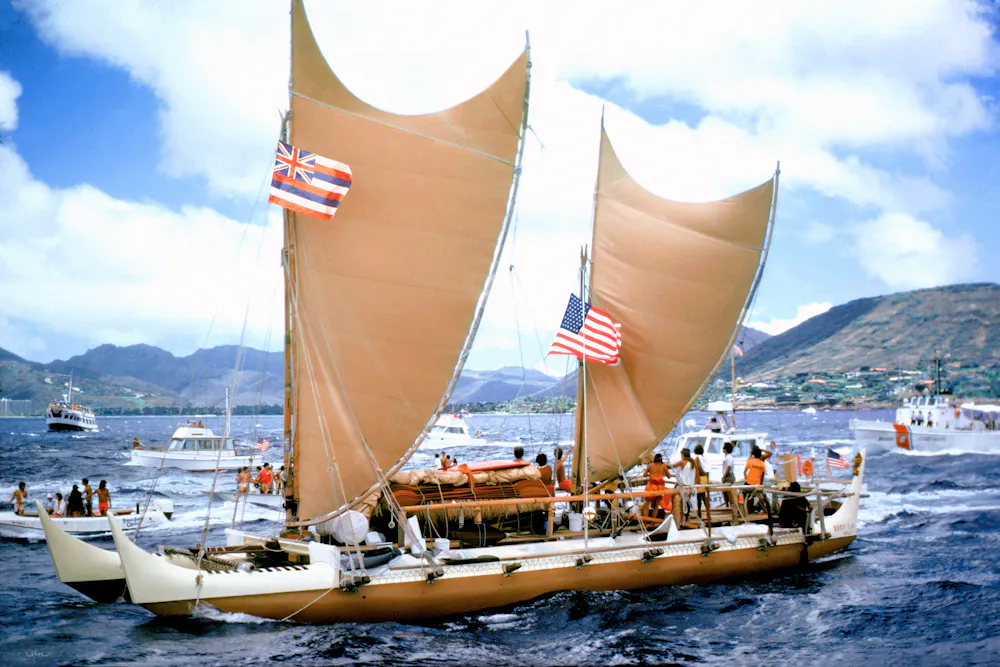 Polynesian voyagers travelled in double-hulled canoes much like the Hokule'a, a reconstruction of a traditional vessel built in the 1970s.
Phil Uhl / Wikimedia, CC BY-SA
Polynesian voyagers travelled in double-hulled canoes much like the Hokule'a, a reconstruction of a traditional vessel built in the 1970s.
Phil Uhl / Wikimedia, CC BY-SA
A great feat of sailing
Polynesians are among the greatest navigators and sailors in the world. Their ancestors had been undertaking voyages on the open ocean for at least 3,000 years.
Double hulled Polynesian voyaging canoes were rapidly and systematically sailing eastwards across the Pacific. They would not have stopped until they hit the coast of the Americas. Then, they would have returned home, using their well proven skills in navigation and sailing.
While Heyerdahl showed American-made rafts could make it out to the Pacific, Indigenous Americans have no history of open ocean voyaging. Similarly, there is no archaeological evidence of pre-Polynesian occupation on any of the islands of Polynesia.
Read more: Chickens tell tale of human migration across Pacific
The limitations of genetic analysis
Genetic analyses attempting to reconstruct historical events based on data from modern populations are fraught with potential sources of error. Addressing questions where only a few hundred years make a major difference is particularly difficult.
Modelling population history needs to consider demographic impacts such as the massive depopulation caused by disease and other factors associated with European colonisation.
Ioannidis and colleagues took this into account for Rapa Nui, but not for the Marquesas. Estimates of population decline in the Marquesas from 20,000 in 1840 to around 3,600 by 1902 indicate a significant bottleneck.
The choice of comparative populations was also interesting. The only non-East Polynesian Pacific population used in analyses was from Vanuatu. Taiwanese Aboriginal populations were used as representatives of the “pure” Austronesian ancestral population for Polynesians.
This is wrong and overly simplistic. Polynesian genomes themselves are inherently admixed. They result from intermarriages between people probably from a homeland in island southeast Asia (not necessarily Taiwan) and other populations encountered en route through the Pacific.
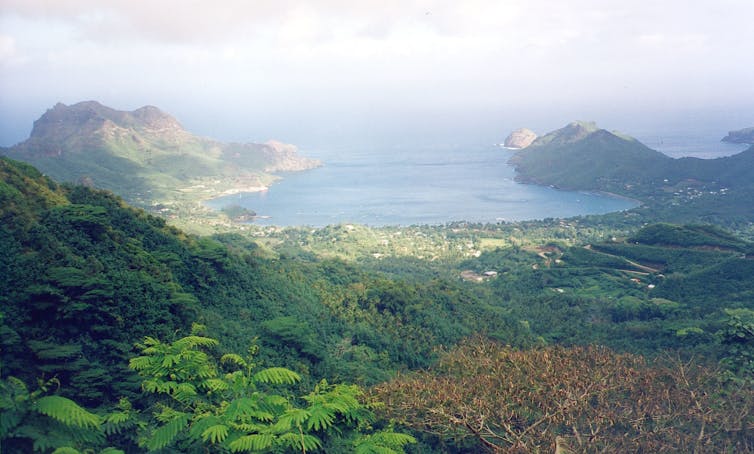 The Marquesas islands in what is now French Polynesia are one of the potential sites for American contact proposed by Ioannidis and colleagues.
James Shrimpton / AAP
The Marquesas islands in what is now French Polynesia are one of the potential sites for American contact proposed by Ioannidis and colleagues.
James Shrimpton / AAP
Polynesian Y chromosomes and other markers show clear evidence of admixture with western Pacific populations. Excluding other Oceanic and Asian populations from the analyses may have skewed the results. Interestingly, the amount of Native American admixture identified in the Polynesian samples correlates with the amount of European admixture found in those populations.
Finally, like many recent population genetic studies, Ioannidis and colleagues did not look at sequences of the whole genome. Instead, they used what are called single nucleotide polymorphism (SNP) arrays.
SNP arrays are designed based on genetic variation identified through studies of primarily Asian, African and European genomes. Very few Pacific or other indigenous genomes were included in the databases used to design SNP arrays. This means variation in these populations may be misinterpreted or underestimated.
Summing up
While the results presented by Ioannidis and colleagues are very interesting, to fully understand them will require a level of scholarly engagement that may take some time.
Did contact between Polynesians and indigenous Americans happen? Significant evidence indicates that it did. Do these new data prove this? Perhaps, though there are a number of factors that need further investigation. Ideally, we would like to see evidence in ancient genetic samples. Engagement with the Pacific communities involved is also critical.
However, if the data and analyses are correct, did the process likely occur via the arrival of indigenous Americans, on their own, on an island in eastern Polynesia? This, we argue, is highly questionable.
Authors: Lisa Matisoo-Smith, Professor of Biological Anthropology, University of Otago