

Malaysia’s media crackdowns are being driven by an insecure government highly sensitive to criticism
- Written by Ross Tapsell, Senior Lecturer in the School of Culture, History and Language, College of Asia and the Pacific., Australian National University
The recent police interrogations of six Al Jazeera journalists in Malaysia – five of whom are Australian – was not about shaping international reportage or a diplomatic rift.
Rather, it was part of a troubling pattern of crackdowns on the media and freedom of speech in the country, driven by the domestic concerns of an insecure government highly sensitive to criticism.
While the previous government led by former Prime Minister Mahathir Mohamad was by no means consistent or perfect, Malaysia was hailed just last year as an example of a country improving on press freedom.
This started to change in March, however, as Muhyiddin Yassin’s new government came to power. Tolerance for criticism and dissent has since been in short supply.
Al Jazeera’s documentary on the plight of migrant workers during COVID-19.Pattern of repression
The Al Jazeera journalists have been accused of sedition and defamation over a documentary about the government’s treatment of migrant workers during the COVID-19 pandemic. Malaysian officials and national television claim the documentary was inaccurate, misleading and unfair.
But these journalists are hardly the only ones to be targeted by the new government.
Steven Gan, chief editor of the trusted online news portal Malaysiakini, is facing contempt of court charges and could be sent to jail over reader comments briefly published on the news site that were apparently critical of the judiciary. Gan’s lawyer warned the case could have a “chilling effect”.
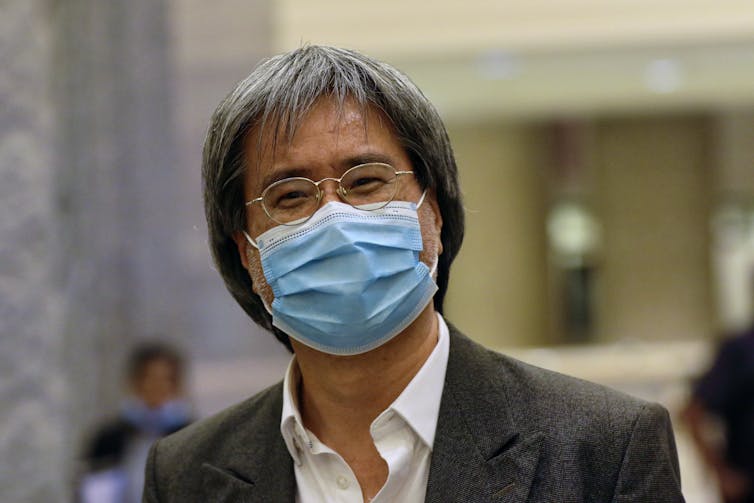 Steven Gan arriving in court this week.
AHMAD YUSNI/EPA
Steven Gan arriving in court this week.
AHMAD YUSNI/EPA
South China Morning Post journalist Tashny Sukamaran has been investigated for reporting on police raids of migrant workers and refugees.
Another journalist, Boo Su-Lyn, is being investigated for publishing the findings of an inquiry into a fire at a hospital in 2016 that left six dead.
A book featuring articles by political analysts and journalists has been banned over the artwork on the cover that allegedly insulted the national coat of arms. Sukamaran and journalists from Malaysiakini have been questioned by police about their involvement.
Opposition politicians have also been questioned by police for tweets and comments they made in the media prior to the new government taking power.
Whistle-blowers are included in this, too. For example, the government this week cancelled the work permit of the migrant worker who was featured in the Al Jazeera documentary.
Why the recent crackdown?
Malaysia’s current coalition government – Perikatan Nasional – was controversially formed earlier this year. The alliance came to power via backdoor politicking and support from the Malaysian king as Mahathir’s dysfunctional coalition imploded.
The new government coalition includes the United Malays National Organisation (UMNO), the party voted out of power in 2018 following a massive corruption scandal. This was the first time Malaysia had changed government in its 60-year history.
With UMNO now back in government, it is perhaps no surprise there are again more crackdowns on the media, as their previous rule saw regular attacks on journalists, activists and opposition figures.
Read more: Malaysia takes a turn to the right, and many of its people are worried
Malaysia has also become known for its “cybertroopers” - social media commentators similar to “trolls” – who drive heated nationalistic and race-related agendas, and target government critics.
After the Al Jazeera documentary, these cyber-troopers provided fervent support for the government’s actions, arguing it had every right to round up migrants and evict them if it sees fit. Al Jazeera said its journalists were also targeted by cyber-troopers, saying they
faced abuse online, including death threats and disclosure of their personal details over social media.
Shaky government looking to firm up support
There’s another reason for the return of media crackdowns and online-driven activity beyond just the government’s desire to control the media.
It is also tactical as it allows government ministers to respond with firm statements asking security forces to intervene – enabling them to look strong, coherent and nationalistic.
Muhyiddin’s coalition is on shaky ground. It holds a slim majority in parliament and internal party factions have come to dominate political debate, with “party-hopping” becoming increasingly common. Malaysiakini even has a rolling news page regularly updated to track politicians’ changing alliances.
Malaysia’s parliament also finally resumed this week after a long and unstable hiatus, and was described as a “circus”. Politicians shouted over one another, with some trading racist and sexist remarks.
The house speaker, who was part of Mahathir’s administration, was also controversially replaced. There has been consistent talk of snap polls.
In this environment, politicians who don’t respond forcefully enough in the “culture wars” over documentaries and controversial artwork on book covers, or conform with the online mob on immigration, risk looking weak.
Read more: How blaming others dominates Indonesian and Malaysian twitterspheres during COVID-19 pandemic
A ‘new normal’ settling in
A snap election won’t necessarily help Muyhiddin strengthen his position, as parties within the coalition can become rivals during a campaign for certain seats.
But no matter who rules Malaysia in the coming months, the result will likely be a government that is fragile, insecure and worried about its legitimacy. For Malaysians, this is their “new normal”.
The risk for journalists in this “new normal” is further repression and harassment of independent media. As we have seen elsewhere in Southeast Asia, as well as in Australia, the state seems increasingly willing to use legal and regulatory pressure to make sure journalists and whistle-blowers are afraid to speak up.
Authors: Ross Tapsell, Senior Lecturer in the School of Culture, History and Language, College of Asia and the Pacific., Australian National University

















