

what if we took all farm animals off the land and planted crops and trees instead?
- Written by Sebastian Leuzinger, Professor, Auckland University of Technology
 CC BY-ND
Climate Explained is a collaboration between The Conversation, Stuff and the New Zealand Science Media Centre to answer your questions about climate change.
If you have a question you’d like an expert to answer, please send it to climate.change@stuff.co.nz
I would like to know how much difference we could make to our commitment under the Paris Agreement and our total greenhouse gas emissions if we removed all cows and sheep from the country and grew plants in their place (hemp, wheat, oats etc). Surely we could easily become carbon neutral if we removed all livestock? How much more oxygen would be produced from plants growing instead? How would this offset our emissions? And what if we returned the land the animals were on to native forests or even pine plantations?
This is an interesting question and gives me the opportunity for some nice – albeit partly unrealistic – model calculations. Before I start, just two comments regarding the question itself.
Oxygen concentrations have been relatively stable at around 21% of the air we breathe for millions of years. This will not change markedly even if carbon dioxide emissions increase for years to come. Carbon dioxide concentrations, even in the most pessimistic emissions scenarios, will only get to around 0.1% of the atmosphere, hardly affecting the air’s oxygen content.
Secondly, grazing animals like cows and sheep emit methane — and that’s what harms the climate, not the grassland itself. Hemp or wheat plantations would have a similar capacity to take up carbon dioxide as grassland. But growing trees is what makes the difference.
Read more:
Climate explained: how different crops or trees help strip carbon dioxide from the air
Here’s a back-of-the-envelope calculation to work out how New Zealand’s carbon balance would change if all livestock were removed and all agricultural land converted to forest.
CC BY-ND
Climate Explained is a collaboration between The Conversation, Stuff and the New Zealand Science Media Centre to answer your questions about climate change.
If you have a question you’d like an expert to answer, please send it to climate.change@stuff.co.nz
I would like to know how much difference we could make to our commitment under the Paris Agreement and our total greenhouse gas emissions if we removed all cows and sheep from the country and grew plants in their place (hemp, wheat, oats etc). Surely we could easily become carbon neutral if we removed all livestock? How much more oxygen would be produced from plants growing instead? How would this offset our emissions? And what if we returned the land the animals were on to native forests or even pine plantations?
This is an interesting question and gives me the opportunity for some nice – albeit partly unrealistic – model calculations. Before I start, just two comments regarding the question itself.
Oxygen concentrations have been relatively stable at around 21% of the air we breathe for millions of years. This will not change markedly even if carbon dioxide emissions increase for years to come. Carbon dioxide concentrations, even in the most pessimistic emissions scenarios, will only get to around 0.1% of the atmosphere, hardly affecting the air’s oxygen content.
Secondly, grazing animals like cows and sheep emit methane — and that’s what harms the climate, not the grassland itself. Hemp or wheat plantations would have a similar capacity to take up carbon dioxide as grassland. But growing trees is what makes the difference.
Read more:
Climate explained: how different crops or trees help strip carbon dioxide from the air
Here’s a back-of-the-envelope calculation to work out how New Zealand’s carbon balance would change if all livestock were removed and all agricultural land converted to forest.
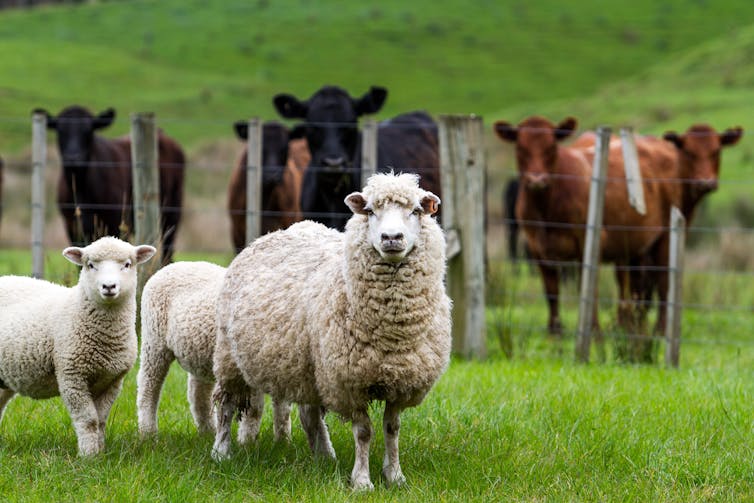 If New Zealand stopped farming cows and sheep, it would remove methane emissions.
Heath Johnson/Shutterstock
Converting pasture to trees
This would remove all methane emissions from grazing animals (about 40 megatonnes of carbon dioxide equivalent per year).
New Zealand has about 10 million hectares of grassland. Let us assume that mature native bush or mature pine forests store the equivalent of roughly 1,000 tonnes of carbon dioxide per hectare.
If it takes 250 years to grow mature native forests on all former agricultural land, this would lock away 10 billion tonnes of carbon dioxide within that time span, offsetting our carbon dioxide emissions (energy, waste and other smaller sources) during the 250 years of regrowth. Because pine forest grows faster, we would overcompensate for our emissions until the forest matures (allow 50 years for this), creating a net carbon sink.
Note these calculations are based on extremely crude assumptions, such as linear growth, absence of fire and other disturbances, constant emissions (our population will increase, and so will emissions), ignorance of soil processes, and many more.
If agricultural land was used to grow crops, we would save the 40 megatonnes of carbon dioxide equivalent emitted by livestock in the form of methane, but we would not store a substantial amount of carbon per hectare.
Read more:
Climate explained: how the climate impact of beef compares with plant-based alternatives
Steps towards a carbon-neutral New Zealand
How should we interpret this rough estimate? First, we must acknowledge even with our best intentions, we still need to eat, and converting all agricultural land to forest would leave us importing food from overseas — certainly not great for the global carbon budget.
Second, it shows if livestock numbers were at least reduced, and we all turned to a more plant-based diet, we could reduce our emissions substantially. The effect would be similar to reforesting large parts of the country.
Third, this example also shows that eventually, be it after 250 years in the case of growing native forests, or after about 50 years in the case of pine forests, our net carbon emissions would be positive again. As the forests mature, carbon stores are gradually replenished and our emissions would no longer be compensated. Mature forests eventually become carbon neutral.
Even though the above calculations are coarse, this shows that a realistic (and quick) way to a carbon-neutral New Zealand will likely involve three steps: reduction of emissions (both in the agricultural and energy sectors), reforestation (both native bush and fast growing exotics), and a move to a more plant-based diet.
If New Zealand stopped farming cows and sheep, it would remove methane emissions.
Heath Johnson/Shutterstock
Converting pasture to trees
This would remove all methane emissions from grazing animals (about 40 megatonnes of carbon dioxide equivalent per year).
New Zealand has about 10 million hectares of grassland. Let us assume that mature native bush or mature pine forests store the equivalent of roughly 1,000 tonnes of carbon dioxide per hectare.
If it takes 250 years to grow mature native forests on all former agricultural land, this would lock away 10 billion tonnes of carbon dioxide within that time span, offsetting our carbon dioxide emissions (energy, waste and other smaller sources) during the 250 years of regrowth. Because pine forest grows faster, we would overcompensate for our emissions until the forest matures (allow 50 years for this), creating a net carbon sink.
Note these calculations are based on extremely crude assumptions, such as linear growth, absence of fire and other disturbances, constant emissions (our population will increase, and so will emissions), ignorance of soil processes, and many more.
If agricultural land was used to grow crops, we would save the 40 megatonnes of carbon dioxide equivalent emitted by livestock in the form of methane, but we would not store a substantial amount of carbon per hectare.
Read more:
Climate explained: how the climate impact of beef compares with plant-based alternatives
Steps towards a carbon-neutral New Zealand
How should we interpret this rough estimate? First, we must acknowledge even with our best intentions, we still need to eat, and converting all agricultural land to forest would leave us importing food from overseas — certainly not great for the global carbon budget.
Second, it shows if livestock numbers were at least reduced, and we all turned to a more plant-based diet, we could reduce our emissions substantially. The effect would be similar to reforesting large parts of the country.
Third, this example also shows that eventually, be it after 250 years in the case of growing native forests, or after about 50 years in the case of pine forests, our net carbon emissions would be positive again. As the forests mature, carbon stores are gradually replenished and our emissions would no longer be compensated. Mature forests eventually become carbon neutral.
Even though the above calculations are coarse, this shows that a realistic (and quick) way to a carbon-neutral New Zealand will likely involve three steps: reduction of emissions (both in the agricultural and energy sectors), reforestation (both native bush and fast growing exotics), and a move to a more plant-based diet.
Authors: Sebastian Leuzinger, Professor, Auckland University of Technology

















