

Australians want more funding for higher-quality aged care — and most are willing to pay extra tax to achieve it
- Written by: Julie Ratcliffe, Professor of Health Economics and Mathew Flinders Fellow, Caring Futures Institute, Flinders University
It’s often said the true measure of any society is how well it treats its most vulnerable members. By this measure, Australia is falling woefully short. The Royal Commission into Aged Care Quality and Safety recently highlighted shocking instances of abuse and neglect involving our most vulnerable older citizens.
The aged care sector represents a multibillion-dollar industry, predominantly publicly funded. But during the proceedings of the royal commission, it’s been characterised as a sector receiving significant underinvestment and delivering substandard care.
It has failed to keep up with community expectations and the changing needs of our older population.
Our new research, published today, suggests most Australians believe more public money should be devoted to providing higher-quality aged care – and many would even be willing to pay higher taxes to this end.
Read more: So you're thinking of going into a nursing home? Here's what you'll have to pay for
Exploring Australians’ attitudes to aged care funding
The Caring Futures Institute at Flinders University recently conducted a first-of-its-kind survey — both in Australia and internationally — to assess the views of the general public on the quality of aged care and the future funding of the sector.
We surveyed more than 10,000 Australian adults not currently receiving aged care services, aged between 18 and 91, with representation from every state and territory.
 Many people prefer to receive aged care at home rather than to move into a residential facility.
Shutterstock
Many people prefer to receive aged care at home rather than to move into a residential facility.
Shutterstock
There was strong recognition among the general public of the central role government funding plays in the financing of a quality aged care system. Almost 90% of our survey respondents indicated the government should provide more funding to support the delivery of quality aged care.
According to the Royal Commission’s findings, the Australian government currently allocates 4% of tax collected to Australia’s aged care system. Our respondents said on average 8% of tax collected should be spent on Australia’s aged care system (as opposed to other public services).
Some 61% of current taxpaying respondents were willing to pay an additional 1.4% per year in income tax so all Australians had access to a satisfactory level of quality aged care. Further, 55% of current taxpayers would be willing to pay an extra 1.7% in tax — equating to 3.1% additional income tax in total — to ensure equal access to a high level of quality aged care.
Most respondents indicated they would be willing to pay co-contributions (fees out of their own pocket) if they needed to access aged care services in the future. Those who have experienced the aged care system through a close family member or friend receiving care would be willing to make higher co-contributions on average than those without current experience.
Read more: Aged-care funding creates dependency and lowers well-being of residents
An overwhelming majority of respondents indicated they would prefer to remain living at home rather than enter a residential care facility if their health had deteriorated to the extent that they required an intensive level of care and support.
In general, we found younger people would be willing to pay more than older people to stay at home. In total, 72% of our survey respondents indicated they would be willing to pay A$184 per week on average, equating to almost A$10,000 per year, to remain living at home and avoid moving into a residential care facility.
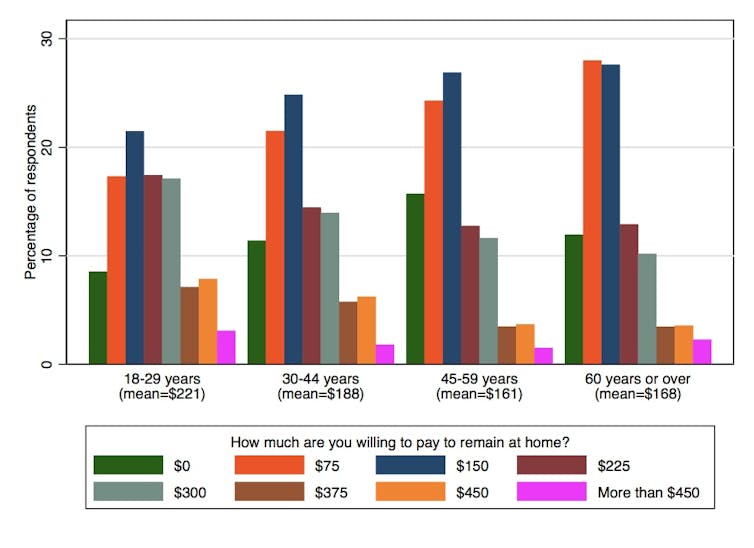 Young people tended to be willing to pay more.
Ratcliffe et al. Caring Futures Institute, Flinders University, South Australia. Royal Commission into Aged Care Quality and Safety Research Report no 6 July 2020, Author provided
Young people tended to be willing to pay more.
Ratcliffe et al. Caring Futures Institute, Flinders University, South Australia. Royal Commission into Aged Care Quality and Safety Research Report no 6 July 2020, Author provided
What is quality in aged care?
There was a high level of agreement among our survey respondents about what constitutes quality in aged care. Characteristics consistently rated as highly important included:
treating the older person with respect and dignity at all times
a trained and skilled workforce providing care that supports the older person’s health and well-being, and
the ability to lodge complaints with the knowledge that appropriate action will be taken.
In 2017-18 almost a million Australians accessed home care services and more than 200,000 people were permanently living in residential aged care. These estimates are expected to increase rapidly in the coming decades due to growth in Australia’s ageing population.
There is an urgent need for different care models to accommodate the overwhelming preference of the vast majority of Australians to remain living and cared for at home as they age.
There is an urgent need for new investment in aged care infrastructure to deliver a uniformly skilled and trained workforce to accommodate the needs, expectations and preferences of increasing numbers of older people in our society.
And finally, there’s an urgent need for stronger integration between the aged care sector and the health system to ensure all older Australians can access the care and services they need to maximise their quality of life.
Read more: Confused about aged care in the home? These 10 charts explain how it works
Our survey responses highlight that the general public recognise the fundamental importance of additional investment in the sector, including to ensure all aged care staff have the skills and training needed to provide the highest standards of care.
The findings provide an important and timely societal perspective with which to inform aged care policy and practice in Australia and in other countries which share similar values, aspirations and circumstances.
Authors: Julie Ratcliffe, Professor of Health Economics and Mathew Flinders Fellow, Caring Futures Institute, Flinders University


















