

The Uluru statement is not a vague idea of 'being heard' but deliberate structural reform
- Written by: Gabrielle Appleby, Professor, UNSW Law School, UNSW
In May 2017, the Uluru Statement from the Heart was delivered to the Australian people. It sets out three steps to achieve structural reform to recognise First Nations sovereignty and address their current structural powerlessness.
First is the establishment of a constitutionally enshrined First Nations Voice. This is to be followed by the establishment of a Makarrata Commission to oversee a process of agreement-making and truth-telling. Voice. Treaty. Truth.
Professor Anne Twomey has proposed what she claims are alternative means of constitutional recognition of Aboriginal and Torres Strait Islander people that would allow them to interact with the Commonwealth, or allow them to “be heard”.
In this piece, I will explain the process that delivered the Uluru Statement. Understanding the sophistication and informed nature of this exercise reveals these reforms were carefully and deliberately selected.
How was consensus reached at Uluru?
The Uluru Statement is the culmination of unprecedented engagement with Aboriginal and Torres Strait Islander peoples. This was undertaken by the Referendum Council in 2016 and 2017, involving 12 regional dialogues conducted with more than 1,000 Aboriginal and Torres Strait Islander people across the country. These culminated in a national constitutional convention at Uluru.
These meetings all considered several possible constitutional amendments to “recognise” Aboriginal and Torres Strait Islander peoples. From these deliberations a consensus emerged around the need for a single form of constitutional recognition: a First Nations Voice.
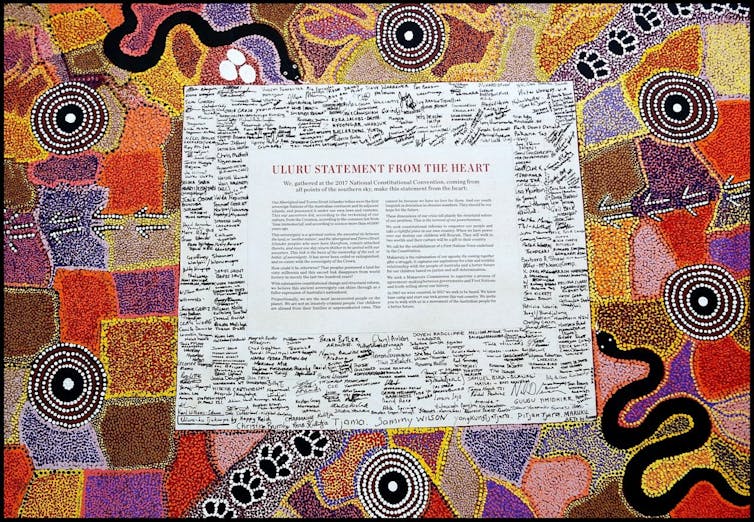 Uluru Statement from the Heart.
How did the national constitutional convention settle on this amendment? And what amendments were rejected? The Referendum Council’s full report explains the process in detail.
At the convention, the delegates agreed to a set of ten guiding principles. These are that any change:
- does not diminish Aboriginal sovereignty and Torres Strait Islander sovereignty
- involves substantive, structural reform
- advances self-determination and the standards established under the United Nations Declaration on the Rights of Indigenous Peoples
- recognises the status and rights of First Nations
- tells the truth of history
- does not foreclose on future advancement
- does not waste the opportunity of reform
- provides a mechanism for First Nations agreement-making
- has the support of First Nations
- does not interfere with positive legal arrangements
Each of the proposed reforms was assessed against these principles.
Statement of acknowledgement
The dialogues rejected a statement of acknowledgement of the place of First Nations as the First Peoples of Australia for three key reasons.
The first was that the reform, on its own, would be predominantly symbolic and minimalist. It would not, for instance, involve substantive structural reform (guiding principle 2), nor advance self-determination (guiding principle 4) and would waste the present opportunity of reform (guiding principle 7).
The second was that there were serious concerns that minimalist recognition of the place of First Nations could undermine claims of sovereignty (guiding principle 1).
Finally, there were concerns that the final statement that would be agreed upon would be so minimalist as to be inconsistent with truth-telling (guiding principle 5).
Amendment to the race power
An amendment to the Australian Constitution’s so-called race power, which allows the Commonwealth parliament to make laws with respect to people of a particular race, was also rejected. While there was significant concern regarding the potential of this power to be used to discriminate adversely against Aboriginal and Torres Strait Islander peoples, it was understood the proposed amendment to the power would not necessarily prevent this.
Perhaps most fundamentally, removal of the word “race” from the power was not seen as a substantive, structural reform (guiding principle 2). In this respect, the proposed amendment was rejected as it might waste the opportunity for reform (guiding principle 7). It was understood to largely reflect the status quo.
The Commonwealth parliament already has power, for instance, to make laws that facilitate the “interaction” between Aboriginal and Torres Strait Islander peoples and the Commonwealth parliament and government. But, at the moment, the parliament is under no obligation to create these interactions.
It was also understood that any amendment to the race power might actually put in jeopardy important legislation with respect to heritage protection, land rights and native title (guiding principle 10).
Finally, the current power of the Commonwealth to facilitate these interactions does not advance self-determination of First Nations (guiding principle 3) because, unlike through a First Nations Voice, there is no guarantee the parliament and government will be required to engage with Aboriginal and Torres Strait Islander people before making decisions that affect them.
Prohibition against racial discrimination
The insertion of a new provision in the constitution that would prohibit racial discrimination was considered substantive, structural reform (guiding principle 2).
However, as it created a legal protection, or shield, it was seen as less consistent with advancing self-determination (guiding principle 3) and recognition of the unique status and rights of First Nations (guiding principle 4). It would not explicitly provide a platform to advance treaty and truth-telling (guiding principles 5 and 8).
Enshrining a Voice to Parliament
The constitutional convention did not agree on the detail of the constitutional amendment to enshrine a First Nations Voice called for in the Uluru Statement. However, there was agreement as to its core function. Reflecting what was discussed at the convention, one proposal for the amendment is as follows:
Section 129
1) There shall be a body, to be called the First Nations Voice
2) The First Nations Voice:
shall present its views to Parliament and the Executive on matters relating to Aboriginal and Torres Strait Islander peoples; and
may perform such additional functions as the Parliament provides
3) The Parliament shall, subject to this Constitution, have power to make laws with respect to the composition, functions, powers and procedures of the First Nations Voice.
This proposal can be said to be consistent with the “spirit of the Uluru statement” in that it promotes all of the guiding principles. It provides recognition of First Nations sovereignty through a substantive, structural reform that delivers self-determination for First Nations, through which they can pursue agreement-making, truth-telling or other reforms in the future.
 A Voice to Parliament is not just about ‘being heard’.
Alternative proposals that might require the Commonwealth to “hear” Aboriginal and Torres Strait Islander peoples, such as Twomey proposed, or to set up “voices” for Aboriginal and Torres Strait Islander peoples, such as some suggested to the Joint Select Committee, leave open how this hearing and speaking will occur. As Twomey explains, it would be up to the Commonwealth to decide whether it would be given effect by government action, legislation, a parliamentary committee, or a combination of all of them.
These options, however, do not mandate substantive, structural reform (guiding principle 2). Indeed, the Commonwealth might choose simply to mirror the many current arrangements through which the government seeks input from Aboriginal and Torres Strait Islander people when developing policies and laws. These include through government-appointed advisory bodies, such as the Indigenous Advisory Council, or through peak organisations that were established to provide key services such as health.
As Professor Megan Davis has recently explained, many delegates in the regional dialogues said that, while they provided critical services, the peak organisations were not representative bodies for them.
Further, by allowing the Commonwealth the freedom to choose the form of interaction, it can create and demolish these interactions as it pleases, with no input from Aboriginal and Torres Strait Islander people. This would repeat the experiences of the past. The constant changing of avenues for interaction gives little continuity and political power to First Nations.
The spirit of Uluru
The process at the national convention that led to the consensus position around Voice. Treaty. Truth. was highly informed and deliberative. The assessments undertaken there reveal that the spirit of Uluru is not a vague idea of a “voice” or “being heard”. Instead, it is a well-developed and sophisticated call for structural reform in the form of a First Nations Voice.
Authors: Gabrielle Appleby, Professor, UNSW Law School, UNSW


















