

Will school temperature checks curb the spread of coronavirus?
- Written by: Fiona Russell, Principal research fellow, University of Melbourne
This week, most students in Melbourne and Mitchell Shire returned to remote learning for term 3.
Students whose parents can’t work from home are allowed to receive remote learning from school, as was the case during the first lockdown.
But this time, students in years 11 and 12, students in year 10 undertaking VCE or the applied learning equivalent, and specialist school students, are attending school for face-to-face learning.
This move recognises older students are more likely to be able to social distance than younger students, ensures senior students are supported during their VCE, and acknowledges the particular difficulties of remote learning for students with special needs.
In announcing this new model, the Victorian government also revealed daily temperature checks would be introduced for all students attending school face-to-face in term 3.
The details
The Victorian government pledged to supply schools in Melbourne, Mitchell Shire and surrounding areas with more than 14,000 non-contact infrared thermometers. These are the type of thermometer positioned from a distance, generally towards a person’s forehead, to take their temperature.
In the case a student records a temperature of 37.5℃ or above, the school will contact the student’s parent or guardian to take the child home, and encourage them get a COVID-19 test.
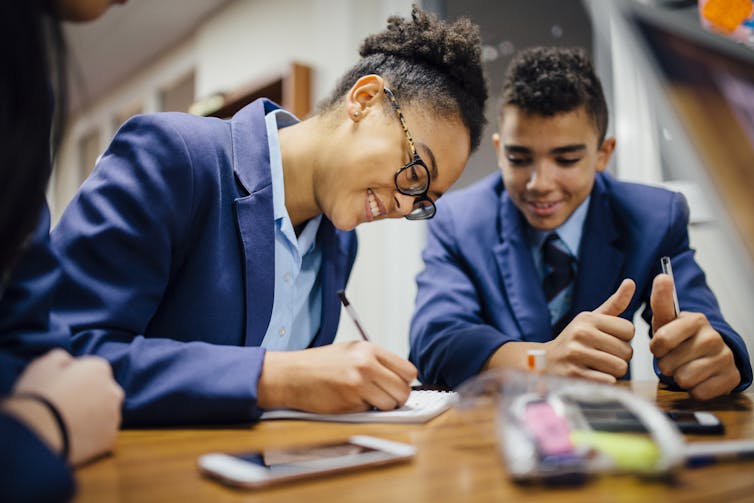 While some Victorian students are back at school, most are learning from home again.
Shutterstock
While some Victorian students are back at school, most are learning from home again.
Shutterstock
The temperature checks are designed to detect fever as an indicator of possible SARS-CoV-2 infection. But there are a couple of things we need to keep in mind when considering how useful temperature checks will be.
First, these types of thermometers won’t always reliably detect fever. And second, many children with COVID-19 won’t have a fever.
Sensitivity and specificity
A few key features are important when screening for disease. In the case of non-contact infrared thermometers, the “disease” we’re screening for is fever.
First, a tool should be able to correctly identify those with the disease (sensitivity). Second, a tool should correctly identify those without the disease (specificity). Third, a tool should have high probability that a person with a positive result does have the disease (positive predictive value, or PPV).
Testing of non-contact infrared thermometers has reported wide variation on each of these measures. One review found sensitivity ranged from 4%-89.6% and specificity from 75.4%-99.6%. Where one in 100 people had a fever, the PPV was between 3.55%-65.4%.
Non-contact infrared thermometers measure skin (peripheral) temperature without physical contact, which offers a convenient option for temperature checking large numbers of children.
But their readings can be affected by factors such as outdoor temperature, where on the body you aim the thermometer, and distance from the subject.
We also need to remember fever reducing medications, such as paracetamol, can lower a child’s temperature.
Combined, these factors indicate non-contact infrared thermometers may not be very reliable in detecting a fever (regardless of whether or not the fever is related to COVID-19).
Do children with COVID-19 have fever?
A review of studies found fever was the most common symptom in children and young people under 21 with COVID-19, recorded in 47% of cases. Other symptoms include cough (37%) and diarrhoea (4%).
Two reviews explored asymptomatic infection in children, reporting 14% and 19% of children had no symptoms at all.
This means fever screening may miss more than half of infected children in schools, as they could either have no symptoms, have symptoms that don’t include fever, or have fever not detected by the non-contact infrared thermometers.
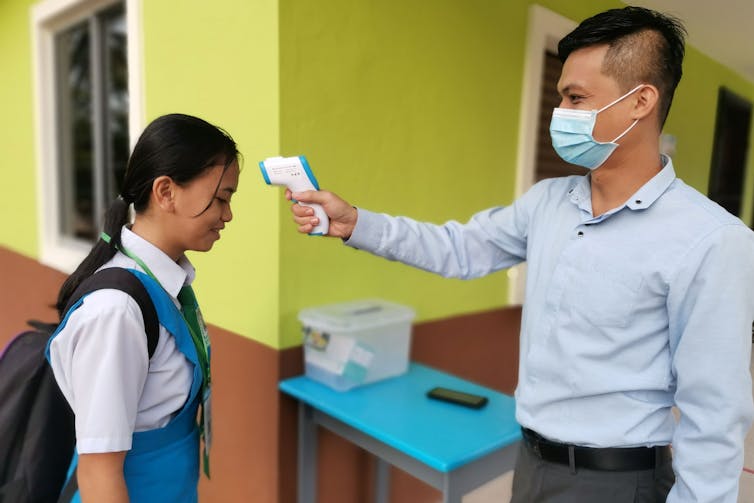 Schools in other countries are also checking students’ temperatures.
Shutterstock
Schools in other countries are also checking students’ temperatures.
Shutterstock
Do children transmit COVID-19 in schools?
Initial reports suggested children don’t transmit SARS-CoV-2 as much as adults, however evidence in this space is still evolving.
A NSW government report found no student-to-teacher transmission and very low student-to-student transmission.
Conversely, one of Victoria’s largest outbreaks to date occurred at a P-12 school; staff, students, and close contacts have tested positive. But it’s not yet clear how much transmission can be attributed to school activities as opposed to household and community transmission.
Read more: 8 tips on what to tell your kids about coronavirus
A recent study from South Korea found within the home, ten to 19-year-old children transmit the virus as much as adults, whereas children aged under ten transmit less than adults.
While this paper focused on household transmission, a recent study from Israel reported on an outbreak in a secondary school. It found overcrowded classrooms, lack of mask wearing and air conditioning use were likely to be contributing factors.
Schools around the world
Among countries that have now returned to school, Japan, South Korea, Taiwan and Vietnam have implemented fever screening.
France, Belgium, Germany and Israel have differing requirements for use of face masks among students and teachers.
The US Centers for Disease Control and Prevention (CDC) recommends parents check their child’s temperature before or upon arrival at school.
The use of non-contact infrared thermometers to identify children who could have COVID-19 may not be reliable.
But at the very least, this tool provides a visible important reminder to parents, staff and students of the risk of COVID-19, and for children to remain at home if they’re unwell.
Authors: Fiona Russell, Principal research fellow, University of Melbourne
Read more https://theconversation.com/will-school-temperature-checks-curb-the-spread-of-coronavirus-142999


















