

Humans see just 4.7km into the distance. So how can we truly understand what the bushfires destroyed?
- Written by Nanda Jarosz, PhD Candidate, University of Sydney
When the ashes from Australia’s last bushfire season cooled, we were left with a few mind-boggling numbers: 34 human lives lost, more than a billion animals dead, and 18.6 million hectares of land burned.
But those figures don’t necessarily help us understand what was lost. The human mind struggles to grasp very large scales. And in Australia, our colonial past skews the way we view landscapes today.
This disconnect is important. Many scientific concepts, including climate change, happen at scales outside human perception.
Understanding the scale of destruction wrought by bushfires is vital if governments and societies are to adapt in the future. So how can Australians truly come to terms with the damage wrought by last summer’s bushfires?
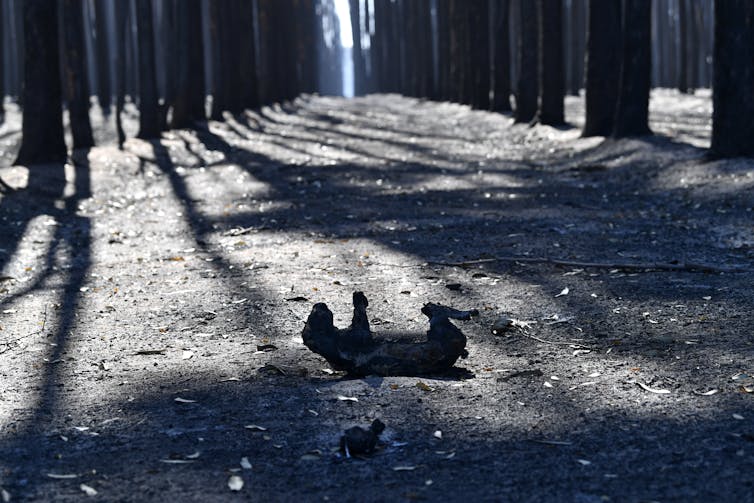 More than a billion animals died in last summer’s fires.
Daniel Mariuz/AAP
More than a billion animals died in last summer’s fires.
Daniel Mariuz/AAP
Beyond human perception
On average, humans can only see about 4.7 kilometres into the distance. So perceiving the true extent of the destruction bushfires requires using our imaginations.
This is not only true of bushfires. It also applies to human understanding of climate change, nanoseconds, the size of the Universe and the geological time scale (the millions of years over which continents, oceans and mountains formed).
But science has shown humans have trouble understanding, or imagining, large orders of magnitude. In one US study for example, university students struggled to understand the relative relationships between the age of the Earth, the time required for the origin of the first life forms, and the evolution of dinosaurs and humans.
Even university students studying STEM subjects (science, technology, engineering and mathematics) have been shown to struggle with identifying and comparing magnitudes at large scales.
So what’s actually going on in our brains here? Research suggests humans use both numerical and “categorical” information – concepts drawn from their prior experience – to estimate the size of an object. For example, a person estimating the width of a truck might set it as a proportion of the presumed width of highway lanes.
The use of this prior experience can improve the accuracy of estimations. But it can also introduce bias and lead to inexact estimations.
 Even university students studying STEM subjects struggled to comprehend large orders of magnitude.
Shutterstock
Even university students studying STEM subjects struggled to comprehend large orders of magnitude.
Shutterstock
Understanding vast landscapes
During the fires, satellite images and interactive maps sought to help us understand the scale of the crisis. But they can’t give a full picture of the life destroyed. So how might we otherwise understand the richness lost in a burnt landscape?
Unfortunately, our colonial views of the land are not much help here. British colonisation of Australia, and subsequent land laws, were established on the basis of “terra nullius” – meaning the land belonged to no one. This denied Indigenous people’s prior occupation of the land in order to legitimise its “lawful” settlement by Europeans.
Settlers tended to describe the Australian landscape as empty and unpopulated when, in fact, it was biologically [abundant] and peopled by Indigenous Australians.
Read more: Friday essay: this grandmother tree connects me to Country. I cried when I saw her burned
These colonial views have had lasting effects. It took more than 200 years before the terra nullius myth was formally dispelled by the 1992 Mabo decision.
Seeking to understand Indigenous perspectives of Country might help non-Indigenous Australians to truly comprehend the loss brought by bushfires. As Indigenous academic Bhiamie Williamson wrote on The Conversation in January:
the experience of Aboriginal peoples in the fire crisis engulfing much of Australia is vastly different to non-Indigenous peoples. How do you support people forever attached to a landscape after an inferno tears through their homelands: decimating native food sources, burning through ancient scarred trees and destroying ancestral and totemic plants and animals?
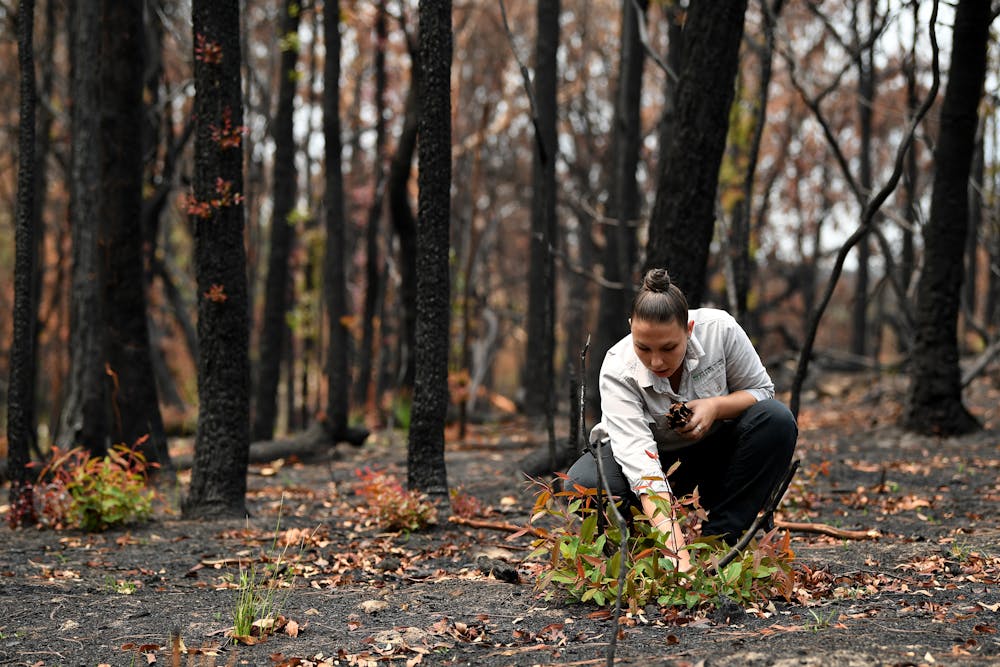 Considering Indigenous perspectives of Country might help comprehend bushfire loss.
AAP/Joel Carrett
Considering Indigenous perspectives of Country might help comprehend bushfire loss.
AAP/Joel Carrett
A human-centric view
Beyond the colonial influence, our generally human-centred view of the world also tends to render invisible the plants and wildlife within it. As Australian researcher Brendan Wintle and others noted in a recent paper, firefighting strategies routinely overlook the need to protect natural assets. They wrote:
It may be unrealistic to expect critical habitats of our most precarious species to compete for firefighting resources with houses and farms. We are far too self-interested. However, could we imagine the last remaining habitat for a brush-tailed rock-wallaby (Petrogale penicillata) might feature as an asset for protection in a fire that is burning through a wilderness area? Surely that needs doing.
In other words, gaining a better understanding the scale of a fire’s destruction means taking a more holistic view of what dwells in the landscape, and might need saving.
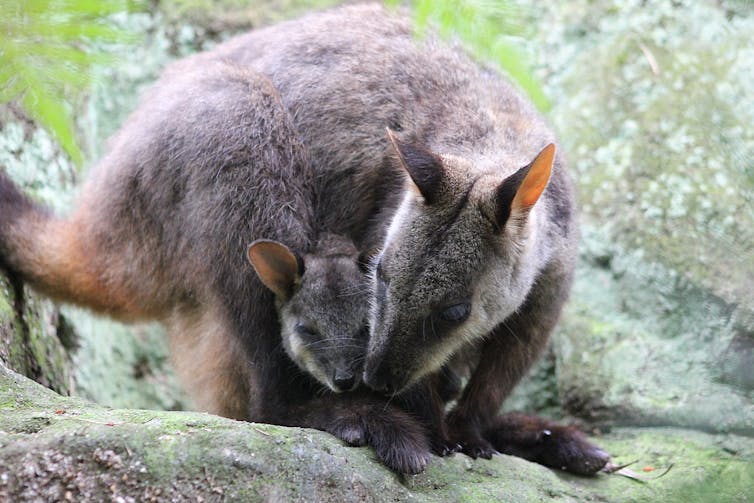 Rock wallaby habitat should be protected from fire.
Taronga Zoo
Rock wallaby habitat should be protected from fire.
Taronga Zoo
Future fires
Under climate change, bushfires in Australia will become more severe and frequent. So bearing in mind our limited abilities to perceive the potential scale of loss next time, what can we do to prepare?
As Wintle argues, more work is needed to organise conservation efforts before, during, and immediately after a bushfire. That includes establishing “insurance populations” of species and keeping them out of harm’s way, and better monitoring and surveying before a fire, so we know which places need protecting.
Williamson wrote of how most Indigenous Australians “have been consigned to the margins in managing our homelands”, watching on as they were “mismanaged and neglected”, which increased the bushfire risk.
Read more: Double trouble: this plucky little fish survived Black Summer, but there's worse to come
The current bushfire royal commission has pledged to consider ways Indigenous land and fire management practices could improve our resilience to natural disasters. There is much room for ancient traditions to be incorporated into mainstream fire management.
It will take some time to grasp the repercussions of the last bushfire season. But it’s clear that we must transcend colonial, non-Indigenous, human-centred perceptions of the land if we’re to truly understand what was lost.

Authors: Nanda Jarosz, PhD Candidate, University of Sydney

















