

'Far too many' Victorians are going to work while sick. Far too many have no choice
- Written by Julian Teicher, Professor of Human Resources and Employment and Deputy Dean (Research), School of Business and Law, CQUniversity Australia
There is nothing new about people turning up to work when they’re sick. During the 1918 Spanish Flu pandemic, many Melburnians had no option but to carry on working in defiance of public health advice, during an era before paid sick leave and with virtually no social safety net.
Today many employees are entitled to sick leave. And yet Victorian Premier Daniel Andrews this week complained that “far too many people” are going to work with COVID-19 symptoms, describing this as the “biggest driver” of the state’s persistently high rates of transmission.
Read more: Two weeks into Melbourne's lockdown, why aren't COVID-19 case numbers going down?
It’s easy to understand Andrews’ frustration. But while times have indeed changed for many employees since 1918, those in the casual and part-time workforce face the same stark choice – stay home or get paid – as their counterparts more than a century ago.
Casuals account for 25% of the Australian workforce, mainly in lower-paid jobs. This creates huge vulnerability, both in terms of these workers’ personal circumstances and in the public’s efforts to suppress COVID-19.
This pandemic has starkly revealed the consequences of casualisation in industries such as food distribution, meat processing, health care and private security. In April, a cluster of cases associated with the Cedar Meats abbatoir in Melbourne’s west was traced to casual workers employed by a Brisbane-based labour hire contractor.
Labour hire came under further scrutiny over the Victorian government’s decision to manage its hotel quarantine with the help of three private security firms, one of which subcontracted to other labour hire firms. One guard claims to have been hired via WhatsApp and said he received no training and was paid as little as A$18 per hour. Add to the mix alleged shortages of PPE and hand sanitiser, and the recipe for uncontrolled transmission begins to take shape.
Multiple jobs, no sick pay
The problem is compounded by the fact that many casual and part-time workers need more than one job to make ends meet. This means when they turn up to work despite being sick or waiting on test results, they are turning up sick to more than one workplace.
It gets worse still. Many people with more than one job work in the health sector, and particularly in aged care, where hourly wages are low. According to industry peak body Leading Age Services, 20-30% of the aged-care workforce have jobs in more than one facility.
Federal Aged Care Minister Richard Colbeck has pledged to help aged-care providers cover the costs of employees’ entitlements so they can work at just one facility. But the problem is an entrenched one.
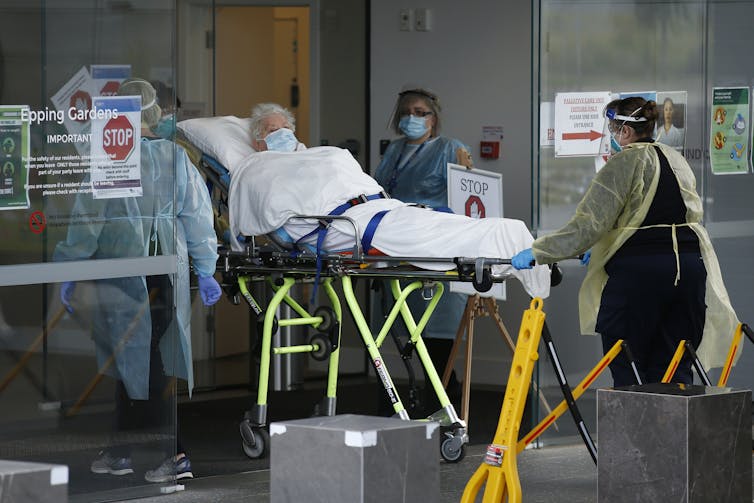 Melbourne’s aged-care homes have become a focal point in the COVID-19 crisis.
Daniel Pockett/AAP Image
Melbourne’s aged-care homes have become a focal point in the COVID-19 crisis.
Daniel Pockett/AAP Image
What help is available?
The Andrews government has offered various forms of assistance to encourage workers to stay home if unwell or being tested for COVID-19. But there are some exclusions.
Workers can claim a one-off payment of A$1,500 if unable to work during isolation, and a A$300 payment to cover isolation while awaiting COVID-19 test results, but only if they don’t already receive any other benefits or income and have already exhausted any paid leave entitlements. As the aged-care workforce is predominantly low-paid, an estimated 16% are already on some form of benefit and will likely miss out.
In April, the Fair Work Commission updated the terms of many industry awards to specifically include annual leave or unpaid leave for COVID-19-related absences. Yet this ruling did not cover casual workers or the 40% of workers on enterprise agreements, and unpaid leave would be an unpalatable option for those who have already used up their paid entitlement.
This week the Commission ordered paid COVID-19 leave in three health and aged-care awards to cover both ongoing and casual workers, although some employers have complained the measure will be difficult and costly to implement.
Read more: View from The Hill: Aged care crisis reflects poor preparation and a broken system
Workforce casualisation is part of a wider move towards increasing “labour flexibility”. This is touted as a way for workers to enjoy more control over their lives, but in practice it allows employers to offer lower-paid, less secure jobs while freeing themselves of obligation to their employees and in some cases even receiving government subsidies into the bargain.
A classic example is private aged-care homes, which are staffed via layers of labour hire agencies, have received a federal government cash injection to help them deal with COVID-19, and are not bound by the same staffing conditions enforced in Victoria’s public aged-care facilities.
These facilities are in a full-blown public health crisis, accounting for a worrying proportion of Victoria’s COVID-19 cases. Yet their owners have argued that the government and even the elderly residents themselves should fund their workers’ pandemic leave.
It is a profound irony, given how “flexible” work practices have worsened the spread of COVID-19, that Prime Minister Scott Morrison and Treasurer Josh Frydenberg are now calling for even more labour market flexibility as part of the process of economic recovery from the pandemic.
Authors: Julian Teicher, Professor of Human Resources and Employment and Deputy Dean (Research), School of Business and Law, CQUniversity Australia

















