

New Zealand wants to build a 100% renewable electricity grid, but massive infrastructure is not the best option
- Written by: Janet Stephenson, Associate Professor and Director, Centre for Sustainability, University of Otago
A proposed multibillion-dollar project to build a pumped hydro storage plant could make New Zealand’s electricity grid 100% renewable, but expensive new infrastructure may not be the best way to achieve this.
New Zealand’s electricity generation is already around 80% renewable, with just over half of that provided by hydro power. The government is now putting NZ$30 million towards investigating pumped hydro storage, which uses cheap electricity to pump river or lake water into an artificial reservoir so that it can be released to generate electricity when needed, especially during dry years when hydro lakes are low.
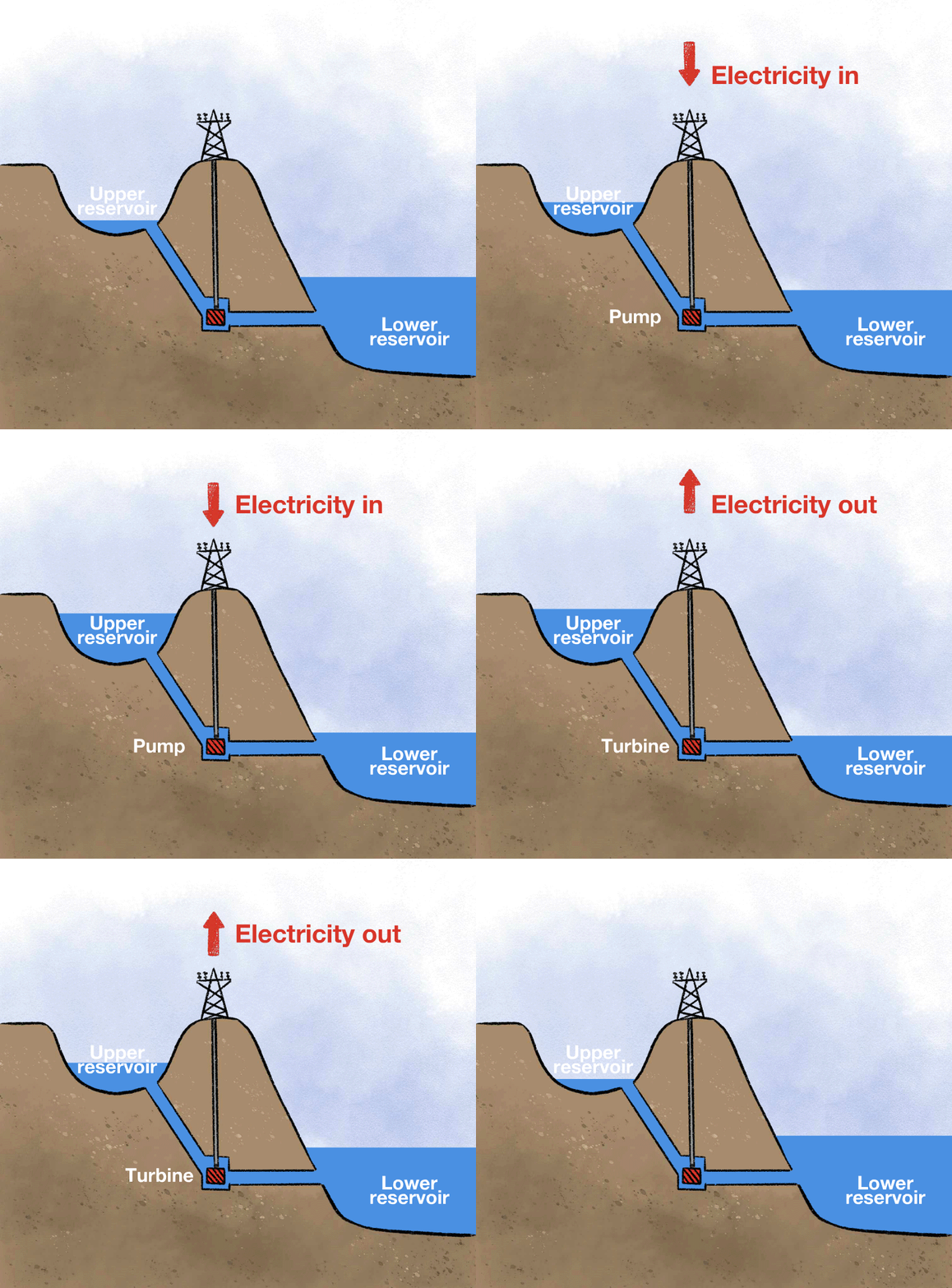
The response to the announcement was mostly enthusiastic - not least because of the potential for local jobs. But whether it is the best solution needs careful evaluation.
There are many realisable changes to electricity demand, and New Zealand should consider other, potentially cheaper options that deliver more efficient use of electricity.
Read more: Five gifs that explain how pumped hydro actually works
Promise of a purely renewable grid
Electricity is mooted to play a major role in achieving New Zealand’s target of net zero carbon emissions by 2050. To support the government’s plan to accelerate the electrification of the transport and industrial heating sectors, generation will need to grow by around 70% by 2050, all from renewable sources.
Worldwide, pumped hydro energy storage is seen as a promising option to support cheap and secure 100% renewable electricity grids.
New Zealand’s analysis will mainly focus on one particular lake, Lake Onslow. If it stacks up, it would be the biggest infrastructure project since the “think big” era of the 1980s. But at an estimated NZ$4 billion, the cost would also be massive and the project would likely face opposition on ecological grounds.
Such a scheme would be a step towards the government’s target of 100% renewable electricity generation by 2035 and fit with the overall goal of New Zealand achieving net zero carbon emissions by 2050. It would also solve the problem conventional hydropower plants face during dry years, when water storage runs low and fossil-fuelled power stations have to kick in to fill the gap.
But the possible closure of the Tiwai Point aluminium smelter would free up around 13% of renewable electricity supply for flexible use. This alone raises the question whether a pumped storage development on this scale is necessary.
Read more: NSW has approved Snowy 2.0. Here are six reasons why that's a bad move
Changing supply and demand
Getting to 100% renewables and achieving a 70% increase in supply in the next 30 years will mainly come from new wind and solar generation (both now the cheapest options for electricity generation) as well as some new geothermal. Major new hydro dams are unlikely because of their significant environmental impacts.
As a result, electricity supplies will become increasingly variable, dependent on the vagaries of sun, wind and river flows. This creates a growing challenge for matching supply with demand, especially if hydro lakes are low.
Last year, the Interim Climate Change Commission concluded New Zealand could get to 93% renewable generation by 2035 under current market conditions. But it warned the final few per cent would require significant overbuilding of renewable generation that would rarely be used.
It suggested the most cost-effective solution would be to retain some fossil-fuelled generation as a backup for the few occasions when demand overshoots supply. At the same time it recommended a detailed investigation into pumped storage as a potential solution for dry years.
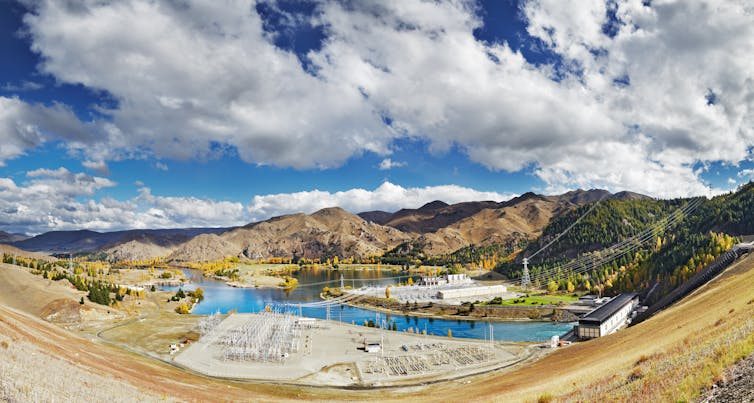 New Zealand already has more than 100 conventional hydropower stations supplying renewable electricity.
Dmitry Pichugin/Shutterstock
New Zealand already has more than 100 conventional hydropower stations supplying renewable electricity.
Dmitry Pichugin/Shutterstock
Electricity demand — the collective consumption of all businesses, organisations and households — is also changing.
Households and businesses are switching to electric vehicles. Farm irrigation is becoming widespread and creates new demand peaks in rural areas. Heat pumps are increasingly used for both heating and cooling. These all create new patterns of demand.
And households aren’t just consuming power. More and more people are installing solar generation and feeding surplus back into the grid or storage batteries. Local community energy initiatives are starting to emerge.
New markets are developing where businesses can be paid to temporarily reduce their demand at times when supply is not keeping up. It is only a matter of time before such demand response mechanisms become commonplace for households, too. In the near future, housing collectives could become virtual power plants, and electric vehicles could feed into the grid when supply is stressed.
Cheaper options with added health benefits
So with more reliance on sun, wind and water, electricity supply will become more variable. At the same time, patterns of demand will become more complex, but will have more potential to be adjusted quickly to match supply, on time scales of minutes, hours or days.
The big problem lies with winter peaks when demand is at its highest, and dry years when supply is at its lowest – especially when these coincide. At these times the potential mismatch between demand and supply can last for weeks.
The current solutions being mooted are to increase the security of supply, either with fossil-powered generation or pumped hydro storage. But there are options on the demand side New Zealand should consider.
New Zealand houses are typically cold because they are poorly insulated and waste a lot of heat. Despite relatively new insulation standards for new houses and subsidies for retrofitting older houses, our standards fall well below most developed countries.
Read more: Labour's low-carbon 'warm homes for all' could revolutionise social housing – experts
We can take inspiration from Europe where new buildings and retrofits are required to meet near-zero energy building standards. By investing in upgrading the national housing stock to something closer to European standards, we could achieve a significant drop in peak demand as well as additional benefits of lower household heating costs and better health.
Efficient lighting is another under-explored solution, with recent research suggesting a gradual uptake of energy-efficient lighting could reduce the winter evening peak demand (6pm to 8pm) by at least 9% by 2029, with the bonus of lower power bills for households.
Such solutions to the supply-demand mismatch could be much cheaper than a single think-big project, and they come with added benefits for health. Alongside the NZ$30 million being put into investigating pumped hydro storage, I suggest it is time to develop a business case for demand-side solutions.
Authors: Janet Stephenson, Associate Professor and Director, Centre for Sustainability, University of Otago


















