

In both schooling and sport, Australia has slowly come to recognise its Aboriginal talent pool
- Written by: Colin Tatz, ANU Visiting Professor, Politics and International Relations, Australian National University
The year was 1979, not 1879, when Fr Eugene Perez, a Catholic priest in the Kimberleys, asserted that “his” Aborigines “correspond to the Palaeolithic age”, “primitives who remain dwarfed to the bare essentials of human existence”, “undeniably immature” as members of “a decomposed society”.
A decade earlier, my book, Aborigines and Education, had analysed Aboriginal schooling opportunities and progress: there were nine Aboriginal people at university in 1969. By 2014, between 30,000 and 35,000 had a degree.
Sport, too, has changed entirely. Before the 1960s, no Aboriginal or Torres Strait Islander person made it into the Commonwealth or the Olympic Games. Between 1962 and now, 31 Aboriginal athletes have represented Australia in the Commonwealth Games and 68 in the Olympics (and Paralympics).
Read more: In Harley Windsor, Australia has its first Indigenous Winter Olympian – why has it taken so long?
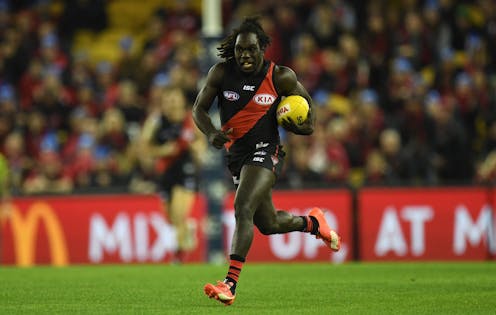
In Australian football, no more than six Aboriginal players appeared in the first 80 years of that game. Today, we know of 276 players who have made it in senior football.
In AFL and rugby league, just on 3% of Australia’s population comprises at least 10%, and generally 12%, of senior footballers. In a Gold Coast-South Sydney rugby league match in 2016, 12 of the 26 players on the field were Aboriginal.
So what have been the propellants, the dynamics of change? The whispering in our hearts, white largesse, fundamental shifts in Australian racial attitudes, Closing the Gap strategies, nicer missionaries than Perez?
Giving Aboriginal athletes a chance
Opportunity rather than affirmative action is one answer.
Opportunity often means chance — and some luck. Thus, a purely Spanish-speaking Benedictine monk, Dom Rosendo Salvado, introduced cricket to the people from the New Norcia Aboriginal Mission he described as “these poor natives, so hideous to look at”. He thought it would “civilise” them.
Daisy Bates, an early anthropologist, wrote about the hundreds of spectators who flocked to see the players from New Norcia Mission in Western Australia at the start of the 19th century. Nicknamed “The Invincibles”, coached only by a local grazier, H S Lefroy, the team walked 120 kilometres each way for matches in Perth and Fremantle.
In the Depression, and certainly by 1944, Aboriginal men in New South Wales resisted being shifted to country towns as indentured and unpaid apprentices. They also fought the policy of “assimilation” that sought to break up Aboriginal clusters. They created the Redfern All-Blacks rugby league team as a fulcrum of identity, a way to claim space and place in the social mainstream.
The rest, as the saying goes, is history.
In the 1950s, the armed services recruited Tiwi Islanders to work in Darwin. Sexy uniforms notwithstanding, the Tiwi men were servants.
The Catholic bishop was anxious about their undue seduction by the pale glitter of 1950s Darwin, and sought help from a patrol officer, Ted Egan, a flock member. He duly founded the St Mary’s Australian football team, subsequent winner of dozens of Northern Territory premierships, and the nursery of football clans like the Burgoynes, the Riolis and the Longs.
A worthier priest than Perez, Dave Perrett in Armidale, helped found the all-Aboriginal Narwan rugby league team in the 1970s. This was despite howls from the townspeople and the academics who insisted such a team was redolent of South African apartheid and was unconscionable.
Narwan won several major competitions, and did more for race relations than any other single activity.
On occasion, a rare mission teacher has inspired a cohort of youth to pursue education, as at the mission station once known as Roper River (now Ngukurr) in the NT.
Early on, at several missions, at least one youngster was sent south to a leading private school — to return as a role model. The schemes didn’t work out well, for anyone. But later, in the 1990s, smarter heads brought small groups south, housing them together and counselling them with sensitivity and cushioning not so much the cultural change but the shock of geographic dislocation.
Aboriginal nostalgia for home and country is a vital force, and often defeats the best-intentioned programs.
Read more: The land we play on: equality doesn’t mean justice
The results are there
Private sponsors and religious groups began to accommodate to Aboriginal realities, and programs started to work.
The Gamararda scholarships program at UNSW’s Shalom Institute has led to 18 Aboriginal medical graduates. Special university centres, like Shalom and the Monash Indigenous Centre, have shown just how accommodating (and “unassimilating”) one can be.
Most of these successes have come about by hard-won trial and error – lots of error – but in the end the results are there. In both schooling and sport, we have slowly come to recognise the talent pool.
There is, however, a wrinkle. Back in the 1960s, I wrote seemingly endless pieces about sport being a better pathway for Aboriginal youth than education. That remains true: where else but on the sports field can an under-educated and even a troubled youth pit their skills against opponents, get paid enormous sums, manage their own brand names, have entourages, achieve celebrity status and social mobility – and get to publish memoirs before reaching the age of 30?
But what happens to life after sport is another story.
Colin Tatz and Paul Tatz’s new book, Black Pearls: The Aboriginal and Islander Sports Hall of Fame, published by Aboriginal Studies Press, will be available in May.
Authors: Colin Tatz, ANU Visiting Professor, Politics and International Relations, Australian National University


















