

here's why Melbourne's new business restrictions will reduce cases
- Written by Philip Russo, Associate Professor, Director Cabrini Monash University Department of Nursing Research, Monash University
Victorian Premier Daniel Andrews has announced sweeping changes to businesses across metropolitan Melbourne, including closure of retail stores and restrictions on some industries, including construction. The new constraints come into force from midnight on Wednesday night.
They come after metropolitan Melbourne moved to stage 4 restrictions on Sunday, with a nightly curfew and stricter limits on residents’ movement.
Read more: State of disaster called as Melbourne moves to nightly curfew and stage 4 restrictions
Andrews said maintaining stage 3 restrictions would mean new daily cases plateau at 400-500 indefinitely, so the aim of these new stronger restrictions is to drive daily numbers down. Given the apparently widespread transmission of the virus at workplaces, the hope is that restrictions on business will help improve the situation.
We also expect to see the effects of mandatory mask-wearing alongside other measures, to become evident in the case numbers over the coming week, and further reduced numbers from the latest round of lockdown restrictions to become apparent in two weeks’s time. But this will only happen if we stick to the rules.
What are the new restrictions?
Monday’s restrictions relate to businesses, and will be in place for at least six weeks. The Victorian government has grouped businesses into three categories:
those that can continue full operations on-site, while maintaining COVID-safe practices. This group includes supermarkets, grocers, butchers, bottle shops, post offices, pharmacies, fuel stations and facilities involved in the frontline pandemic response
others that have to operate under new restrictions. This group includes meat processing and construction sites, which will have to observe new limits on staffing levels
some that will cease all on-site activity and move to home or drive-through delivery where possible. This includes non-essential retailers and restaurants.
Andrews assured Melburnians that the continued operation of supermarkets and grocers means there is “no need to be buying months’ worth of groceries”. Melburnians can also take heart in the fact takeaway coffee is still allowed.
Construction and meatworks can continue but will look very different. Major government infrastructure projects, such as level crossing removals, will continue but with around 50% fewer on-site personnel. Large commercial buildings above three storeys need to reduce to the “practical minumum”, operating at no more than 25% staff capacity. Residential building sites can have no more than five people working on-site at any time.
Abbatoir workers will be required to wear full personal protective equipment, including masks, face shields, gloves and gowns. They will also have their temperatures checked and will be regularly tested for COVID-19. Meat processing facilities will reduce to two-thirds operating capacity. The rules to abattoirs apply statewide, not just in metropolitan Melbourne – a move Andrews said was essential to prevent the industry’s problems with COVID-19 spreading to regional areas.
The retail sector will have to close storefronts. However, these businesses can continue to provide “click-and-collect”, takeaway or delivery services where possible, all of which minimise interactions between people.
Hairdressers, education, elective surgery, brothels and strip clubs, legal services, advertising, and food courts will all be required to cease on-site operations.
Andrews has flagged a “permit system” under which certain workers can be granted permission to travel more than 5km from their homes, and to breach curfew. More details will be provided on this later in the week.
Why are the new measures important?
The most common method of spread is through close contact, and a lot of transmission of the coronavirus has been occurring in workplaces. This is because, ultimately, workplaces bring people together. Even masks won’t stop the spread if people come very close together.
The new restrictions will reduce the movement of people, reducing the frequency of contact and the contact time between them. They will reduce the risk of transmission in key industries that have had clusters in the past, such as the Cedar Meats outbreak.
Melbourne needs to see hundreds of thousands fewer interaction between people every day to bring case numbers down from their current levels.
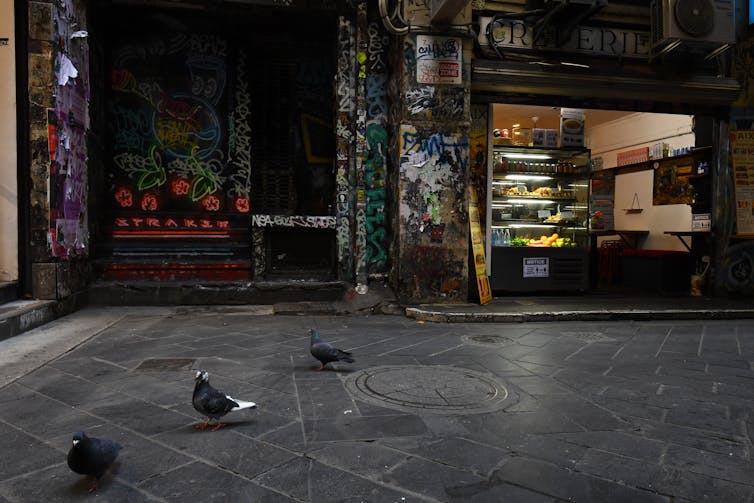 Don’t worry, Melbourne. Takeaway coffee is still allowed under the latest restrictions — as long as it’s within 5km of your home.
James Ross/AAP
Don’t worry, Melbourne. Takeaway coffee is still allowed under the latest restrictions — as long as it’s within 5km of your home.
James Ross/AAP
But the central messages remain
The new measures are welcome, in epidemiological terms at least, and are likely to reduce the spread of the virus. And despite the new strictures, the underlying message remains the same: staying at home, and limiting your interactions with other people as much as possible, is crucial to slowing transmission.
Even when we need to leave the house for one of the accepted reasons, physical distancing still remains the most effective preventative intervention.
These new restrictions will not work unless we follow them.
When will we see change?
Every morning, Melburnians wake up and look at the new daily numbers — often with despair. Over the past few weeks, since the start of stage 3 restrictions, new cases have plateaued at around 400-500 every day, but are not decreasing.
As Victoria’s Chief Health Officer Brett Sutton pointed out today, stage 3 restrictions have prevented cases spiralling out of control, but have not reduced numbers as much as we would like.
The latest restrictions will apply for six weeks, but there will be a daily review of the data by health authorities. The restrictions could be modified or extended if there are any hiccups along the way.
We expect to see the effects from the latest round of lockdown restrictions to become apparent in roughly two weeks’ time.
Read more: Which mask works best? We filmed people coughing and sneezing to find out
This article is supported by the Judith Neilson Institute for Journalism and Ideas.
Authors: Philip Russo, Associate Professor, Director Cabrini Monash University Department of Nursing Research, Monash University

















