

why health-care workers in Australia are inadequately protected against coronavirus
- Written by Alicia Dennis, Associate Professor MBBS, PhD, MPH, PGDipEcho, FANZCA, University of Melbourne
In Victoria, more than 1,100 health-care workers have now been infected with SARS-CoV-2, the coronavirus that causes COVID-19. Some 11% of active cases are workers in the health-care sector.
Health-care workers are reported to be among those fighting for life in Victorian intensive care units.
While we don’t know what proportion of the Victorian health-care workers currently infected with COVID-19 acquired it at work rather than in the community, it’s almost certain a portion of these infections were contracted in the workplace.
Early experience from China found the proportion of health-care workers who contract COVID-19 can be up to 29% in settings with inadequate personal protective equipment, or PPE.
Lessons from China also show workplace transmission of SARS-CoV-2 can be reduced to negligible numbers with sufficient supply, and correct use of, airborne precaution PPE.
Right now, Australia is sitting somewhere in the middle. National guidance needs to be urgently updated to reflect safest practice and acknowledge what we’re learning about the airborne spread of the virus.
What is PPE?
PPE is a crucial part of controlling exposure to hazards in all workplaces.
It includes items such as masks, respirators, face shields, gowns and gloves.
PPE is categorised into three tiers, corresponding to the type of hazard.
Level 1: standard and contact precaution PPE
This PPE limits exposure to standard contact hazards. Examples include face coverings and administrative controls such as hand hygiene, cough etiquette and physical distancing.
Level 2: droplet precaution PPE
This PPE prevents exposure to contact and droplet hazards. Examples include surgical masks, eye shields or goggles, long-sleeved gowns, and gloves.
Level 3: airborne precaution PPE
This PPE aims to prevent exposure to contact, droplet and airborne hazards. It includes N95/P2 respirators or powered air-purifying respirators with a P2 filter, eye shields or goggles, fluid-resistant gowns, double gloves, disposable head and neck wear, and protective footwear.
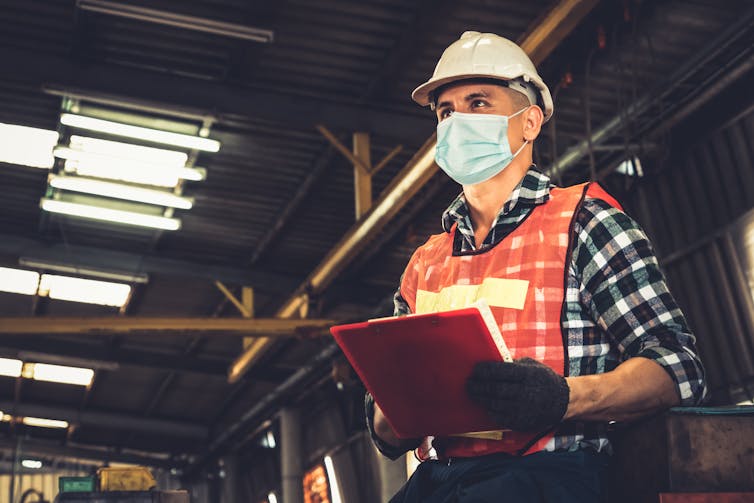 We’ve heard a lot about PPE in the context of coronavirus. But PPE isn’t just for health-care settings.
Shutterstock
We’ve heard a lot about PPE in the context of coronavirus. But PPE isn’t just for health-care settings.
Shutterstock
Current Australian guidelines
The national guidance on the use of PPE in hospitals during the COVID-19 outbreak has been written by the Infection Control Expert Group and endorsed by the Australian Health Protection Principal Committee.
The guidance doesn’t recommend universal airborne precaution PPE for health-care workers dealing with patients suspected or confirmed to have COVID-19. It only recommends level 3 protection for highly specialised procedures such as intubating a patient.
Read more: Is the airborne route a major source of coronavirus transmission?
A preprint in the Medical Journal of Australia has criticised the current guidance, noting it’s not aligned with increasing scientific evidence regarding airborne transmission of SARS-CoV-2 and is therefore inadequate to protect health-care workers.
Inadequate national guidance has led to an inconsistent and non-standardised approach to airborne precaution PPE across all health-care settings.
In the absence of strong national safety guidance, some hospitals and jurisdictions are making independent improved safety recommendations to their staff.
Why we need level 3
Transmission of SARS-CoV-2 occurs by direct contact with droplets and contaminated surfaces — but emerging data suggests it can also be spread by the airborne route.
An analysis of health-care worker deaths in the United Kingdom found none among wearers of level 3 PPE, suggesting airborne precaution PPE was protective.
 Surgical masks don’t offer as much protection against COVID-19 as respirator masks.
Shutterstock
Surgical masks don’t offer as much protection against COVID-19 as respirator masks.
Shutterstock
Importantly, surgical masks are primarily designed to protect the environment from the wearer. They’re not designed to protect the wearer from respiratory pathogens.
A recent review found N95 respirators offered significantly better protection against viruses including COVID-19 than surgical face masks, while one study found N95 respirators provided 8-12 times more protection than surgical masks against small viral particles.
Read more: Rising coronavirus cases among Victorian health workers could threaten our pandemic response
In Australia, N95 is synonymous with P2 respiratory protection and refers to the filtration efficiency (so N95 means 95% of particles are filtered). But it’s the total inward leakage — what goes through and around the facemask — that’s the critical factor in determining the level of protection the wearer achieves.
To ensure total inward leakage is minimised, respiratory masks used under level 3 PPE must meet certain standards, including fit testing and the training of wearers in their use.
We need immediate action
SARS-CoV-2 is a highly contagious virus with the potential to cause significant ill health and death. In health-care settings, it should be classified as a lethal biohazard and managed accordingly.
The safest approach is to consider all people with confirmed or suspected COVID-19 in hospital, being transported to hospital or being tested for COVID-19 as being able to spread the virus via the airborne route. As such, the use of airborne precaution PPE with a correctly fitted N95/P2 respirator is essential.
Read more: Health-care workers share our trauma during the coronavirus pandemic – on top of their own
There’s also an urgent need for a national registry of health-care worker infections, containing data about the category of health-care worker, where the infection was acquired, severity of disease, hospitalisation, intensive care and death numbers.
This will give us a better understanding of the scope and specifics of the problem, and inform policy and prevention strategies.
Finally, adequate supply of airborne precaution PPE must be available throughout Australia to protect health-care workers from COVID-19.
Authors: Alicia Dennis, Associate Professor MBBS, PhD, MPH, PGDipEcho, FANZCA, University of Melbourne

















