

Beirut explosion yet another heartbreak for a country already on the brink
- Written by Tony Walker, Adjunct Professor, School of Communications, La Trobe University
Lebanon did not need one of the world’s most horrific accidental detonations to remind people it is a state teetering on the edge of collapse.
However, the destructive power of 2,750 metric tonnes of ammonium nitrate ignited in Beirut’s port, killing 135 people and injuring 5,000 more so far, has amplified the parlous state in which Lebanon finds itself.
Read more: Beirut explosion: the disaster was exceptional but events leading up to it were not – researchers
Lebanon might not meet the accepted definition of a failed state because it retains the trappings of a central government. But an administration corrupted by a patronage system based on the country’s confessional groupings has long failed to deliver basic services to a population of 6.8 million.
Power shortages are a fact of daily life, inflation is rampant, the Lebanese pound has collapsed, unemployment has gone through the roof, crime has sky-rocketed, and food shortages are endemic.
If not a failed state, Lebanon is a failing one.
And it has been failing for a long time.
In essence, Lebanon’s problems are structural and therefore not capable of simple, or even rational, solutions.
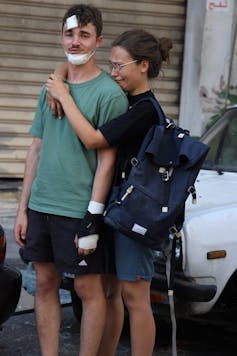 A young couple caught up in the explosion in Beirut.
Ibrahim Dirani/Dar al Mussawir/EPA/AAP
A young couple caught up in the explosion in Beirut.
Ibrahim Dirani/Dar al Mussawir/EPA/AAP
The problems go back to the French mandate-era constitution of 1926, which sought to divide power between the country’s Christians and Muslims.
Under these arrangements, refined over the years, the president would be a Maronite Christian, the prime minister a Sunni Muslim, and the speaker of the National Assembly, or parliament, a Shia Muslim.
Cabinet’s composition would reflect these main confessional strands. So would positions in the military, security apparatus, judiciary and bureaucracy.
Needless to say, haggling over the distribution of the spoils of office has contributed to one of the most corrupt countries on the planet.
According to Transparency International’s Corruption Perception Index, Lebanon ranks 137 out of 180 globally.
Lebanon’s wealth, such as it is, has been looted over the years by officeholders and their cronies to the point where the country is effectively bankrupt.
All this has taken place against the background of a civil war throughout the 1970s and 1980s, and two Israeli invasions, one in 1982, the other in 2006.
Then there is the increasing and disruptive influence of the Iranian-backed Hezbollah, now the dominant political force in the country. Hezbollah’s growing power is one of the reasons Lebanon’s fragile power-sharing arrangements have come under increasing stress.
At the same time, Lebanon has been inundated by Syrians displaced by their homeland’s civil war.
Relative to its population, Lebanon has absorbed more refugees than any other country in the world. They account for 30% of Lebanon’s population.
These pressures have pushed the Lebanese administration close to breaking point.
In that context, the port ammonium nitrate explosion could hardly have come at a worse moment for an embattled government. It has been engaged in months of testy negotiations with the International Monetary Fund on a bailout plan.
IMF negotiators have been frustrated by their inability to get Lebanese counterparts to sign on to an emergency relief scheme to enable Lebanon to keep functioning.
Among the sticking points has been agreement on what money has been lost or otherwise misappropriated.
“It has been really difficult. The core of the issue is whether there can be unity of purpose in the country,” the IMF’s managing director, Kristalina Georgieva, told reporters after talks had stalled.
This is an understatement.
Lebanese have been taking to the streets to protest against government corruption and incompetence. Those protests will now be fuelled by greater levels of outrage over the mismanagement by port authorities of highly combustible material that arrived on a Russian ship bound for Madagascar in 2013.
That ship did not continue the voyage. Its cargo was offloaded and placed in a warehouse. Higher authorities ignored repeated warnings from customs officials about the risks of continuing to store the ammonium nitrate.
Tragically, this episode pretty much sums up Lebanon’s central problem: lack of accountability due to a fractured and fragmented administration.
Read more: Trouble in the Gulf as US-Iran dispute threatens to escalate into serious conflict
Action is already being taken against officials deemed immediately responsible for overseeing security in the Beirut port. But this is unlikely to assuage anger among the general population over what has taken place.
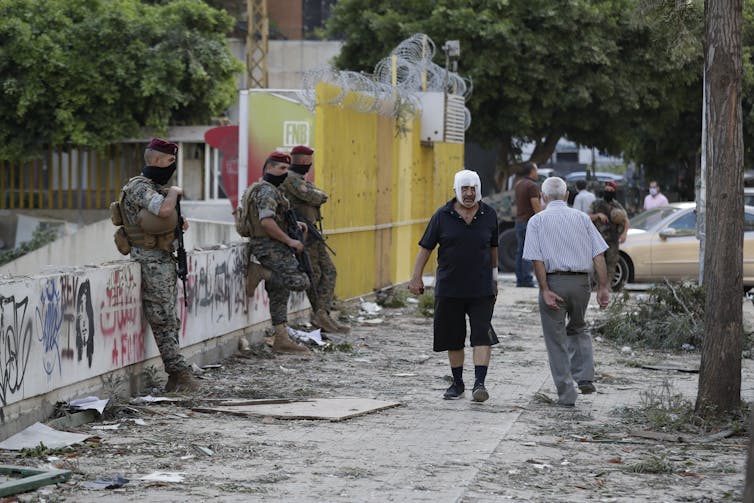 Lebanon was already on tenterhooks before the explosion.
Hassan Ammar/AP/AAP
Lebanon was already on tenterhooks before the explosion.
Hassan Ammar/AP/AAP
In the days before the explosion, and separate from it, Lebanon was already on tenterhooks in anticipation of a UN-backed court verdict in the trial of four members of Hezbollah accused of assassinating former prime minister Rafik Hariri.
Hariri, who spearheaded Lebanon’s reconstruction after its civil war, was killed in Beirut in 2005 by a massive truck bomb.
UN investigations based on phone records identified four alleged culprits, none of whom have been seen in public for years.
Hezbollah has questioned the validity of the UN’s inquiries.
The verdict was due on February 7. It has now been put off to August 18.
If the UN court finds the accused guilty it will add to sectarian tensions.
Questions have been asked in the past about whether Lebanon can survive as a confessional state based on archaic power-sharing arrangements. Those questions may resurface.
In the meantime, the country’s strategic significance, abutting Israel in the south and Syria to its east and north, means it is not in the interests of the wider Arab world, nor the West, to allow it to implode.
The outlook for Lebanon, whose main city was once known as the Paris of the East, is bleak.
Authors: Tony Walker, Adjunct Professor, School of Communications, La Trobe University

















