

Plants use advertising-like strategies to attract bees with colour and scent
- Written by: Aphrodite Kantsa, Postdoctoral Researcher, University of the Aegean
Watching plants and pollinators such as bees can teach us a lot about how complex networks work in nature.
There are thousands of species of bees around the world, and they all share a common visual system: their eyes are sensitive to ultraviolet, blue and green wavelengths of the light spectrum.
This ancient colour visual system predates the evolution of flowers, and so flowers from around the world have typically evolved colourful blooms that are easily seen by bees.
For example, flowers as perceived by ultraviolet-sensitive visual systems look completely different than what humans can see.
However, we know that flowers also produce a variety of complex, captivating scents. So in complex natural environments, what signal should best enable a bee to find flowers: colour or scent?
Our latest research uncovered a surprising outcome. It seems that rather that trying to out-compete each other in colour and scent for bee attention, flowers may work together to attract pollinators en masse. It’s the sort of approach that also works in the world of advertising.
Read more: Want a better camera? Just copy bees and their extra light-sensing eyes
Daunting amount of field work
Classic thinking would suggest that flowers of a particular species should have reasonably unique flower signatures. It makes sense that this should promote the capacity of a bee to constantly find the same rewarding species of flower, promoting efficient transfer of pollen.
So a competition view of flower evolution for different flower species with the same colour – for example purple – would suggest that each flowering plant species should benefit from having different scents to enable pollinator constancy and flower fidelity. By the same logic, flowers with the same scents should have different colours so they’re easily distinguished.
To know for sure what happens requires a daunting amount of field work. The challenges include measuring flower colours using a spectrophotometer (a very sensitive instrument that detects subtle colour differences) and also capturing live flower scent emissions with special pumps and chemical traps.
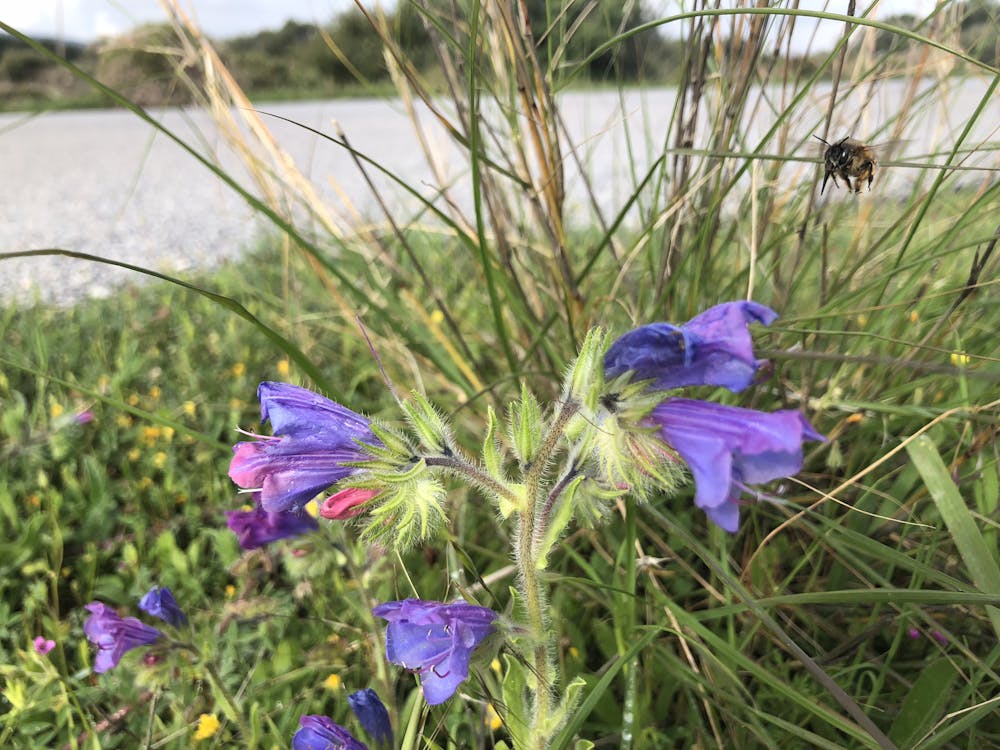 A wild bee of the genus Anthophora upon making the decision to visit the flowers of purple viper’s bugloss, in a Mediterranean scrubland in Greece.
Aphrodite Kantsa.
A wild bee of the genus Anthophora upon making the decision to visit the flowers of purple viper’s bugloss, in a Mediterranean scrubland in Greece.
Aphrodite Kantsa.
At the same time, in order to record the actual pollinator “clientele” of the flowers, detailed recordings of visits are required. These data are then built into models for bee perception. Statistical analyses allow us to understand the complex interactions that are present in a real world evolved system.
Not what we thought
And what we found was unexpected. In two new papers, published in Nature Ecology & Evolution and in Nature Communications, we found the opposite to competition happens: flowers have evolved signals that work together to facilitate visits by bees.
So flowers of different, completely unrelated species might “smell like purple”, whilst red coloured species share another scent. This is not what is expected at all by competition, so why in a highly evolved classical signal receiver has this happened?
The data suggests that flowers do better by attracting more pollinators to a set of reliable signals, rather than trying to use unique signals to maximise individual species.
By having reliable multimodal signals that act in concert to allow for easy finding of rewarding flowers, even of different species, more pollinators must be facilitated to transfer pollen between flowers of the same species.
Read more: Which square is bigger? Honeybees see visual illusions like humans do
Lessons for advertising
A lot of research on advertising and marketing is concerned with consumer behaviour: how we make choices. What drives our decision-making when foraging in a complex environment?
While a lot of modern marketing emphasises product differentiation and competition to promote sales, our new research suggests that nature can favour facilitation. It appears that by sharing desirable characteristics, a system can be more efficient.
This facilitation mechanism is sometimes favoured by industry bodies, for example Australian avocados and Australian honey. En masse promotion of the desirable characteristics of similar products can grow supporter base and build sales. Our research suggests evolution has favoured this solution, which may hold important lessons for other complex market based systems.
A successful colour–scent combination targeted at attracting bees can be adopted by several different plant species in the same community, implying that natural ecosystems can function as a “buyers markets”.
Read more: Curious Kids: Do bees ever accidentally sting other bees?
We also know from research that flowers can evolve and change colours to suit the local pollinators. Colours can thus be changed by flowers if instead of bees pollinating flowers, flies, with different colour perception and preferences, dominate the community.
These findings can also prove useful for identifying those colour-scent combinations that are the most influential for the community. This way, the restoration of damaged or disrupted plant-pollinator communities can become better managed to be more efficient in the future.
When next enjoying a walk in a blooming meadow, remember plants’ strategies. The colourful flowers and the mesmerising scents you experience may have evolved to cleverly allure the efficient pollinators of the region.
Authors: Aphrodite Kantsa, Postdoctoral Researcher, University of the Aegean


















