

Early and mid-career scientists face a bleak future in the wake of the pandemic
- Written by Justine Shaw, Conservation Biologist, The University of Queensland
The COVID-19 pandemic has taken a heavy toll on research in Australia. We surveyed 333 early and mid-career researchers in science, technical, engineering and medical (STEM) fields and found the impact on their productivity and mental health has been dire, with many considering leaving research altogether.
Survey says: it’s bad
In May, the Early and Mid Career Researcher (EMCR) Forum of the Australian Academy of Science conducted a national survey to understand the effects of COVID-19 restrictions such as lockdown and the transition to remote learning. We found the effects of COVID-19 have made existing problems worse, and are likely to have a long-lasting impact on careers and well-being.
Researchers across the country reported increased anxiety not only due to the pandemic, but also to the uncertainty in their employment situation resulting from loss of university revenue and calls for cuts to jobs and pay.
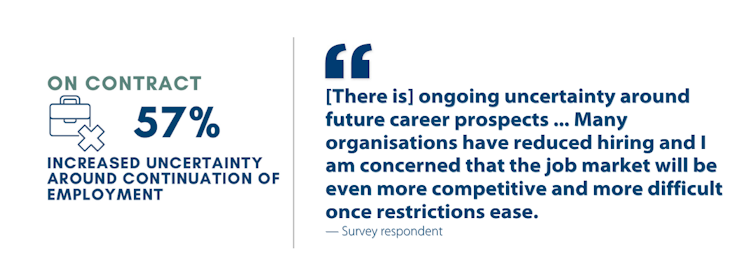 Employment uncertainty for researchers on a fixed-term contract.
They also revealed their research has often had to take a back seat to heavier loads of teaching and administrative work, and other priorities such as caring for children.
Even short-term disruptions can have long-term impact
In scientific research, career success often depends on steadily accumulating performance indicators such as publications, citations, keynote addresses and awards.
COVID-19 restrictions make it harder for less established researchers to hit these targets. Missing them means lower chances of future funding, and ultimately less job stability.
Researchers with a longer track record of success will be less affected, because these impacts will be less visible.
Read more: Science prizes are still a boys' club. Here's how we can change that
Not all junior researchers are affected equally, either. The blows fall most heavily on casual and part-time workers who are paid via fixed-term research or teaching contracts; those who are primary carers (typically women); those who are in Australia on temporary work visas; and those who depend on their institution or employer to secure an income to support their families (as opposed to those who are paid via externally funded fellowships).
Broadly speaking, these impacts are consistent with how the COVID-19 pandemic is affecting women in scientific fields. Impacts of COVID-19 on university budgets and federal research funding could lead to some of these most vulnerable researchers losing their employment.
There have been considerable efforts from the Australian Academy of Science, Science and Technology Australia, the Australian Research Council and the National Health and Medical Research Council to increase the representation of minorities, and these are now at risk.
Early stability builds future security
Early and mid-career researchers are the engine of the research helping us navigate this unprecedented health crisis. In addition, each researcher is the product of 10-15 years of intensive post-secondary education and training, representing an investment (primarily by government) of at least A$500,000.
Read more: Raising the cost of a PhD
Just as importantly, each researcher is an individual with unique and irreplaceable experience and training.
In our survey many researchers commented that they no longer see a future in pursuing a research career in the short or long term. This is not only happening in Australia – countries around the world face the loss of a generation of scientists.
Supporting these researchers is essential to securing the present and future of Australia’s knowledge economy. A significant loss of research capacity and knowledge could take generations to recover from.
A generation at risk
Solutions to this crisis will require cooperation between employers, funding bodies, government and researchers themselves.
A sensible first step would be for funding bodies and employers to let researchers renegotiate what they can deliver, to account for COVID-19 disruptions. This will give researchers more certainty about how they will be assessed in this time.
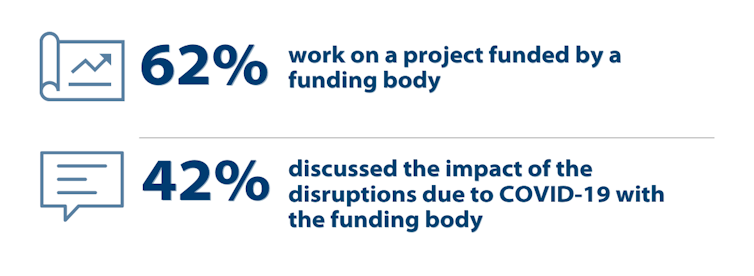 Funding bodies and their role in EMCR employment and research.
In addition, there needs to be clear instruction on how to capture the career disruptions due to COVID-19 in applications and assessments.
Another change that could prevent the loss of thousands of jobs would be for JobKeeper payments to be extended to cover public universities.
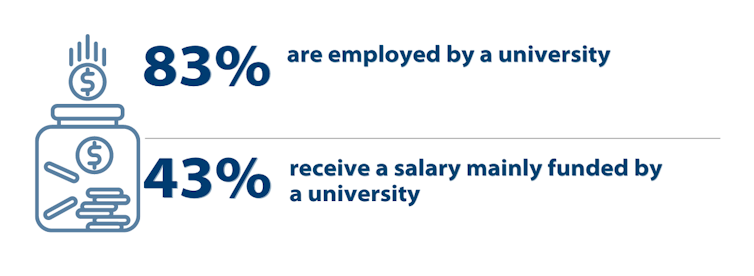 The majority of EMCRs surveyed are employed by universities.
The effect of losing an entire generation of Australian scientists, particularly one that has benefited from efforts to support women in STEM, will be astronomical.
Not only does Australia’s economy depend on a strong scientific workforce, but the pandemic has also shown these people are an essential asset in tackling global health disasters.
Although the federal government is encouraging tertiary enrolments in STEM degrees through its higher education package, the initiative is doomed to fail without early and mid-career researchers to drive teaching and research training. When the next pandemic strikes, we may not have the world-class scientists we need ready to swing into action.
Authors: Justine Shaw, Conservation Biologist, The University of Queensland

















