

Australia's move to store carbon in soil is a problem for tackling climate change
- Written by Robert Edwin White, Professor Emeritus, University of Melbourne
To slow climate change, humanity has two main options: reduce greenhouse gas emissions directly or find ways to remove them from the atmosphere. On the latter, storing carbon in soil – or carbon farming – is often touted as a promising way to offset emissions from other sources such as energy generation, industry and transport.
The Morrison government’s Technology Investment Roadmap, now open for public comment, identifies soil carbon as a potential way to reduce emissions from agriculture and to offset other emissions.
In particular, it points to so-called “biochar” – plant material transformed into carbon-rich charcoal then applied to soil.
But the government’s plan contains misconceptions about both biochar, and the general effectiveness of soil carbon as an emissions reduction strategy.
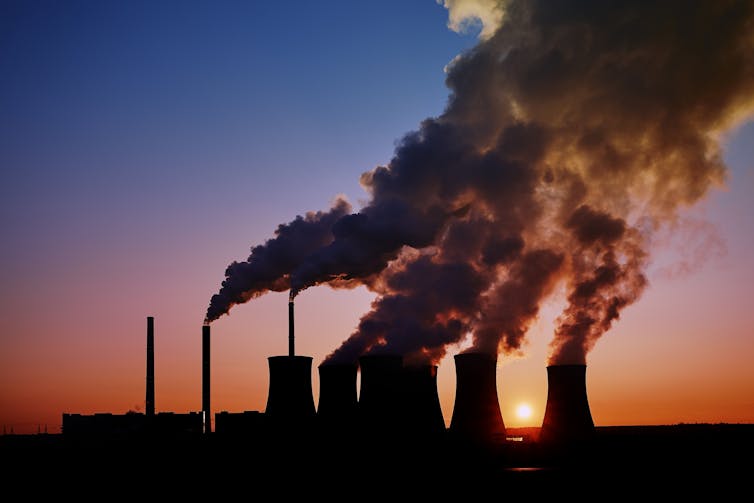 Soil carbon storage is touted as a way to offset emissions from industry and elsewhere.
Shutterstock
Soil carbon storage is touted as a way to offset emissions from industry and elsewhere.
Shutterstock
What is biochar?
Through photosynthesis, plants turn carbon dioxide (CO₂) into organic material known as biomass. When that biomass decomposes in soil, CO₂ is produced and mostly ends up in the atmosphere.
This is a natural process. But if we can intervene by using technology to keep carbon in the soil rather than in the atmosphere, in theory that will help mitigate climate change. That’s where biochar comes in.
Making biochar involves heating waste organic materials in a reduced-oxygen environment to create a charcoal-like product – a process called “pyrolysis”. The carbon from the biomass is stored in the charcoal, which is very stable and does not decompose for decades.
Plant materials are the predominant material or “feedstock” used to make biochar, but livestock manure can also be used. The biochar is applied to the soil, purportedly to boost soil fertility and productivity. This has been tested on grassland, cropping soils and in vineyards.
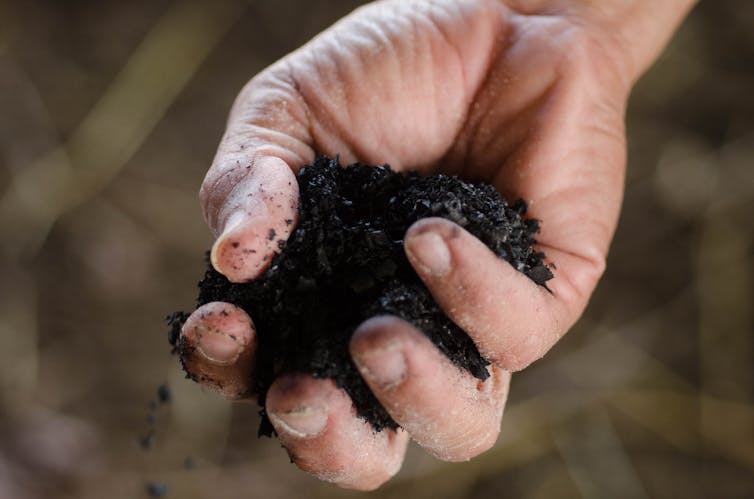 Biochar is produced by burning organic material in a low oxygen environment.
Shutterstock
Biochar is produced by burning organic material in a low oxygen environment.
Shutterstock
But there’s a catch
So far, so good. But there are a few downsides to consider.
First, the pyrolysis process produces combustible gases and uses energy – to the extent that when all energy inputs and outputs are considered in a life cycle analysis, the net energy balance can be negative. In other words, the process can create more greenhouse gas emissions than it saves. The balance depends on many factors including the type and condition of the feedstock and the rate and temperature of pyrolysis.
Second, while biochar may improve the soil carbon status at a new site, the sites from which the carbon residues are removed, such as farmers’ fields or harvested forests, will be depleted of soil carbon and associated nutrients. Hence there may be no overall gain in soil fertility.
Read more: A pretty good start but room for improvement: 3 experts rate Australia's emissions technology plan
Third, the government roadmap claims increasing soil carbon can reduce emissions from livestock farming while increasing productivity. Theoretically, increased soil carbon should lead to better pasture growth. But the most efficient way for farmers to take advantage of the growth, and increase productivity, is to keep more livestock per hectare.
Livestock such as cows and sheep produce methane – a much more potent greenhouse gas than carbon dioxide. Our analysis suggests the methane produced by the extra stock would exceed the offsetting effect of storing more soil carbon. This would lead to a net increase, not decrease, in greenhouse gas
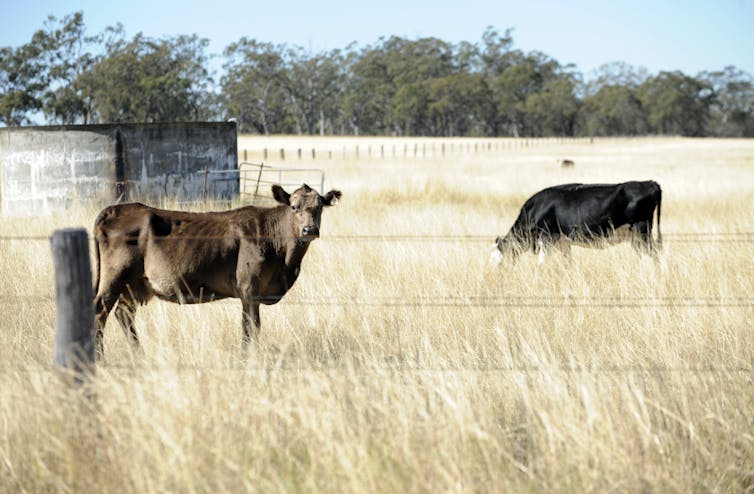 Farmers would have to increase stock numbers to benefit from pasture growth.
Dan Peled/AAP
Farmers would have to increase stock numbers to benefit from pasture growth.
Dan Peled/AAP
A policy failure
The government plan refers to the potential to build on the success of the Emissions Reduction Fund. Among other measures, the fund pays landholders to increase the amount of carbon stored in soil through carbon credits issued through the Carbon Farming Initiative.
However since 2014, the Emissions Reduction Fund has not significantly reduced Australia’s greenhouse gas emissions – and agriculture’s contribution has been smaller still.
So far, the agriculture sector has been contracted to provide about 9.5% of the overall abatement, or about 18.3 million tonnes. To date, it’s supplied only 1.54 million tonnes – 8.4% of the sector’s commitment.
The initiative has largely failed because several factors have made it uneconomic for farmers to take part. They include:
- overly complex regulations
- requirements for expensive soil sampling and analysis
- the low value of carbon credits (averaging $12 per tonne of CO₂-equivalent since the scheme began).
 For many farmers, taking part in the Emissions Reduction Fund is uneconomic.
Shutterstock
For many farmers, taking part in the Emissions Reduction Fund is uneconomic.
Shutterstock
A misguided strategy
We believe the government is misguided in considering soil carbon as an emissions reduction technology.
Certainly, increasing soil carbon at one location can boost soil fertility and potentially productivity, but these are largely private landholder benefits – paid for by taxpayers in the form of carbon credits.
Read more: Climate explained: are we doomed if we don't manage to curb emissions by 2030?
If emissions reduction is seen as a public benefit, then the payment to farmers becomes a subsidy. But it’s highly questionable whether the public benefit (in the form of reduced emissions) is worth the cost. The government has not yet done this analysis.
To be effective, future emissions technology in Australia should focus on improving energy efficiency in industry, the residential sector and transport, where big gains are to be made.
Authors: Robert Edwin White, Professor Emeritus, University of Melbourne

















