Poor ventilation may be adding to nursing homes' COVID-19 risks
- Written by Geoff Hanmer, Adjunct Professor of Architecture, University of Adelaide
Over 2,000 active cases of COVID-19 and 245 resident deaths as of August 19 have been linked to aged care homes in Victoria, spread across over 120 facilities. The St Basil’s cluster alone now involves 191 cases. In New South Wales, 37 residents were infected at Newmarch House, leading to 17 deaths.
Why are so many aged care residents and staff becoming infected with COVID-19? New research suggests poor ventilation may be one of the factors. RMIT researchers are finding levels of carbon dioxide in some nursing homes that are more than three times the recommended level, which points to poor ventilation.
An examination of the design of Newmarch in Sydney and St Basil’s in Melbourne shows residents’ rooms are arranged on both sides of a wide central corridor.
The corridors need to be wide enough for beds to be wheeled in and out of rooms, but this means they enclose a large volume of air. Windows in the residents’ rooms only indirectly ventilate this large interior space. In addition, the wide corridors encourage socialising.
If the windows to residents’ rooms are shut or nearly shut in winter, these buildings are likely to have very low levels of ventilation, which may contribute to the spread of COVID-19. If anyone in the building is infected, the risk of cross-infection may be significant even if personal protective equipment protocols are followed and surfaces are cleaned regularly.
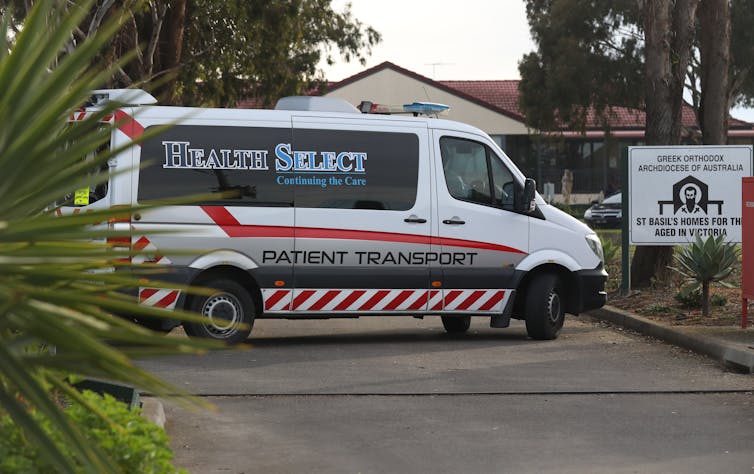 The COVID-19 cluster linked to St Basil’s has grown to 191 cases.
David Crosling/AAP
The COVID-19 cluster linked to St Basil’s has grown to 191 cases.
David Crosling/AAP
Why does ventilation matter?
Scientists now suspect the virus that causes COVID-19 can be transmitted as an aerosol as well as by droplets. Airborne transmission means poor ventilation is likely to contribute to infections.
A recent article in the journal Nature outlines the state of research:
Converging lines of evidence indicate that SARS-CoV-2, the coronavirus responsible for the COVID-19 pandemic, can pass from person to person in tiny droplets called aerosols that waft through the air and accumulate over time. After months of debate about whether people can transmit the virus through exhaled air, there is growing concern among scientists about this transmission route.
Read more: Is the airborne route a major source of coronavirus transmission?
Under the National Construction Code (NCC), a building can be either “naturally ventilated” or “mechanically ventilated”.
Natural ventilation requires only that ventilation openings, usually the openable portion of windows, must achieve a set percentage of the floor area. It does not require windows to be open, or even mandate the minimum openable area, or any other measures that would ensure effective ventilation. Air quality tests are not required before or after occupation for a naturally ventilated building.
Nearly all aged care homes are designed to be naturally ventilated with openable windows to each room. In winter most windows are shut to keep residents warm and reduce drafts. This reduces heating costs, so operators have a possible incentive to keep ventilation rates down.
From inspection, many areas of typical nursing homes, including corridors and large common spaces, are not directly ventilated or are very poorly ventilated. The odour sometimes associated with nursing homes, which is a concern for residents and their visitors, is probably linked to poor ventilation.
Carbon dioxide levels sound a warning
Carbon dioxide levels in a building are a close proxy for the effectiveness of ventilation because people breathe out CO₂. The National Construction Code mandates CO₂ levels of less than 850 parts per million (ppm) in the air inside a building averaged over eight hours. A well-ventilated room will be 800ppm or less – 600ppm is regarded as a best practice target. Outside air is just over 400ppm
An RMIT team led by Professor Priya Rajagopalan is researching air quality in Victorian aged care homes. He has provided preliminary data showing peaks of up to 2,000ppm in common areas of some aged care homes.
This figure indicates very poor ventilation. It’s more than twice the maximum permitted by the building code and more than three times the level of best practice.
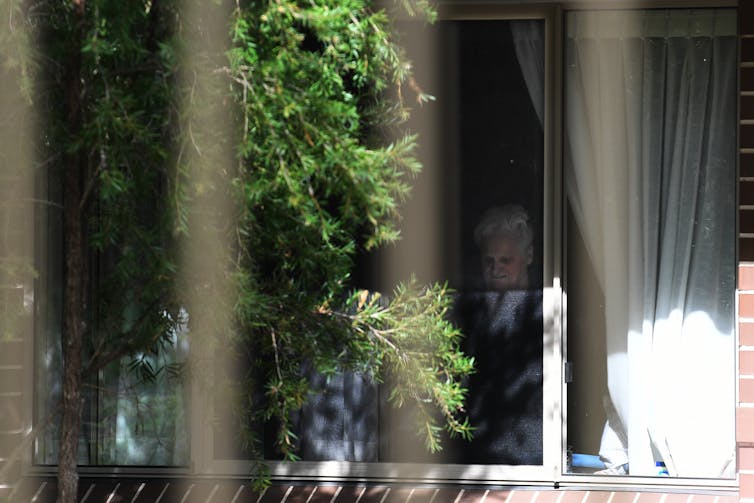 Ventilation can be poor unless windows are open in an aged care facility like Newmarch House.
Dean Lewins/AAP
Ventilation can be poor unless windows are open in an aged care facility like Newmarch House.
Dean Lewins/AAP
Research from Europe also indicates ventilation in aged care homes is poor.
Good ventilation has been associated with reduced transmission of pathogens. In 2019, researchers in Taiwan linked a tuberculosis outbreak at a Taipei University with internal CO₂ levels of 3,000ppm. Improving ventilation to reduce CO₂ to 600ppm stopped the outbreak.
Read more: How to use ventilation and air filtration to prevent the spread of coronavirus indoors
What can homes do to improve ventilation?
Nursing home operators can take simple steps to achieve adequate ventilation. An air quality detector that can reliably measure CO₂ levels costs about A$200.
If levels in an area are significantly above 600ppm over five to ten minutes, there would be a strong case to improve ventilation. At levels over 1,000ppm the need to improve ventilation would be urgent.
Most nursing homes are heated by reverse-cycle split-system air conditioners or warm air heating systems. The vast majority of these units do not introduce fresh air into the spaces they serve.
The first step should be to open windows as much as possible – even though this may make maintaining a comfortable temperature more difficult.
Read more: Open windows to help stop the spread of coronavirus, advises architectural engineer
Creating a flow of warmed and filtered fresh air from central corridor spaces into rooms and out through windows would be ideal, but would probably require investment in mechanical ventilation.
Temporary solutions could include:
industrial heating fans and flexible ventilation duct from an open window discharging into the central corridor spaces
radiant heaters in rooms, instead of recirculating heat pump air conditioners, and windows opened far enough to lower CO₂ levels consistently below 850ppm in rooms and corridors.
The same type of advice applies to any naturally ventilated buildings, including schools, restaurants, pubs, clubs and small shops. The operators of these venues should ensure ventilation is good and be aware that many air-conditioning and heating units do not introduce fresh air.
People walking into venues might want to turn around and walk out if their nose tells them ventilation is inadequate. We have a highly developed sense of smell for many reasons, and avoiding badly ventilated spaces is one of them.
Authors: Geoff Hanmer, Adjunct Professor of Architecture, University of Adelaide
Read more https://theconversation.com/poor-ventilation-may-be-adding-to-nursing-homes-covid-19-risks-144725