Why freedom of religion won't likely trump public health interests with a future COVID-19 vaccine
- Written by Renae Barker, Senior Lecturer, University of Western Australia
Religious objections to vaccinations have been around almost as long as vaccinations themselves.
This week, three leading Australian religious figures have written to Prime Minister Scott Morrison outlining ethical concerns they have with the potential COVID-19 vaccine being developed at Oxford University.
The three Sydney archbishops are concerned the vaccine utilises a cell line derived from an aborted foetus. In their letter, they say the use of this cell line
will raise serious issues of conscience for a proportion of the population.
Today, the Australian Federation of Islamic Councils also signalled its “profound concern” over the use of foetal tissue in vaccine development. President Rateb Jneid urged Morrison
to reconsider accessing such vaccines but instead to invest into Australian research into ethical alternatives.
With Morrison saying last week he wants 95% of Australians to take a future COVID-19 vaccine, this will raise significant issues of freedom of religion.
Why some faith groups oppose vaccines
Faith groups object to vaccinations for a range of reasons. For example, Christian Scientists object to all vaccinations, relying instead on prayer to prevent and cure disease. They do so on the basis that
disease, in this construct, is not fundamentally real, but rather something that can be dispelled, to reveal the perfection of God’s creation.
Other faith groups only object to specific vaccines. In some cases, these objections are based on inactive ingredients in the vaccine.
For example, some Jews and Muslims object to vaccines that contain pork products. In 2018, Indonesia’s top Islamic body issued a fatwa declaring that the rubella-measles vaccine was religiously prohibited (haram) because it contained “traces of pork and human cells.”
Other faith groups object to vaccines because of the method by which they are developed. This is the basis for the archbishops’ objection to the potential Oxford COVID-19 vaccine.
In their letter to Morrison, the three archbishops, who represent he Anglican, Roman Catholic and Greek Orthodox communities in Sydney, said
Please be assured that our churches are not opposed to vaccination: as we have said we pray that one may be found. But we also pray that it be one that is not ethically tainted.
A number of existing vaccines use cells originally taken from aborted foetuses. While the use of these cells is considered ethical by most standards, this does not alleviate religious concerns about the practice.
In their letter, the archbishops say some Australians may
be concerned not to benefit in any way from the death of the little girl whose cells were taken and cultivated, not to be trivialising that death, and not to be encouraging the foetal tissue industry.
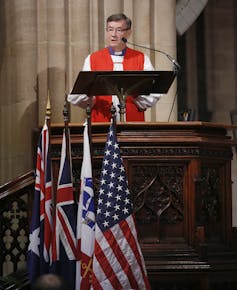 Sydney Anglican Archbishop Glenn Davies, one of the three signatories to the letter.
David Moir/AAP
Sydney Anglican Archbishop Glenn Davies, one of the three signatories to the letter.
David Moir/AAP
How does freedom of religion factor in?
Religious objections like these pose a dilemma for law and policy-makers, particularly now, in the middle of a pandemic.
On the one hand, there are strong public health reasons to create incentives to encourage widespread vaccination. On the other hand, such policies have the potential to inhibit freedom of religion.
Read more: Can the government, or my employer, force me to get a COVID-19 vaccine under the law?
Freedom of religion is a fundamental human right, provided for under the UN International Covenant on Civil and Political Rights.
However, this freedom is not unlimited. Under article 18 of the UN covenant, these rights may be limited in the interests of public health. It reads:
Freedom to manifest one’s religion or beliefs may be subject only to such limitations as are prescribed by law and are necessary to protect public safety, order, health, or morals or the fundamental rights and freedoms of others.
COVID-19 is not the first time the government has had to decide whether or not to limit freedom of religion in favour of public health outcomes.
In 1998, the federal government implemented a policy requiring proof of childhood vaccines in order for families to receive certain welfare benefits. Certain exemptions were permitted for religious and conscientious objectors.
In 2015, the government announced it was revising its “no-jab, no-pay” policy to remove these exemptions. The explanatory memorandum accompanying the bill noted
objection to vaccination can limit the rights of others to physical and mental health.
And in the context of COVID-19, we have already seen significant restrictions on freedom of religion, including the size of religious gatherings and the closure of places of public worship.
Read more: How religions and religious leaders can help to combat the COVID-19 pandemic: Indonesia's experience
Freedom of religion in Australia is narrowly interpreted
In Australia, freedom of religion is primarily protected via section 116 of the Australian Constitution, which says
the Commonwealth shall not make any law for establishing any religion, or for imposing any religious observance, or for prohibiting the free exercise of any religion, and no religious test shall be required as a qualification for any office or public trust under the Commonwealth.
While this section appears to provide strong protection for freedom of religion, it has been interpreted narrowly by the High Court.
 Scott Morrison has signalled he wants near-total compliance with a future COVID-19 vaccine.
DAN HIMBRECHTS/AAP
Scott Morrison has signalled he wants near-total compliance with a future COVID-19 vaccine.
DAN HIMBRECHTS/AAP
In 1943, for instance, the High Court unanimously ruled a ban on the Jehovah’s Witnesses was not prohibited by section 116. The court found that in the context of war time, a ban was acceptable to protect the interests of a free society, even though it had the effect of limiting freedom of religion.
Further, section 116 only applies to federal laws. Any state-based laws creating incentives to encourage widespread uptake of a future COVID-19 vaccine would not allow for objections under the section.
While the potential Oxford University COVID-19 vaccine may “raise serious issues of conscience” for some religious groups, the interests of public health are likely to outweigh any freedom of religion concerns.
Despite this, the government cannot force people to be vaccinated, only compel them to do so. And there are likely to be some people, like Anglican Archbishop Glenn Davies, who would rather wait for a vaccine they find to be less “ethically tainted.”
Read more: Religious groups are embracing technology during the lockdown, but can it replace human connection?
Authors: Renae Barker, Senior Lecturer, University of Western Australia