A man in Hong Kong caught COVID-19 a second time. Here's why that's not surprising (and there's no need to panic)
- Written by Vasso Apostolopoulos, Professor of Immunology and Pro Vice-Chancellor, Research Partnerships, Victoria University
A Hong Kong man who recovered from COVID-19 more than four months ago has reportedly been reinfected with SARS-CoV-2, the virus that causes COVID-19. This time he didn’t have any symptoms.
This is not necessarily unexpected, because very few natural infections generate an immune response that completely prevents reinfection. Instead, what generally happens after an infection is that the body’s immune response gradually declines over months after the infection is cleared.
Specialised immune cells in the body are tasked with remembering each particular infection, so if you get infected again your body quickly starts producing the relevant antibodies and other immune cells (called T cells) in large numbers. This helps clear the new infection more rapidly and effectively. So you can still get reinfected, but you’re more likely to have fewer symptoms or be asymptomatic.
This is what seems to have happened to the 33-year-old Hong Kong man at the centre of the latest reports. The first infection caused symptoms, which he reportedly suffered from for some time. But the second time around he was asymptomatic, presumably because his body effectively repelled the disease.
The same phenomenon has previously been shown in monkeys, with one experimental study showing reinfection with SARS-CoV-2 is possible, but that reinfection did not result in the development of disease.
However, we have to be careful about over-interpreting what we know about this case. This is just one person. Is he the exception or the rule? We don’t know yet for sure, and we have to wait for further research. Also, his case was announced via a press release, so we have to wait for the paper to be officially published to be able to properly scrutinise the data.
A different strain
There have been anecdotal reports of people being reinfected before, but many of these seem to be cases in which the initial infection simply persisted for a long time, or in which the person’s lungs were expelling dead virus.
But in this case, the virus isolated from the man’s two separate positive COVID-19 tests had slightly different genetic sequences. This suggests they had a different origin and are therefore different strains.
So far, there have been many SARS-CoV-2 mutations detected around the world. One particular mutant strain, known as the G-variant, seems to be more infectious than the original virus.
We must remember, however, it’s common for viruses to mutate. So it’s also possible we’ll need several different vaccines to account for multiple strains of the virus, like is often done with the flu vaccine.
Read more: The Oxford deal is welcome, but remember the vaccine hasn't been proven to work yet
What does this mean for our immune system?
The good news is this particular person’s immune system seems to have recognised the second infection, as shown by the fact his blood boosted antibodies against it. Despite the mutation, the man could still mount a good defence against the new strain.
Antibodies usually last in the blood for roughly 120 days following a stimulus such as natural infection with a virus or injection with a vaccine, though it varies depending on the disease. Both the B cells that produce antibodies, and the T cells that kill infected cells, also wane over time after the stimulus.
Vaccines can induce longer-lasting responses. But the key point is both natural infections and vaccines do generate memory B and T cells. So when the body comes in contact with the infection the second time, the memory cells respond rapidly and in high numbers. This can be so quick and strong that in some cases it can even result in “sterile protection”, effectively preventing the virus from infecting our cells. More commonly, there may be a small lag time for the immune system to respond fully, but in the end the virus is still unlikely to infect many cells.
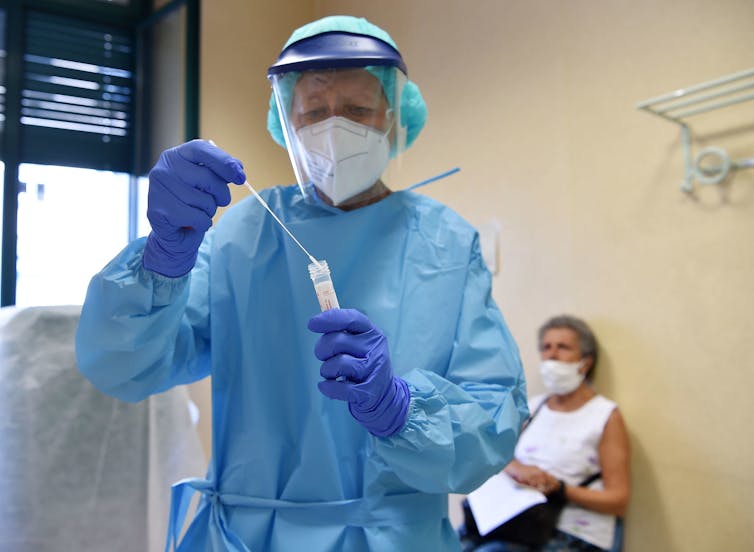 In this case it appears the first infection was enough to teach the person’s immune system how to deal with the virus a second time. So he was reinfected, but didn’t develop symptoms.
Alessandro Di Marco/EPA/AAP
In this case it appears the first infection was enough to teach the person’s immune system how to deal with the virus a second time. So he was reinfected, but didn’t develop symptoms.
Alessandro Di Marco/EPA/AAP
He didn’t develop symptoms, but could he still pass it on?
At the moment it’s unclear if asymptomatic carriers can transmit infection. Indeed, there may be different types of asymptomatic carriers. Some asymptomatic people might transmit the virus, while others don’t. We don’t know why this is the case.
But based on our experience with other diseases, the higher the number of viral particles being spread from person to person, the higher the chance of infection. Therefore, asymptomatic carriers, who do not shed lots of virus through coughing or sneezing, should in theory have a lower risk of infecting others.
Read more: Exposure to common colds might give some people a head start in fighting COVID-19
Does reinfection mean herd immunity is impossible?
Herd immunity is still possible if we get a successful vaccine, because vaccines can be more powerful and protective than the immunity conferred by being naturally infected with the virus. Some epidemiologists suggest at least 70% of a population needs to be immunised to achieve herd immunity.
What’s more, becoming reinfected does not mean the virus will necessarily be transmitted — it depends on the viral dose and the susceptibility of people around the infected person. If they are all immunised with a vaccine, we generate a ring of fire that can contain spread of the virus.
It’s also possible SARS-CoV-2 becomes an endemic virus, like many viruses circulating in the population. But as long as there are diagnostics, vaccines and treatments, we could continue functioning normally just as we do with influenza present in the population. Ultimately it’s about what level of risk society is willing to accept. And we may need to use infection control methods like masks and hand hygiene for some time.
Read more: No, Australia should not follow Sweden's approach to coronavirus
Authors: Vasso Apostolopoulos, Professor of Immunology and Pro Vice-Chancellor, Research Partnerships, Victoria University