Strength training is as important as cardio
- Written by Jason Bennie, Senior Research Fellow, University of Southern Queensland
We often get bombarded with the message “regular physical activity is the key to good health and well-being”. To most of us, when we hear “physical activity”, we typically think of aerobic exercise such as walking, jogging, and cycling.
But recent evidence suggests muscle-strengthening exercise is very beneficial to our health. In our study, published today, we argue muscle-strengthening exercise deserves to be considered just as important as aerobic exercise.
And the good news is strength training can be done by anyone, anywhere — and you don’t need fancy equipment.
Strength is just as important as cardio
Muscle-strengthening exercise is also known as strength, weight or resistance training, or simply “lifting weights”. It includes the use of weight machines, exercise bands, hand-held weights, or our own body weight (such as push-ups, sit-ups or planking). It’s typically performed at fitness centres and gyms, but can also be done at home.
More than 30 years of clinical research has shown that muscle-strengthening exercise increases muscle mass, strength and bone mineral density. It improves our body’s capacity to clear sugar and fat from the bloodstream, and improves our ability to perform everyday activities such as walking up stairs or getting in and out of a chair. It can also reduce symptoms of depression and anxiety.
In our research, we reviewed the evidence from several large studies and found muscle-strengthening exercise is associated with a reduced risk of early death, diabetes, cardiovascular disease and obesity. Importantly, these health benefits remained evident even after accounting for aerobic exercise and other factors such as age, sex, education, income, body mass index, depression and high blood pressure.
Compared with aerobic exercise like jogging, clinical studies show that muscle-strengthening exercise has greater effects on age-related diseases such as sarcopenia (muscle wasting), cognitive decline and physical function.
This is particularly significant considering we have an ageing population in Australia. Declines in muscle mass and cognitive function are predicted to be among the key 21st-century health challenges.
Most of us don’t even lift — but we should
While the health benefits of muscle-strengthening exercise are clear, the reality is most adults don’t do it, or don’t do it enough. Data from multiple countries show only 10-30% of adults meet the muscle-strengthening exercise guidelines of two or more days per week. Australian adults reported among the lowest levels of strength training in the world.
Our data from more than 1.6 million US adults show nearly twice as many do no muscle-strengthening exercise at all, compared with those who do no aerobic exercise.
The reasons fewer people do strength training than aerobic exercise are complex. In part, it might be because muscle-strengthening exercise has only been included in guidelines for less than a decade, compared with almost 50 years of promoting aerobic exercise. Strength training therefore has been considered by some physical activity and public health scientists as the “forgotten” or “neglected” guideline.
Other factors that may contribute to fewer people doing strength training include the fact it:
involves a basic understanding of specific terminology (sets and repetitions)
often needs access to equipment (resistance bands or barbells)
requires confidence to perform potentially challenging activities (squats, lunges and push-ups)
and risks the fear of judgement or falling foul of social norms (such as a fear of excessive muscle gain, or of getting injured).
Here’s how to get started
Unlike most aerobic exercise, strength training can be done at home. It can also be done without extensive equipment, using our own body weight. This makes it a great form of exercise during the COVID-19 pandemic, when many people are confined to their homes or otherwise restriced in where they can go.
If you are currently doing no muscle-strengthening exercise, getting started, even a little bit, will likely have immediate health benefits. Guidelines recommend exercising all major muscle groups at least twice a week: legs, hips, back, chest, abdomen, shoulders and arms. This could include bodyweight exercises like push-ups, squats or lunges, or using resistance bands or hand-held weights.
Here are some excellent free online resources that provide practical tips on how to start a muscle-strengthening exercise routine:
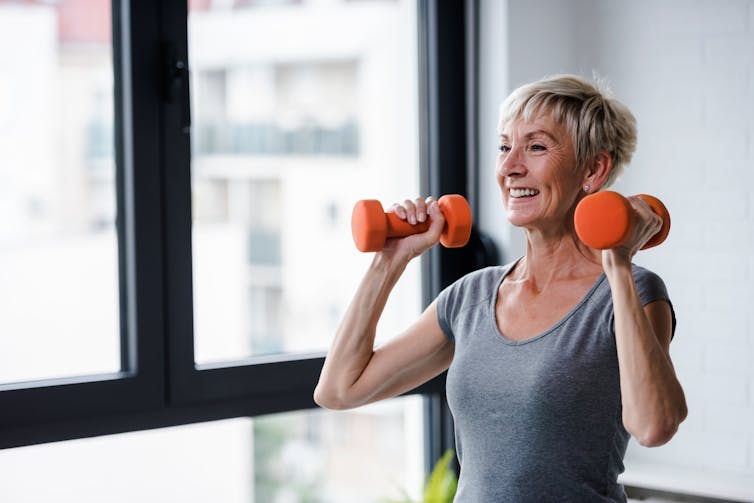 Muscle-strengthening exercise can be performed by anyone, anywhere. And its health benefits rival, and often exceed, aerobic exercise.
Shutterstock
Muscle-strengthening exercise can be performed by anyone, anywhere. And its health benefits rival, and often exceed, aerobic exercise.
Shutterstock
Governments need to step up
Many people find aerobic exercise difficult, impossible or simply unpleasant. For these people, strength training provides a different way to exercise.
The evidence supporting the health benefits of muscle-strengthening exercise, coupled with its low participation levels, provides a compelling case to promote this type of exercise. But historically, physical activity promotion has generally focused on aerobic exercise.
If governments expect more people to do muscle-strengthening exercise, they need to provide support. One strategy may be to provide affordable access to community fitness centres, home-based equipment and fitness trainers. And media campaigns endorsing muscle-strengthening exercise could also be important for challenging negative stereotypes such as excessive muscle gain. It’s unlikely any of these strategies will be successful individually, so we’ll have to tackle the problem on a few different fronts.
Authors: Jason Bennie, Senior Research Fellow, University of Southern Queensland