

Renewable energy can save the natural world – but if we're not careful, it will also hurt it
- Written by Laura Sonter, Lecturer in Environmental Management, The University of Queensland
A vast transition from fossil fuels to renewable energy is crucial to slowing climate change. But building solar panels, wind turbines and other renewable energy infrastructure requires mining for materials. If not done responsibly, this may damage species and ecosystems.
In our research, published today, we mapped the world’s potential mining areas and assessed how they overlap with biodiversity conservation sites.
We found renewable energy production will exacerbate the threat mining poses to biodiversity – the world’s variety of animals and plants. It’s fair to assume that in some places, the extraction of renewables minerals may cause more damage to nature than the climate change it averts.
Australia is well placed to become a leader in mining of renewable energy materials and drive the push to a low-carbon world. But we must act now to protect our biodiversity from being harmed in the process.
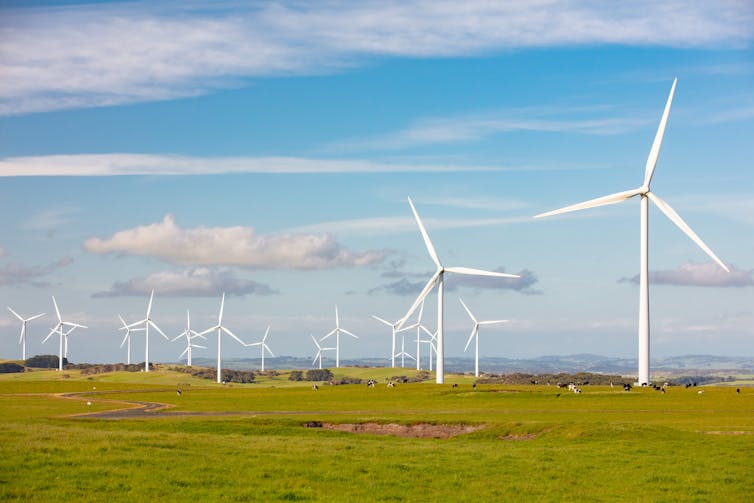 Renewable energy infrastructure such as wind farms are good for the planet – but it requires minerals extraction.
Shutterstock
Renewable energy infrastructure such as wind farms are good for the planet – but it requires minerals extraction.
Shutterstock
Mining to prevent climate change
Currently, about 17% of current global energy consumption is achieved through renewable energy. To further reduce greenhouse gas emissions, this proportion must rapidly increase.
Building new renewable energy infrastructure will involve mining minerals and metals. Some of these include:
- lithium, graphite and cobalt (mostly used in battery storage)
- zinc and titanium (used mostly for wind and geothermal energy)
- copper, nickle and aluminium (used in a range of renewable energy technologies).
The World Bank estimates the production of such materials could increase by 500% by 2050. It says more than 3 billion tonnes of minerals and metals will be needed to build the wind, solar and geothermal power, and energy storage, needed to keep global warming below 2℃ this century.
However, mining can seriously damage species and places. It destroys natural habitat, and surrounding environments can be harmed by the construction of transport infrastructure such as roads and railways.
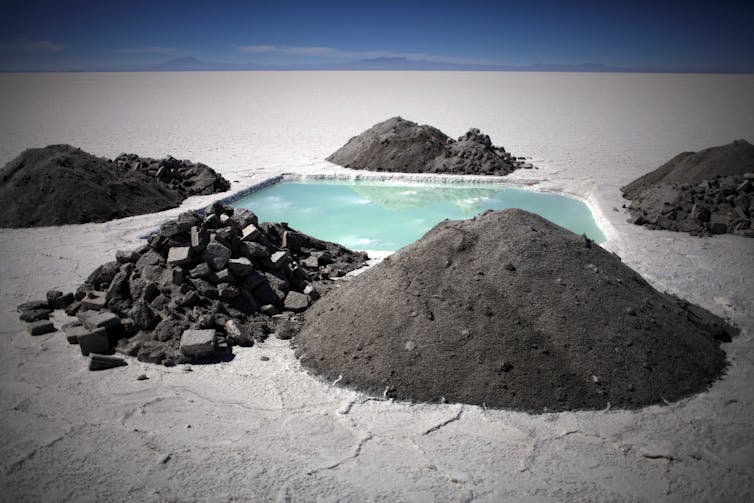 An evaporation pond used to measure lithium and in the Uyuni salt desert in Bolivia. Mining can damage the environment if not done sustainably.
Dado Galdieri/AP
An evaporation pond used to measure lithium and in the Uyuni salt desert in Bolivia. Mining can damage the environment if not done sustainably.
Dado Galdieri/AP
What we found
We mapped areas around the world potentially affected by mining. Our analysis involved 62,381 pre-operational, operational, and closed mines targeting 40 different materials.
We found mining may influence about 50 million km² of Earth’s land surface (or 37%, excluding Antarctica). Some 82% of these areas contain materials needed for renewable energy production. Of this, 12% overlaps with protected areas, 7% with “key biodiversity areas”, and 14% with remaining wilderness.
Our results suggest mining of renewable energy materials may increase in currently untouched and “biodiverse” places. These areas are considered critical to helping species overcome the challenges of climate change.
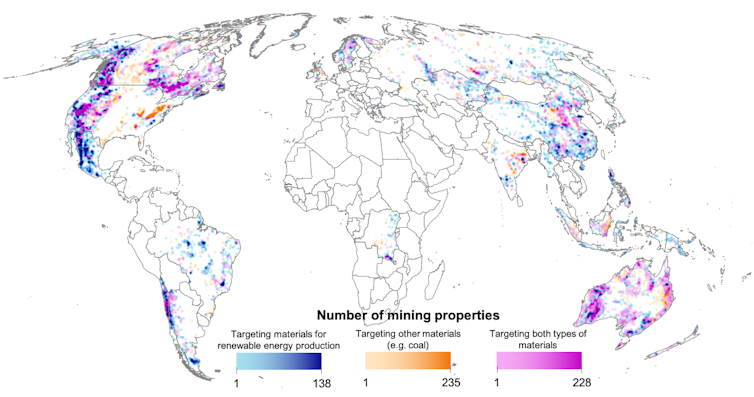 Areas potentially influenced by mining, including for the minerals needed in renewable energy production (shown in blue). See source link for detailed methodology and limitations.
Threats here and abroad
Australia is well positioned to become a leading supplier of materials for renewable energy. We are also one of only 17 nations considered ecologically “megadiverse”.
Yet, many of the minerals needed for renewable energy exist in important conservation areas.
For example, Australia is rich in lithium and already accounts for half of world production. Hard-rock lithium mines operate in the Pilbara region of Western Australia.
This area has also been identified as a national biodiversity hotspot and is home to many native species. These include small marsupials such as the little red antechinus and the pebble-mound mouse, and reptiles including gecko and goanna species.
Read more: World-first mining standard must protect people and hold powerful companies to account
Australia is also ranked sixth in the world for deposits of rare earth elements, many of which are needed to produce magnets for wind turbines. We also have large resources of other renewables materials such as cobalt, manganese, tantalum, tungsten and zirconium.
It’s critical that mining doesn’t damage Australia’s already vulnerable biodiversity, and harm the natural places valued by Indigenous people and other communities.
In many cases, renewables minerals are found in countries where the resource sector is not strongly regulated, posing an even greater environmental threat. For example, the world’s second-largest untouched lithium reserve exists in Bolivia’s Salar de Uyuni salt pan. This naturally diverse area is mostly untouched by mining.
The renewables expansion will also require iron and steel. To date, mining for iron in Brazil has almost wiped out an entire plant community, and recent dam failures devastated the environment and communities.
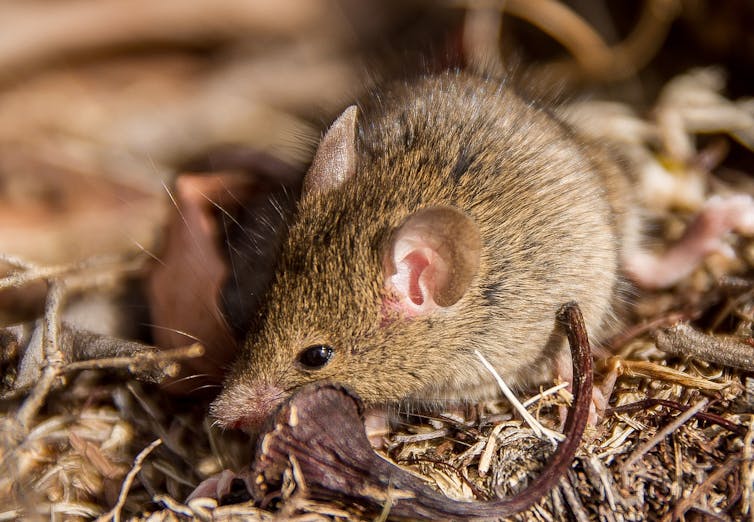 The Pilbara has large lithium deposits and is also home to the little red antechinus.
Needpix
The Pilbara has large lithium deposits and is also home to the little red antechinus.
Needpix
We need proactive planning
Strong planning and conservation action is needed to avoid, manage and prevent the harm mining causes to the environment. However global conservation efforts are often naive to the threats posed by significant growth in renewable energies.
Some protected areas around the world prevent mining, but more than 14% contain metal mines in or near their boundaries. Consequences for biodiversity may extend many kilometres from mining sites.
Meanwhile, other areas increasingly important for conservation are focused on the needs of biodiversity, and don’t consider the distribution of mineral resources and pressures to extract them. Conservation plans for these sites must involve strategies to manage the mining threat.
There is some good news. Our analyses suggest many required materials occur outside protected areas and other conservation priorities. The challenge now is to identify which species are most at risk from current and future mining development, and develop strong policies to avoid their loss.
Read more: Why most Aboriginal people have little say over clean energy projects planned for their land
Authors: Laura Sonter, Lecturer in Environmental Management, The University of Queensland

















