

New research reveals these 20 Australian reptiles are set to disappear by 2040
- Written by Hayley Geyle, Research Assistant, Charles Darwin University
Action came too late for the Christmas Island forest skink, despite early warnings of significant declines. It was lost from the wild before it was officially listed as “threatened”, and the few individuals brought into captivity died soon after.
Australia is home to about 10% of all known reptile species — the largest number of any country in the world. But many of our reptiles are at risk of the same fate as the Christmas Island forest skink: extinction.
In new research published today, we identified the 20 terrestrial snakes and lizards (collectively known as “squamates”) at greatest risk of extinction in the next two decades, assuming no changes to current conservation management.
Preventing extinctions of Australian lizards and snakes.While all 20 species meet international criteria to be officially listed as “threatened”, only half are protected under Australian environmental legislation— the Environment Protection and Biodiversity Conservation (EPBC) Act. This needs urgent review.
Many of these reptiles receive little conservation action, but most of their threats can be ameliorated. By identifying the species at greatest risk of extinction, we can better prioritise our recovery efforts — we know now what will be lost if we don’t act.
Six species more likely than not to go extinct
Our research team — including 27 reptile experts from universities, zoos, museums and government organisations across the country — identified six species with greater than 50% likelihood of extinction by 2040.
This includes two dragons, one blind snake and three skinks. Experts rated many others as having a 30-50% likelihood of extinction over the next 20 years.
More than half (55%) of the 20 species at greatest risk occur in Queensland. Three live on islands: two on Christmas Island and one on Lancelin Island off the Western Australian coast.
Two more species are found in Western Australia, while the Northern Territory, the Australian Capital Territory, Victoria and New South Wales each have one species.
Read more: Australia's smallest fish among 22 at risk of extinction within two decades
Each of the 20 species at greatest risk occur in a relatively small area, which partly explains the Queensland cluster — many species in that state naturally have very small distributions.
Most of the top 20 occupy a total range of fewer than 20 square kilometres, so could be lost to a single catastrophic event, such as a large bushfire.
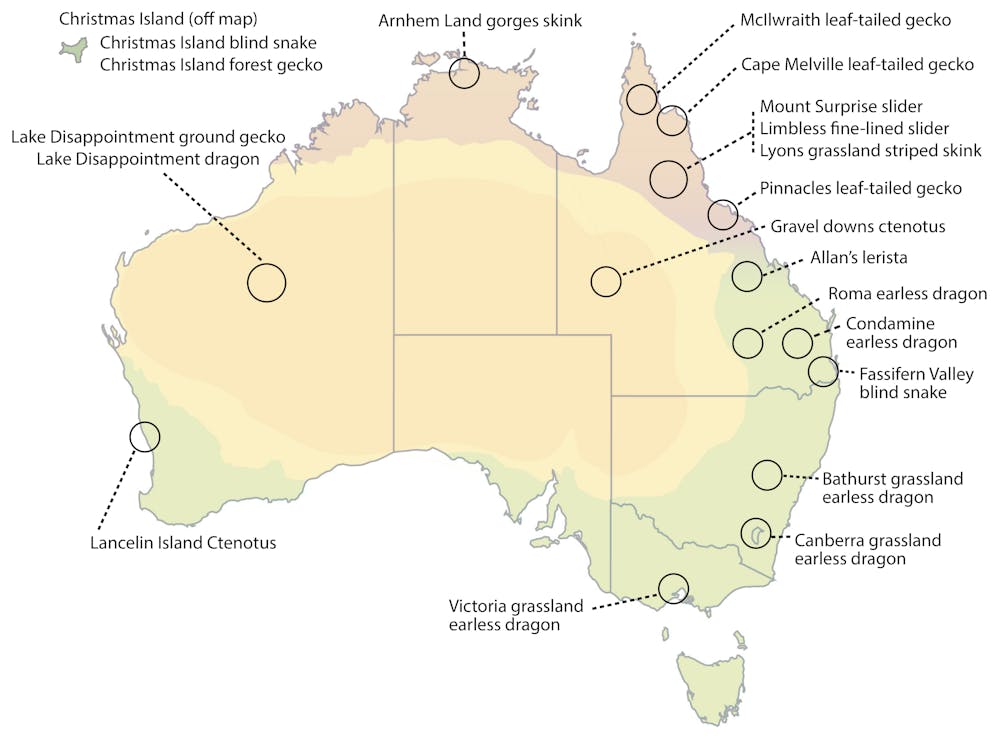 The approximate locations of the 20 terrestrial snakes and lizards at greatest risk of extinction.
Author provided
The approximate locations of the 20 terrestrial snakes and lizards at greatest risk of extinction.
Author provided
So why are they dying out?
Reptile species are declining on a global scale, and this is likely exacerbated by climate change. In Australia, where more than 90% of our species occur nowhere else in the world, the most threatened reptiles are at risk for two main reasons: they have very small distributions, and ongoing, unmitigated threats.
The Cape Melville leaf-tailed gecko meets this brief perfectly. This large and spectacular species was only discovered in 2013, on a remote mountain range on Cape York. It’s threatened by virtue of its very small distribution and population size, and by climate change warming and drying its upland habitat.
 The Arnhem Land gorges skink is considered more likely than not to become extinct by 2040. Threats include changes to food resources and habitat quality, feral cats, and possibly poisoning by cane toads.
Chris Jolly
The Arnhem Land gorges skink is considered more likely than not to become extinct by 2040. Threats include changes to food resources and habitat quality, feral cats, and possibly poisoning by cane toads.
Chris Jolly
Habitat loss is also a major threat for the top 20 species. Australia’s most imperilled reptile, the Victoria grassland earless dragon, used to be relatively common in grasslands in and around Melbourne. But the grasslands this little dragon once called home have been extensively cleared for agriculture and urban development, and now cover less than 1% of their original extent.
Little conservation attention
For most reptile species, there has been less conservation work to address the declines, partly because reptiles have historically received less scientific attention than birds or mammals.
We also still don’t fully understand just how many species there are in Australia. New reptile species are being scientifically described at an average rate of 15 per year (a higher rate than for other vertebrate groups) and many new reptiles are already vulnerable to extinction at the time of discovery.
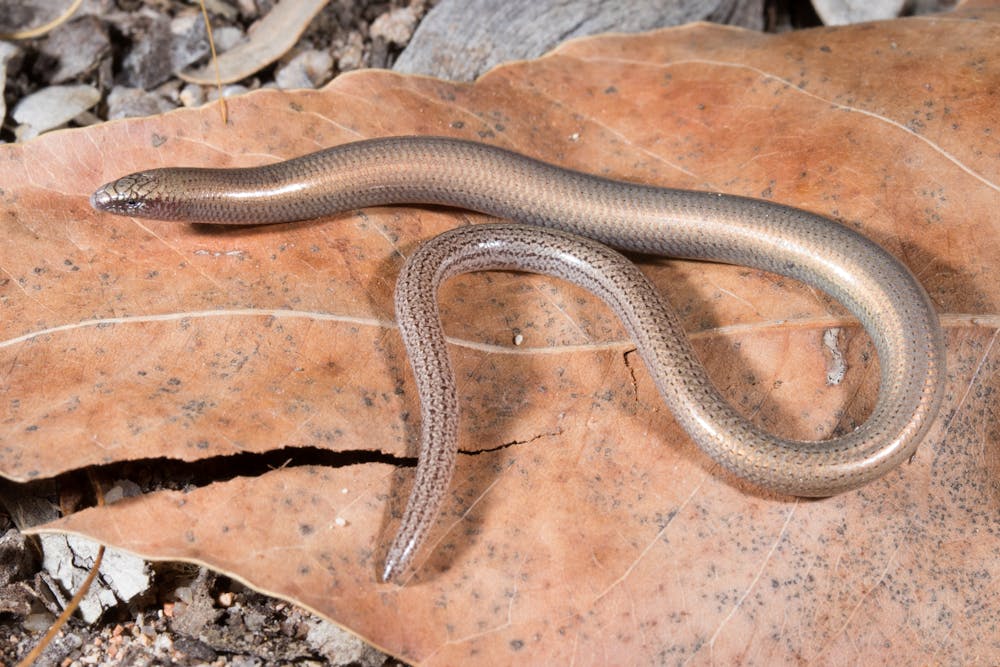 The Mount Surprise slider is threatened by invasive plant species and cattle compacting sandy soils.
Stephen Zozaya, Author provided
The Mount Surprise slider is threatened by invasive plant species and cattle compacting sandy soils.
Stephen Zozaya, Author provided
To make matters worse, few reptiles in Australia are well-monitored. Without adequate monitoring, we have a poor understanding of population trends and the impacts of threats. This means species could slip into extinction unnoticed.
Reptiles also lack the public and political profile that helps generate recovery support for other, (arguably) more charismatic Australian threatened animals — such as koalas and swift parrots — leading to little resourcing for conservation.
Lessons from the past
Only one Australian reptile, the Christmas Island forest skink, is officially listed as extinct, but we have most probably lost others before knowing they exist. Without increased resourcing and management intervention, many more Australian reptiles could follow the same trajectory.
 Habitat loss and degradation due to agriculture is a major threat to the Roma earless dragon. It has not been listed under Australian legislation.
A. O’Grady Museums Victoria, Author provided
Habitat loss and degradation due to agriculture is a major threat to the Roma earless dragon. It has not been listed under Australian legislation.
A. O’Grady Museums Victoria, Author provided
But it’s not all bad news. The pygmy bluetongue skink was once thought to be extinct until a chance discovery kick-started a long conservation and research program.
Animals are now being taken from the wild and relocated to new areas to establish more populations, signifying that positive outcomes are possible when informed by good science.
And the very restricted distributions of most of the species identified here should allow for targeted and effective recovery efforts.
By identifying the species at greatest risk, we hope to give governments, conservation groups and the community time to act to prevent further extinctions before it’s too late. Neglect should no longer be the default response for our fabulous reptile fauna.
Read more: A hidden toll: Australia's cats kill almost 650 million reptiles a year
Authors: Hayley Geyle, Research Assistant, Charles Darwin University

















