

If reducing harm to society is the goal, a cost-benefit analysis shows cannabis prohibition has failed
- Written by Alexander Gillespie, Professor of Law, University of Waikato
The case for a referendum on New Zealand’s cannabis law was already urgent in 2015 when the supposedly more pressing issue was whether we should change the flag. As I argued at the time, prohibition had failed and was costing society far more than the drug itself.
As with alcohol, tobacco, prostitution and gambling, regulation – not prohibition – seemed the smarter way forward. Nothing has changed as the cannabis legalisation and control referendum looms on October 17. If anything, the evidence from five wasted decades of war on cannabis is even more compelling.
First, tens of thousands of New Zealand lives have been disproportionately damaged – not through use of the drug, but because of its criminalisation.
According to figures released under the Official Information Act, between 1975 and 2019, 12,978 people spent time in jail for cannabis-related convictions (using and/or dealing). In the same period, 62,777 were given community-based sentences for cannabis-related convictions.
These statistics have not been evenly distributed. Māori are more likely to be convicted on cannabis charges, even accounting for higher rates of use.
Each conviction represented real or potential harm to job prospects, ability to travel, educational and other forms of social opportunity.
Despite the law, cannabis use increases
Second, despite these penalties and the millions of hours of police time spent enforcing the law, demand remains stronger than ever. Mirroring international trends (an estimated 192 million people used cannabis in 2018, making it the most used drug globally), the number of people using cannabis in New Zealand is increasing.
Read more: Cannabis use after work doesn’t affect productivity – new research
The most recent statistics suggest 15% of people used it at least once in the past year – nearly double the 8% recorded in 2011-12. The rate for those between 15 and 24 could be closer to 29% (nearly double the 15% in 2011-12).
Research suggests most New Zealanders (about 80%) born in the 1970s have used cannabis at least once. Despite the hype, propaganda and fear, such widespread use has not sent the nation spinning of control.
This is not a universal rule. For a minority (perhaps 4% to 10% of all users), there is a risk of developing a dependence that impairs their psychological, social and/or occupational functioning. Again, Maori suffer disproportionately in this area.
Despite these risks, overall the damage of cannabis is far less (for both individuals and wider society) than for legal drugs such as alcohol and tobacco.
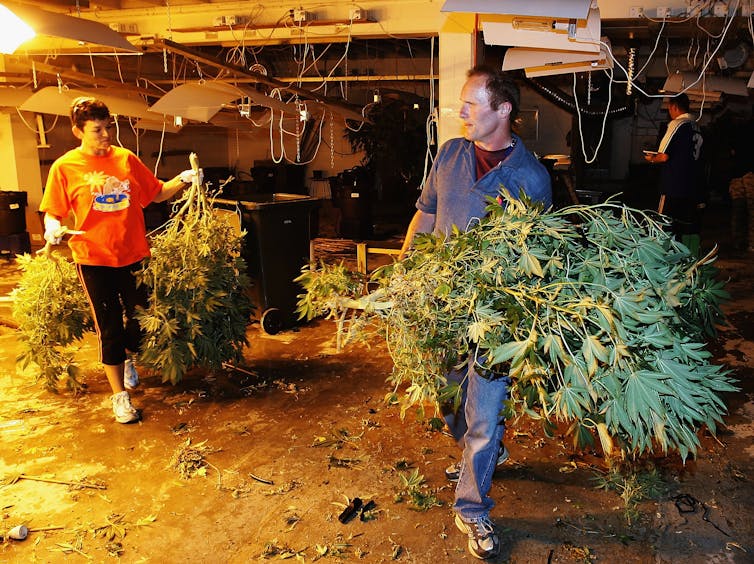 Boom and bust: police remove some of the 1,000 cannabis plants discovered in an Auckland warehouse in 2005.
GettyImages
Boom and bust: police remove some of the 1,000 cannabis plants discovered in an Auckland warehouse in 2005.
GettyImages
Black markets only work for criminals
Third, criminals have thrived on the illegality of cannabis. The median price of an ounce fluctuates between $350 and $400. With such attractive profit margins for an illegal product, a black market is inevitable.
Read more: Cannabis: high potency strains linked to greater chance of anxiety – new research
In turn, the quality and safety of the product are not regulated, the market is not controlled (children become customers), and no tax is earned from the profits. The spill-over crime rate increases as gangs or cartels seek to monopolise business and expand their territory.
The referendum now offers the Cannabis Legislation and Control Bill as a solution to these problems. If it became law the current situation would change in several significant ways:
access to cannabis for those aged 20 or over would be restricted to a personal supply (two plants) or purchase of 14 grams per day at a set potency level
sale would be through licensed premises selling quality-controlled product from licensed producers
standardised health warnings would be mandatory
advertising would be strictly controlled
cannabis could not be consumed in a public place
selling to someone under 20 would risk four years in jail or a fine of up to $150,000
cannabis sales would be taxed
money would be available for public education campaigns to raise awareness of potential harm and promote responsible use.
Read more: Economics of legalising cannabis – pricing and policing are crucial
Some estimates put the potential tax take as high as NZ$490 million per year. There are also optimistic arguments that criminality and harm associated with the drug will drastically reduce, if not be eliminated altogether.
But these outcomes will depend on the price and quality of the product, the effectiveness of policing the non-compliant, and providing the right help to those who need it.
There is no perfect solution
While overseas evidence suggests legalisation reduces many of the peripheral crimes associated with the illegal supply of cannabis, this tends to turn on the types of crimes examined and the nature of the black market.
New Zealand conditions may differ. These caveats suggest it is overly simplistic to believe that regulation of recreational cannabis will lead to a happy utopia down under. There will always be harm and there will undoubtedly be teething problems if the new law goes ahead.
But that is not the question being asked on October 17. What voters have to answer is this: does regulation offer a better pathway than prohibition when it comes to reducing harm in our society?
Five decades of failure would suggest one of those options offers more hope than the other.
Authors: Alexander Gillespie, Professor of Law, University of Waikato

















