

will the tropics eventually become uninhabitable?
- Written by James Shulmeister, Professor, School of Earth and Environmental Sciences, University of Canterbury
 CC BY-ND
Climate Explained is a collaboration between The Conversation, Stuff and the New Zealand Science Media Centre to answer your questions about climate change.
If you have a question you’d like an expert to answer, please send it to climate.change@stuff.co.nz
What is the impact of temperature increases in the tropics? How likely is it that regions along the Equator will be uninhabitable due to high wet bulb temperatures such as 35℃ and more in places like Singapore? Do we have models that suggest how likely this is and at what time frames?
More than 3.3 billion people live in the tropics, representing about 40% of the world’s population. Despite some areas of affluence, such as Singapore, the tropics are also home to about 85% of the world’s poorest people and are therefore particularly susceptible to the impacts of climate change.
The tropics are expected to experience rising temperatures and changes to rainfall, and the question is whether this could make this region uninhabitable. How would this happen?
Heat stress
Humans regulate their body temperature in warm conditions through sweating. The sweat evaporates and cools the skin. But if conditions are humid, sweating and evaporation are much less effective.
Humans can survive and function in quite high temperatures if humidity is low, but as humidity increases our ability to function decreases rapidly. This effect is measured by a heat stress index which shows the apparent temperature you feel under different relative humidity conditions.
From a human health point of view, the wet bulb temperature is critical. This is the temperature a thermometer covered in a wet cloth would measure, and it reflects the maximum amount of cooling that can be achieved by evaporation.
High wet bulb temperatures are more problematic to human health than high absolute temperatures. Wet bulb temperatures above 35℃ are life-threatening because they cause hyperthermia, which means the body cannot cool down and the internal body temperature exceeds 40℃.
Climate modelling predictions used by the Intergovernmental Panel on Climate Change (IPCC) for the period from 2080-2100 suggest warming in the tropics of about 1.6℃ under mid-range emissions scenarios and up to 3.3℃ under high emissions scenarios, with error margins of about 0.5℃ on both predictions.
Read more:
Siberia heatwave: why the Arctic is warming so much faster than the rest of the world
Different parts of the world respond in different ways to warming from greenhouse gas emissions. The projected warming in the tropics represents about 40% of the expected temperature rise in the Arctic.
High-latitude regions – far north or south of the Equator – warm more rapidly than the global average because excess heat in the tropics creates a temperature and pressure gradient. This drives heat up to higher elevations and higher latitudes through an atmospheric circulation called the Hadley cell.
The stronger the gradient, the more heat is exported.
Hot in the city
There is one additional factor: urbanisation. Singapore is a good place to look at actual climate change in the tropics.
CC BY-ND
Climate Explained is a collaboration between The Conversation, Stuff and the New Zealand Science Media Centre to answer your questions about climate change.
If you have a question you’d like an expert to answer, please send it to climate.change@stuff.co.nz
What is the impact of temperature increases in the tropics? How likely is it that regions along the Equator will be uninhabitable due to high wet bulb temperatures such as 35℃ and more in places like Singapore? Do we have models that suggest how likely this is and at what time frames?
More than 3.3 billion people live in the tropics, representing about 40% of the world’s population. Despite some areas of affluence, such as Singapore, the tropics are also home to about 85% of the world’s poorest people and are therefore particularly susceptible to the impacts of climate change.
The tropics are expected to experience rising temperatures and changes to rainfall, and the question is whether this could make this region uninhabitable. How would this happen?
Heat stress
Humans regulate their body temperature in warm conditions through sweating. The sweat evaporates and cools the skin. But if conditions are humid, sweating and evaporation are much less effective.
Humans can survive and function in quite high temperatures if humidity is low, but as humidity increases our ability to function decreases rapidly. This effect is measured by a heat stress index which shows the apparent temperature you feel under different relative humidity conditions.
From a human health point of view, the wet bulb temperature is critical. This is the temperature a thermometer covered in a wet cloth would measure, and it reflects the maximum amount of cooling that can be achieved by evaporation.
High wet bulb temperatures are more problematic to human health than high absolute temperatures. Wet bulb temperatures above 35℃ are life-threatening because they cause hyperthermia, which means the body cannot cool down and the internal body temperature exceeds 40℃.
Climate modelling predictions used by the Intergovernmental Panel on Climate Change (IPCC) for the period from 2080-2100 suggest warming in the tropics of about 1.6℃ under mid-range emissions scenarios and up to 3.3℃ under high emissions scenarios, with error margins of about 0.5℃ on both predictions.
Read more:
Siberia heatwave: why the Arctic is warming so much faster than the rest of the world
Different parts of the world respond in different ways to warming from greenhouse gas emissions. The projected warming in the tropics represents about 40% of the expected temperature rise in the Arctic.
High-latitude regions – far north or south of the Equator – warm more rapidly than the global average because excess heat in the tropics creates a temperature and pressure gradient. This drives heat up to higher elevations and higher latitudes through an atmospheric circulation called the Hadley cell.
The stronger the gradient, the more heat is exported.
Hot in the city
There is one additional factor: urbanisation. Singapore is a good place to look at actual climate change in the tropics.
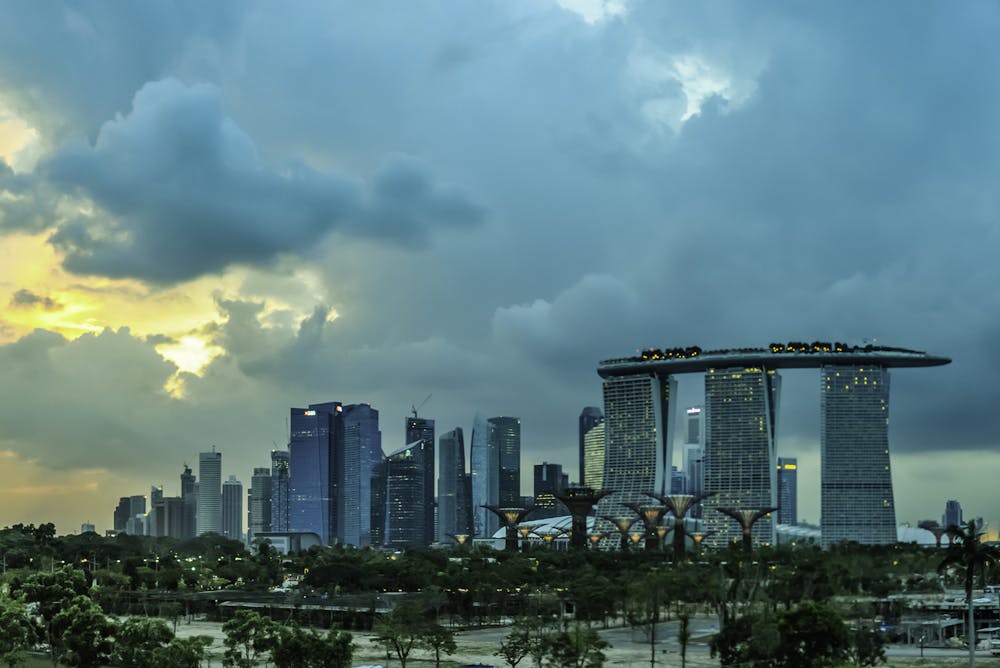 Cities such as Singapore will get hotter.
Flickr/Mohammad Hasan, CC BY-NC
Records from Singapore indicate temperatures have increased by 1.1℃ over 42 years to 2014. This is nearly twice the average global rate of warming over recent decades and is opposite to expectations.
The difference appears to be due to a heat island effect caused by the city itself. This is important because changes in land use amplify background global climate change and put tropical cities at greater risk of extreme heat. As populations are concentrated in cities, this increases the risk to human health.
The mean average temperature for Singapore is about 27℃, whereas Jakarta in Indonesia is slightly warmer. At the scale of predicted mean annual temperature change, neither of these cities would become uninhabitable. But even a small temperature increase would make life more challenging.
This is made worse in at least some parts of the tropics, because total rainfall is increasing, suggesting a long-term rise in humidity. For example, average rainfall in Singapore increased by more than 500mm from 2,192mm in 1980 to 2,727mm in 2014.
Read more:
Urban growth, heat islands, humidity, climate change: the costs multiply in tropical cities
Deadly heat
People working outdoors are at higher risk, as are vulnerable populations, including the elderly. Under the IPCC’s high-emission trajectory, heat-related deaths in Jakarta in August are expected to rise from about 1,800 in 2010 to nearly 27,000 in 2050.
Cities such as Singapore will get hotter.
Flickr/Mohammad Hasan, CC BY-NC
Records from Singapore indicate temperatures have increased by 1.1℃ over 42 years to 2014. This is nearly twice the average global rate of warming over recent decades and is opposite to expectations.
The difference appears to be due to a heat island effect caused by the city itself. This is important because changes in land use amplify background global climate change and put tropical cities at greater risk of extreme heat. As populations are concentrated in cities, this increases the risk to human health.
The mean average temperature for Singapore is about 27℃, whereas Jakarta in Indonesia is slightly warmer. At the scale of predicted mean annual temperature change, neither of these cities would become uninhabitable. But even a small temperature increase would make life more challenging.
This is made worse in at least some parts of the tropics, because total rainfall is increasing, suggesting a long-term rise in humidity. For example, average rainfall in Singapore increased by more than 500mm from 2,192mm in 1980 to 2,727mm in 2014.
Read more:
Urban growth, heat islands, humidity, climate change: the costs multiply in tropical cities
Deadly heat
People working outdoors are at higher risk, as are vulnerable populations, including the elderly. Under the IPCC’s high-emission trajectory, heat-related deaths in Jakarta in August are expected to rise from about 1,800 in 2010 to nearly 27,000 in 2050.
 Working outdoors in the increased heat and humidity will get harder.
Flickr/Jorien, CC BY-NC
Even allowing for a significant increase in elderly people as the Indonesian population ages, this means about 15,000 excess deaths in this month. Estimates under high-emission predictions for the tropics and mid-latitudes suggest about a 40% decline in the ability to undertake manual work during the warmest month by 2050.
These impacts will be stronger in the seasonally wet tropics (such as the Northern Territory of Australia), where more extreme warming is expected than in the equatorial zone.
Predictions for Darwin, in northern Australia, suggest an increase in days with temperatures above 35℃ from 11 days a year in 2015 to an average of 43 days under the mid-range emission scenario (IPCC’s RCP4.5 scenario) by 2030 and an average of 111 (range 54-211) days by 2090. Under the higher emission scenario (IPCC’s RCP8.5), an average of 265 days above 35℃ could be reached by 2090.
In summary, while absolute temperatures are expected to rise more slowly in the tropics when compared with higher latitudes and polar regions, the combination of heat and rising humidity will make life challenging, but not impossible.
Working outdoors in the increased heat and humidity will get harder.
Flickr/Jorien, CC BY-NC
Even allowing for a significant increase in elderly people as the Indonesian population ages, this means about 15,000 excess deaths in this month. Estimates under high-emission predictions for the tropics and mid-latitudes suggest about a 40% decline in the ability to undertake manual work during the warmest month by 2050.
These impacts will be stronger in the seasonally wet tropics (such as the Northern Territory of Australia), where more extreme warming is expected than in the equatorial zone.
Predictions for Darwin, in northern Australia, suggest an increase in days with temperatures above 35℃ from 11 days a year in 2015 to an average of 43 days under the mid-range emission scenario (IPCC’s RCP4.5 scenario) by 2030 and an average of 111 (range 54-211) days by 2090. Under the higher emission scenario (IPCC’s RCP8.5), an average of 265 days above 35℃ could be reached by 2090.
In summary, while absolute temperatures are expected to rise more slowly in the tropics when compared with higher latitudes and polar regions, the combination of heat and rising humidity will make life challenging, but not impossible.
Authors: James Shulmeister, Professor, School of Earth and Environmental Sciences, University of Canterbury

















