

Angus Taylor's tech roadmap is fundamentally flawed — renewables are doable almost everywhere
- Written by Mark Diesendorf, Honorary Associate Professor, UNSW
The Morrison government on Tuesday revealed the five low-emissions technologies it will prioritise for investment. The so called “technology roadmap” offers scant support for renewable energy, for reasons that do not stand up to scrutiny.
The technologies at the centre of the roadmap are:
- clean hydrogen
- energy storage
- low-carbon steel and aluminium
- carbon capture and storage
- soil carbon.
Federal energy minister Angus Taylor said proven technologies such as solar and wind “are not the focus of the roadmap”.
Over the past week or so, Taylor has sought to justify the government’s lack of support for renewable energy. This includes saying two-thirds of Australia’s emissions now are produced “outside the electricity grid” – implying renewable energy has little role to play beyond the power sector. But I believe that claim is misleading.
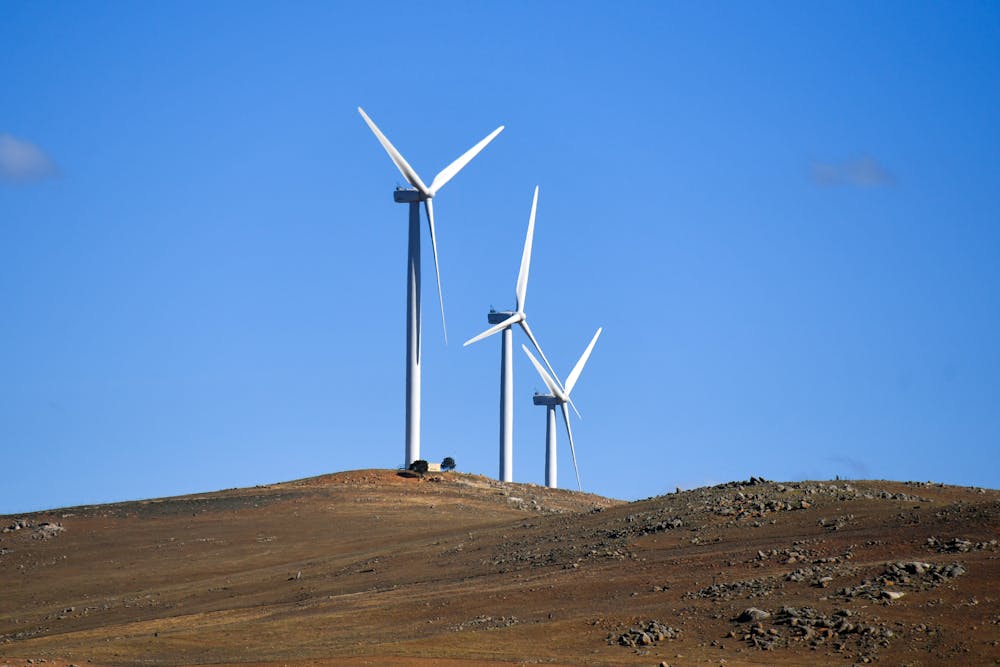 Renewable energy is not a focus in the roadmap.
AAP Image/Mick Tsikas
Renewable energy is not a focus in the roadmap.
AAP Image/Mick Tsikas
Renewables are versatile
The graph below, based on official data, shows the sources of Australia’s greenhouse gas emissions in 2018. It reveals 82% of the national total stems from energy emissions. This does not just include electricity generation, but non-electrical heating, transport, and emissions from extracting, moving and using fossil fuels (or fugitive emissions).
Almost all these emissions can be avoided by renewable energy, such as by:
using electric heat pumps (such as reverse cycle air conditioners), solar hot water, and geothermal and solar thermal for heating
replacing gas and coal with renewable energy for heating in industrial processes
a transition to electric vehicles plus cycling and walking.
Technologies to support these uses are already commercially available.
Renewable electricity cannot directly replace fossil fuel use in activities such as air and sea transport, and industrial processes such as steel-making. But with a bit of development, it can be used to produce “green” hydrogen and ammonia, which promise to decarbonise those areas.
Hydrogen is not the emissions reduction panacea Taylor seems to suggest it is. However, together with energy efficiency, green hydrogen could substitute for Australia’s non-energy industrial emissions (6.4%) together with those from air and sea transport (about 5%).
Hydrogen: a trojan horse?
The roadmap prioritises “clean” hydrogen. This does not just refer to hydrogen produced using renewables — the government says hydrogen can be produced cleanly with coal and gas if resulting carbon is captured and stored. In fact, the plan claims fossil fuel-derived hydrogen “might be the lowest cost clean production methods in the short-term”.
Carbon capture and storage is an expensive, energy-wasting technology. Despite federal governments having spent more than A$1.3 billion on the technology, a commercially viable plant has not come to fruition.
Read more: Earth may temporarily pass dangerous 1.5℃ warming limit by 2024, major new report says
The government will also establish Australia’s first regional hydrogen hub, at a cost of A$70 million, to “scale-up demand and take advantage of the advancements in this low emissions, high powered source of energy”.
Almost all the proposed locations are close to coal mines or gas field, suggesting the government is preparing to wager big on hydrogen from fossil fuels.
In fact, the government’s plans on hydrogen (and associated steel and aluminium production), as well as carbon capture, may all lock in fossil fuel use for decades. This outcome is completely at odds with what’s needed to address the climate emergency.
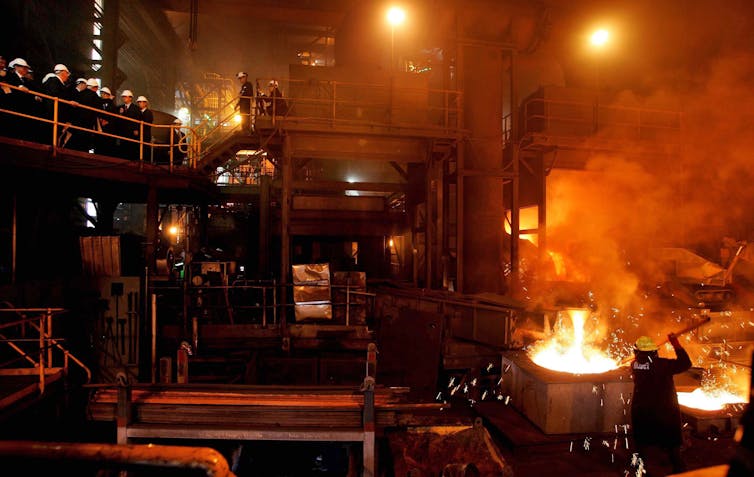 Steel made from renewables-derived hydrogen will substantially reduce emissions.
AAP
Steel made from renewables-derived hydrogen will substantially reduce emissions.
AAP
Renewable energy: a market failure
The Morrison government says solar panels and wind farms “are now clearly commercially viable and have graduated from the need for government subsidies”. The roadmap classifies renewables as mature technologies, giving them low priority.
The government intends only to invest in such mature technologies “where there is a clear market failure, like a shortage of dispatchable generation, or where these investments secure jobs in key industries.”
Read more: Morrison government lays down five technologies for its clean energy investment
But an existing market failure means the future of wind and solar farms is by no means assured. Congestion on transmission lines is limiting renewables growth. More infrastructure is urgently needed to connect renewable energy to the grid, and transmit it where required.
Federal funding is also needed urgently to help the states create renewable energy zones, as recommended by the Australian Energy Market Operator (AEMO). These areas would involve the coordinated development of grid infrastructure, such as transmission lines, in places with big renewable energy potential.
Yet the government package doesn’t prioritise these essential measures – and markets will not build them.
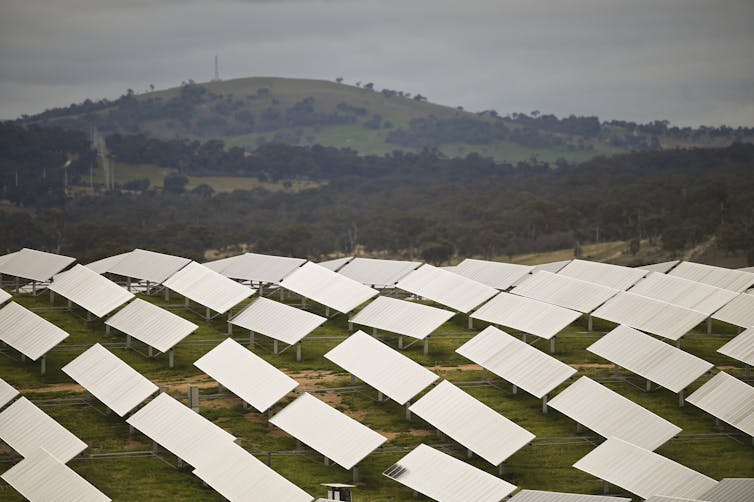 The government must invest more to integrate renewable energy into the grid.
AAP/Lukas Coch
The government must invest more to integrate renewable energy into the grid.
AAP/Lukas Coch
Reason to hope
Amid the economic downturn brought on by COVID-19, there were high hopes the Morrison government would invest in a green-led recovery. While its roadmap contains a few bright spots, such as a focus on energy storage, overall it is not the emissions-busting plan Australia needed.
But there is reason for hope. In the absence of federal government leadership on emissions reduction, others are stepping up with ideas. The Million Jobs Plan, for example, envisages investment in zero-emissions technologies that could create more than a million new jobs in Australia over five years. The plan, by think tank Beyond Zero Emissions, has been backed by Atlassian co-founder Mike Cannon-Brookes and senior business leaders. Other groups have proposed similarly promising plans.
The government’s latest energy plans are a failure of logic. An economic recovery that moves Australia far beyond fossil fuels is the way forward environmentally, socially and economically.
Authors: Mark Diesendorf, Honorary Associate Professor, UNSW

















