

Australians recorded frog calls on their smartphones after the bushfires – and the results are remarkable
- Written by Jodi Rowley, Curator, Amphibian & Reptile Conservation Biology, Australian Museum
Frogs are one of the most threatened groups of animals on Earth. At least four of Australia’s 240 known frog species are extinct and 36 are nationally threatened. After last summer’s bushfires, we needed rapid information to determine which frogs required our help.
This was a challenging task. The fire zone ranged from southern Queensland through New South Wales and Victoria, to Kangaroo Island off South Australia. The area was too large for scientists alone to survey, especially with COVID-19 travel restrictions.
But all was not lost. Thousands of everyday citizens across the fire zone, armed with their mobile phones, began monitoring their local frogs through an app called FrogID.
In research published today, we reveal how 45 frog species, some rare and threatened, were recorded calling after the fires. This has allowed us to collate a snapshot of where frog species are surviving – at least for now.
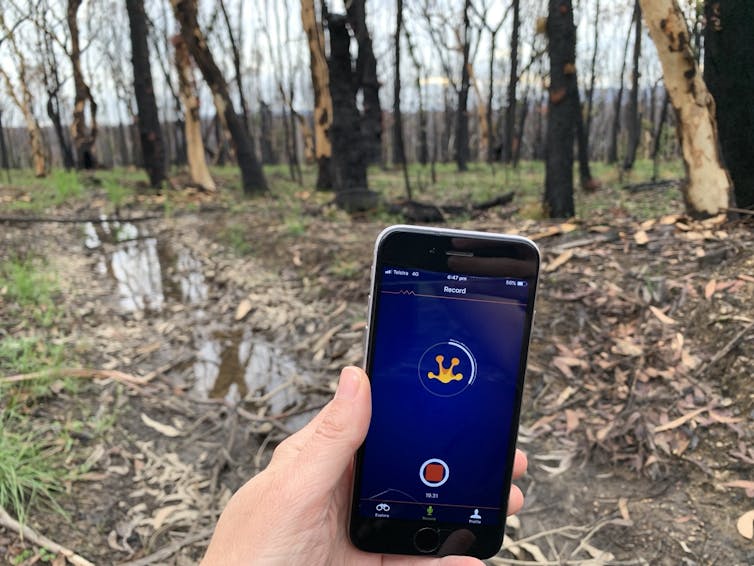 The FrogID app means anyone can help monitor frog numbers.
Jodi Rowley
The FrogID app means anyone can help monitor frog numbers.
Jodi Rowley
Good news for a change
In late 2019 and early 2020, more than 17 million hectares of forest burned in Australia. By size, it was the largest fire season in southeastern Australia since European occupation.
Scientists knew the damage to many plant and animal species was likely to be dramatic, particularly for species already in trouble. Many of Australia’s frog species are already vulnerable, due to pressures such as disease and habitat loss. There was a very real risk the fires had pushed many frog species closer to extinction. However, information on how frogs respond to fires has historically been limited.
Read more: A few months ago, science gave this rare lizard a name – and it may already be headed for extinction
FrogID is a free app downloaded to smart phones. Led by the Australian Museum, the project allows anyone to record a frog call and upload it. The FrogID team then identifies the species by its call, to create a national frog database.
Since the app launched in November 2017, more than 13,000 citizen scientists have recorded the calls of about 220,000 frogs across Australia. Before last summer’s fires, app users had submitted 2,655 recordings of 66 frog species in what would later become fire zones. This gave us a remarkable understanding of the frogs present before the fires.
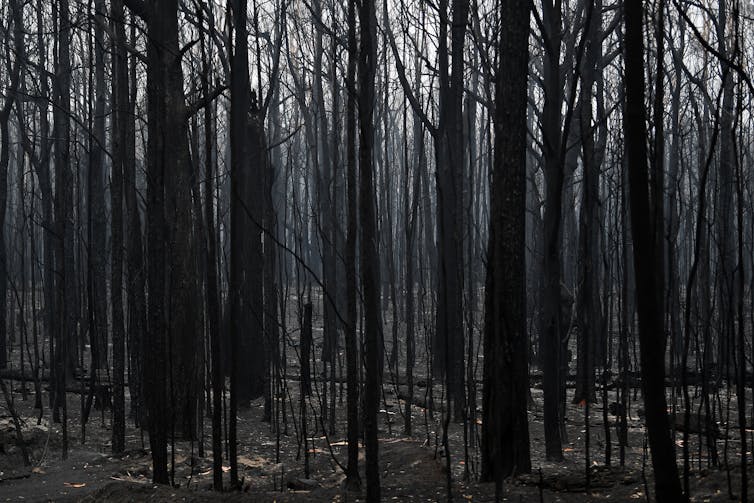 In some places, the fires burnt so intensely it was hard to imagine any wildlife survived.
Dean Lewins/AAP
In some places, the fires burnt so intensely it was hard to imagine any wildlife survived.
Dean Lewins/AAP
Within four months of the fires, app users submitted 632 recordings. These confirmed the existence of 45 of the 66 frog species known to live in the fire zones. Hearteningly, all 33 summer-breeding frog species recorded before the fires were also detected afterwards. In other words, there were no obviously “missing” frog species.
The frog species recorded most frequently in burnt areas were common, broadly distributed species of low conservation concern. These include the common eastern froglet (Crinia signifera) and striped marsh frog (Limnodynastes peronii).
However, rare and threatened species were also recorded in fire-damaged areas. These included:
the vulnerable southern barred frog (Mixophyes balbus), which lives in patches of forest along the NSW east coast. The species was recorded ten times after the fires in northern NSW
the mountain frog (Philoria kundagungan), endangered in NSW and known only from the headwaters of streams in a few pockets of rainforest in far northern NSW and southern Queensland. It is rarely encountered but was recorded once after the fires
the endangered giant barred frog (Mixophyes iteratus), found in forest from southeast Queensland to central NSW. It was recorded twice after the fires.
There was no clear trend in the ecological group or lifestyle of species that were detected post-fire. Burrowing frogs, tree frogs and ground-dwelling frogs were all detected, as were stream, pond, and land-breeding species.
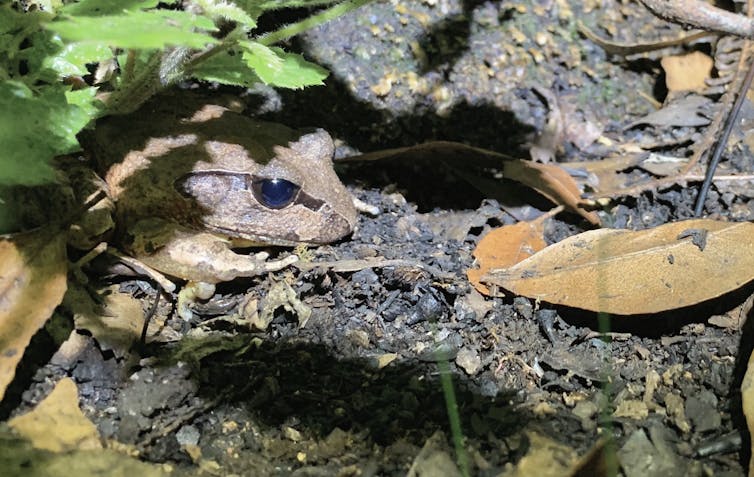 In many places, frogs survived the inferno against the odds.
Jodi Rowley
In many places, frogs survived the inferno against the odds.
Jodi Rowley
A powerful tool
The FrogID records are good news. They show some species have survived in the short term, and male frogs are calling to attract female frogs to mate with.
But there is still much we don’t know about the fate of these frogs. For example, many frogs species in southeastern Australia don’t call in the cooler months, so we don’t yet have a clear picture of how these species have fared over winter.
The frogs’ longer-term prospects also remain uncertain. Fire damage varies dramatically from place to place, and the survival of a frog species in one burnt area does not guarantee its survival in another. We remain worried about species with small geographic ranges, especially rainforest species more sensitive to fire.
Read more: A deadly fungus threatens to wipe out 100 frog species – here's how it can be stopped
We urgently need more information on how last summer’s fires affected Australia’s frogs. This is particularly important given the more frequent and severe fires predicted under climate change, combined with all the other threats frogs face.
Traditional biodiversity surveys by professionals will be needed. This is especially true for frog species of high conservation concern at remote or inaccessible sites, for which the FrogID app has little or no data.
But continued data collection by citizen scientists, through projects such as FrogID, will remain powerful tools. They allow information to be gathered quickly and at scale. This raises the chances that species suffering most after a catastrophic event might get the help they need.
Authors: Jodi Rowley, Curator, Amphibian & Reptile Conservation Biology, Australian Museum

















