

Going cashless isn't straightforward. Ask Sweden, or Zimbabwe
- Written by Chris Vasantkumar, Lecturer in Anthropology, Macquarie University
“No Cash Accepted” signs are increasingly common in Australian shops, thanks to COVID-19. Even before the the pandemic struck, though, we were well along the cashless path, with demand for coins halving between 2013 and 2019.
For the most part Australians have taken cashless payments in their stride. A fully cashless society is often envisaged as inevitable.
But the experiences of Sweden and Zimbabwe, two very different countries that have gone much farther down the path to a cashless society, highlight the pitfalls of such thinking. Sweden shows the need to safeguard access to cash. Zimbabwe shows the importance of the transition not being forced.
Read more: Cashless payment is booming, thanks to coronavirus. So is financial surveillance
Sweden’s cashless experience
Sweden was quick to move toward a cashless society. In the decade to 2018, its central bank, the Riksbank, says the proportion of purchases in shops using cash dropped from about 40% to 13%. Now even panhandlers and public toilets take cards or a mobile payment system called Swish.
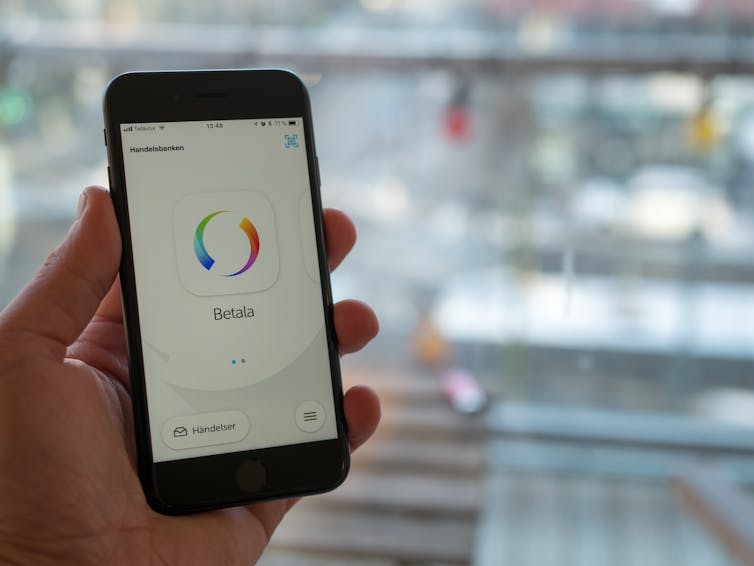 Sweden’s Swish payment system is widely used.
Shutterstock
Sweden’s Swish payment system is widely used.
Shutterstock
But the bloom started coming off Sweden’s cashless rose relatively quickly.
Over the past few years Swedes have been increasingly concerned about the elderly, those living in rural areas and people from migrant backgrounds being left behind by businesses switching to Swish no longer accepting cash.
Last year all but one of Sweden’s political parties supported new laws requiring Sweden’s major banks to continue to offer cash services across the country.
Britain’s government has also promised to guarantee access to cash, with the UK Treasury drafting legislation based on the Swedish laws.
Read more: Why a 'cashless' society would hurt the poor: A lesson from India
In Australia, research by the Reserve Bank of Australia (from 2019) suggests about a quarter of the population remain “high cash users”, for whom no longer being able to use cash would be “a major inconvenience or genuine hardship”:
These high cash users are more likely to be older, have lower household income, live in regional areas, and/or have limited internet access.
With the vast majority of Australians still wanting the choice of cash, the moral from Sweden is maintaining access to cash is likely to require regulation.
Read more: Depending on who you are, the benefits of a cashless society are greatly overrated
Zimbabwe’s cashless experience
The lesson from Zimbabwe’s experience with cashless transactions is rather different. It’s about the importance of the move to cashless being voluntary, and occurring organically.
While the conditions shaping Zimbabwe’s experience are unlikely to be replicated in Australia, it is nonetheless worth understanding for the broader moral.
In Sweden the transition to cashless payments was overwhelmingly welcomed. In Zimbabwe, the change was mixed up with bigger economic travails. It was neither wanted nor particularly welcomed.
Zimbabwe’s chequered history of economic crises include hyperinflation hitting 231,000,000% in October 2008. To deal with that problem, in 2009 the government suspended the Zimbabwean dollar and instead allowed Zimbabweans to use foreign currencies as legal tender. US dollars fast became the cash of choice.
This de facto “dollarisation” stabilised the economy, but it also resulted in a scarcity of cash. Supply could not be topped up by the government printing money. The supply of US dollars was also reduced by their use to buy imports as well as being stashed away as savings.
Government attempts to address this cash shortage, such the introduction of a “surrogate currency” in 2014, failed due to the lack of popular trust. Zimbabweans instead turned to electronic payment platforms such as Ecocash, a phone-based money-transfer service. By 2017, 96% of all transactions were electronic.
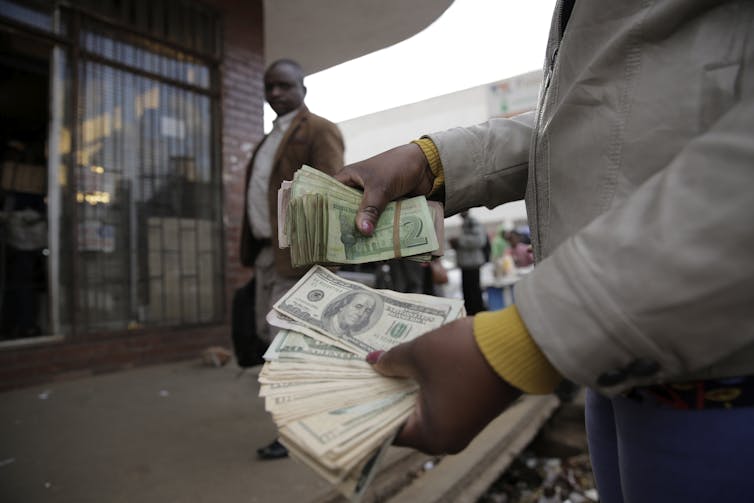 Zimbabwe reintroduced local currency in 2019. A foreign currency trader holds Zimbabwe and US dollars in Harare, Zimbabwe, June 2019.
Aaron Ufumeli/EPA
Zimbabwe reintroduced local currency in 2019. A foreign currency trader holds Zimbabwe and US dollars in Harare, Zimbabwe, June 2019.
Aaron Ufumeli/EPA
Use shapes understanding
In Sweden, the transition to cashless payments has not fundamentally affected people’s concepts of money and value.
In Zimbabwe, however, the move toward cashlessness has been experienced as a disruption of pre-existing forms of economic life, rather than their seamless extension.
It is tainted by distrust in government institutions and the value of all money. “Bad cash is better than good plastic!” as one street trader in Bulawayo (Zimbabwe’s second-largest city) told me.
This crisis of trust in the very understanding of money is worth noting at a time when the COVID-19 pandemic accelerates our move to cashless transactions. Changes in everyday economic life brought about by the shift to cashless transactions have the potential to reshape how we understand money in unpredictable ways.
Authors: Chris Vasantkumar, Lecturer in Anthropology, Macquarie University
Read more https://theconversation.com/going-cashless-isnt-straightforward-ask-sweden-or-zimbabwe-146187

















