

Wellington’s older houses don’t deserve blanket protection — but 6-storey buildings aren’t always the answer
- Written by Morten Gjerde, Associate Professor of Architecture, Te Herenga Waka — Victoria University of Wellington
The proposed blueprint for how Wellington will develop over the next 30 years puts its finger straight on one of the key issues affecting urban growth and change: residential character.
Specifically, the draft spatial plan, named Our City Tomorrow, recommends the architectural character of some inner suburbs should be given less protection.
The proposal has polarised residents, with those who fear for the character of their suburbs accused of being not-in-my-back-yard (NIMBY) enemies of progress.
The real issue is that residential character has, until now, been protected by a blanket rule that assumes any dwelling dating to 1930 or earlier contributes to that character within the wider suburb.
In itself this is not an insurmountable restriction on redevelopment of individual properties. However, it has been enough of a barrier to most landowners that the form of these suburbs has been largely unchanged for decades.
Old, draughty and cold
Despite their location in highly valued neighbourhoods, many of these properties have been poorly looked after. To borrow from the real estate lexicon, they’re often the “worst house in the best street”.
A not insignificant number of older houses have not been upgraded to meet rising standards for thermal insulation. But in Wellington’s scarce housing market almost any property can be rented. Landlords have little incentive to upgrade.
Read more: Cities will endure, but urban design must adapt to coronavirus risks and fears
These older properties, particularly those outside the proposed boundaries of character areas, are ripe for redevelopment. The new plan would mean the council will no longer have to ask whether they contribute to residential character.
While this might upset those intent on preserving the past, it bodes well for the health and well-being of future residents. There is no question that more can and should be done to eliminate cold and damp housing in New Zealand.
It’s easy to say “just bring the houses up to code”, and there are many examples of older homes that have been properly upgraded. But this is not always feasible. In those cases where the owner can’t make the financial case for improving their older property, it’s good to know they will soon have the opportunity to redevelop.
The case for density
The current housing crisis affecting Wellington and other New Zealand cities certainly provides a good incentive to redevelop. Building more densely, many experts believe, will leverage existing infrastructures such as sewers, roads and schools. More people living in an area will also enhance social vitality.
Indeed, the changes proposed by the Wellington City Council are largely aimed at enabling this. Central government is also targeting housing intensification through the recently adopted National Policy Statement on Urban Development (NPSUD).
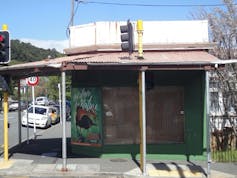 Pre-1930s buildings are not universally characterful or worthy of preserving, a point the current rules do not acknowledge.
Author provided
Pre-1930s buildings are not universally characterful or worthy of preserving, a point the current rules do not acknowledge.
Author provided
The NPSUD requires Wellington (and others cities with severe housing shortages) to provide for housing up to six storeys in height in areas within easy walking distance to the central city. This could lead to significant changes in characterful inner-city suburbs such as Wellington’s Mt Victoria.
However, replacing one blanket rule — restricting demolition of pre-1930s houses — with another blanket rule providing for tall buildings in fringe residential areas seems wrong.
Read more: Healthy, happy and tropical – world's fastest-growing cities demand our attention
Firstly, zoning rules are a blunt planning instrument that make it difficult for councils to regulate responsively. Every site and its setting is unique, yet the rules don’t allow for this. This is likely to create extreme height differences, where new six-storey buildings adjoin older one- and two-storey houses.
Such disparities will diminish the visual quality of the street. Many of Wellington’s older streets are relatively narrow. If built to the proposed plan, new buildings could diminish the spatial quality of these streets.
International research has found the best streets are at least as wide as the heights of the buildings along their edges. But buildings constructed under the new rules could rise up to one-and-a-half times the width of the street.
The not-so-high life
A second and perhaps more important issue is the reduction in quality of life that comes with living in taller buildings. Studies have found psychological strain increases with floor level, and people’s engagement with the street and neighbourhood drops off when living above the third floor.
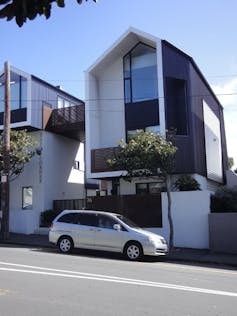 Well designed, higher density residential buildings can contribute to the character of older areas as evidenced by this award-winning project in Mt Victoria.
Author provided
Well designed, higher density residential buildings can contribute to the character of older areas as evidenced by this award-winning project in Mt Victoria.
Author provided
Jan Gehl, an international expert on building cities for people, suggests housing above the fifth floor no longer even belongs to the city. Given the evidence that housing should not be taller than four or five storeys, it’s not clear why the government has advocated for housing up to six storeys.
There can be little doubt more needs to be done to encourage housing that is healthy and located where people want to live. And the draft spatial plan’s two-pronged approach — relaxing the pre-1930s demolition rule and enabling higher densities — addresses the housing shortage around Wellington’s city centre.
But, while there is plenty to recommend removing protection for some older buildings, simply replacing them with buildings up to six storeys high seems a step too far.
NB: public submissions on the draft plan close on October 5.
Authors: Morten Gjerde, Associate Professor of Architecture, Te Herenga Waka — Victoria University of Wellington

















