

how one mine destroyed an island
- Written by Matthew G. Allen, Professor of Development Studies, The University of the South Pacific
This week, 156 people from the Autonomous Region of Bougainville, an island in Papua New Guinea, petitioned the Australian government to investigate Rio Tinto over a copper mine that devastated their homeland.
In 1988, disputes around the notorious Panguna mine sparked a lengthy civil war in Bougainville, leading to the deaths of up to 20,000 people. The war is long over and the mine has been closed for 30 years, but its brutal legacy continues.
Read more: Bougainville has voted to become a new country, but the journey to independence is not yet over
When I conducted research in Bougainville in 2015, I estimated the deposit of the mine’s waste rock (tailings) downstream from the mine to be at least a kilometre wide at its greatest point. Local residents informed me it was tens of metres deep in places.
I spent several nights in a large two-story house built entirely from a single tree dragged out of the tailings — dragged upright, with a tractor. Every new rainfall brought more tailings downstream and changed the course of the waterways, making life especially challenging for the hundreds of people who eke out a precarious existence panning the tailings for remnants of gold.
The petition has brought the plight of these communities back into the media, but calls for Rio Tinto to clean up its mess have been made for decades. Let’s examine what led to the ongoing crisis.
Triggering a civil war
The Panguna mine was developed in the 1960s, when PNG was still an Australian colony, and operated between 1972 and 1989. It was, at the time, one of the world’s largest copper and gold mines.
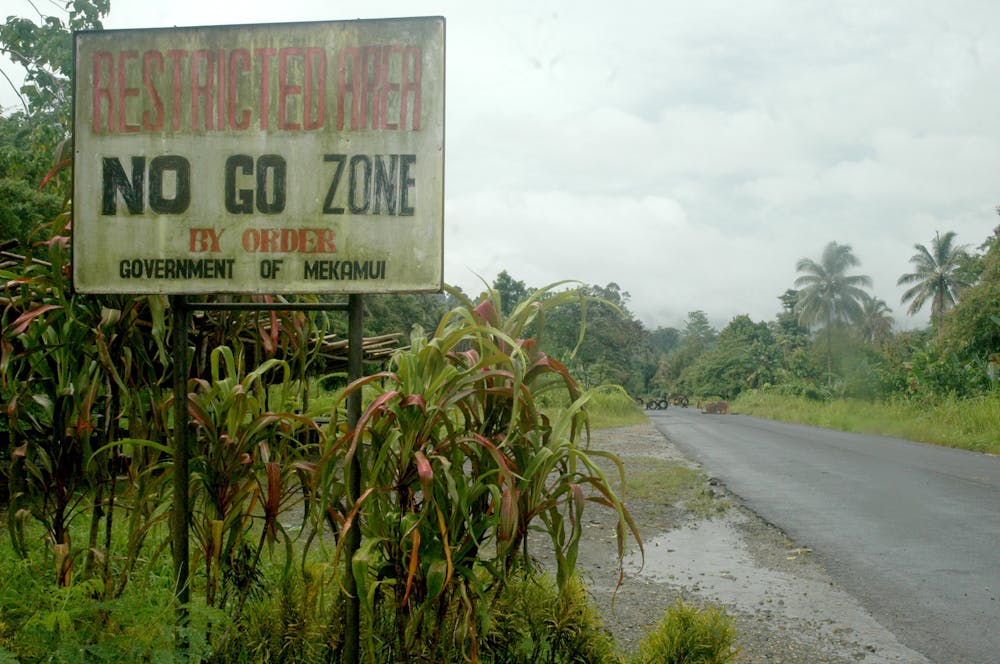 A no-go zone around the Panguna mine, set up by the Meekamui Defence Force, is signposted in Bougainville, 2008.
AAP Image/Ilya Gridneff
A no-go zone around the Panguna mine, set up by the Meekamui Defence Force, is signposted in Bougainville, 2008.
AAP Image/Ilya Gridneff
It was operated by Bougainville Copper Limited, a subsidiary of what is now Rio Tinto, until 2016 when Rio handed its shares to the governments of Bougainville and PNG.
When a large-scale mining project reaches the end of its commercial life, a comprehensive mine closure and rehabilitation plan is usually put in place.
Read more: PNG marks 40 years of independence, still feeling the effects of Australian colonialism
But Bougainville Copper simply abandoned the site in the face of a landowner rebellion. This was largely triggered by the mine’s environmental and social impacts, including disputes over the sharing of its economic benefits and the impacts of those benefits on predominantly cashless societies.
Following PNG security forces’ heavy-handed intervention — allegedly under strong political pressure from Bougainville Copper — the rebellion quickly escalated into a full-blown separatist conflict that eventually engulfed all parts of the province.
By the time the hostilities ended in 1997, thousands of Bougainvilleans had lost their lives, including from an air and sea blockade the PNG military had imposed, which prevented essential medical supplies reaching the island.
The mine’s gigantic footprint
The Panguna mine’s footprint was gigantic, stretching across the full breadth of the central part of the island.
The disposal of hundreds of millions of tonnes of tailings into the Kawerong-Jaba river system created enormous problems.
Rivers and streams became filled with silt and significantly widened. Water flows were blocked in many places, creating large areas of swampland and disrupting the livelihoods of hundreds of people in communities downstream of the mine. These communities used the rivers for drinking water and the adjacent lands for subsistence food gardening.
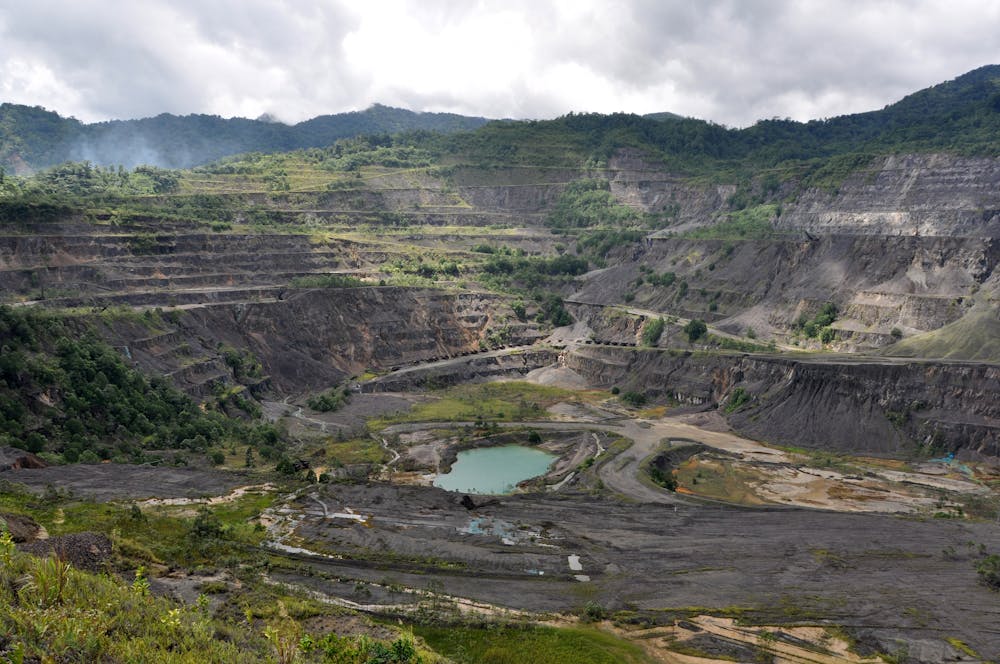 Part of the gigantic Panguna copper mine, one of the largest copper and gold deposits in the world.
AAP Image/Ilya Gridneff
Part of the gigantic Panguna copper mine, one of the largest copper and gold deposits in the world.
AAP Image/Ilya Gridneff
Several villages had to be relocated to make way for the mining operations, with around 200 households resettled between 1969 and 1989.
In the absence of any sort of mine closure or “mothballing” arrangements, the environmental and socio-economic impacts of the Panguna mine have only been compounded.
Since the end of mining activities 30 years ago, tailings have continued to move down the rivers and the waterways have never been treated for suspected chemical contamination.
Long-suffering communities
The 156 complainants live in communities around and downstream of the mine. Many are from the long-suffering village of Dapera.
In 1975, the people of Dapera were relocated to make way for mining activities. Today, it’s in the immediate vicinity of the abandoned mine pit. As one woman from Dapera told me in 2015:
I have travelled all over Bougainville, and I can say that they [in Dapera] are the poorest of the poor.
They, and others, sent the complaint to the Australian OECD National Contact Point after lodging it with Melbourne’s Human Rights Law Centre.
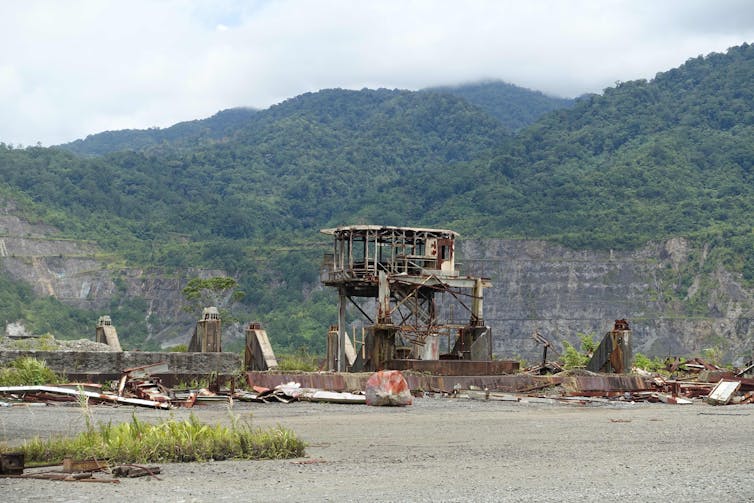 The Panguna mine’s footprint was gigantic, stretching across the full breadth of the central part of the island.
Matthew Allen
The Panguna mine’s footprint was gigantic, stretching across the full breadth of the central part of the island.
Matthew Allen
The complainants say by not ensuring its operations didn’t infringe on the local people’s human rights, Rio Tinto breached OECD guidelines for multinational enterprises.
The Conversation contacted Rio Tinto for comment. A spokesperson said:
We believe the 2016 arrangement provided a platform for the Autonomous Bougainville Government (ABG) and PNG to work together on future options for the resource with all stakeholders.
While it is our belief that from 1990 to 2016 no Rio Tinto personnel had access to the mine site due to on-going security concerns, we are aware of the deterioration of mining infrastructure at the site and surrounding areas, and claims of resulting adverse environmental and social, including human rights, impacts.
We are ready to enter into discussions with the communities that have filed the complaint, along with other relevant parties such as BCL and the governments of ABG and PNG.
A long time coming
This week’s petition comes after a long succession of calls for Rio Tinto to be held to account for the Panguna mine’s legacies and the resulting conflict.
A recent example is when, after Rio Tinto divested from Bougainville Copper in 2016, former Bougainville President John Momis said Rio must take full responsibility for an environmental clean-up.
And in an unsuccessful class action, launched by Bougainvilleans in the United States in 2000, Rio was accused of collaborating with the PNG state to commit human rights abuses during the conflict and was also sued for environmental damages. The case ultimately foundered on jurisdictional grounds.
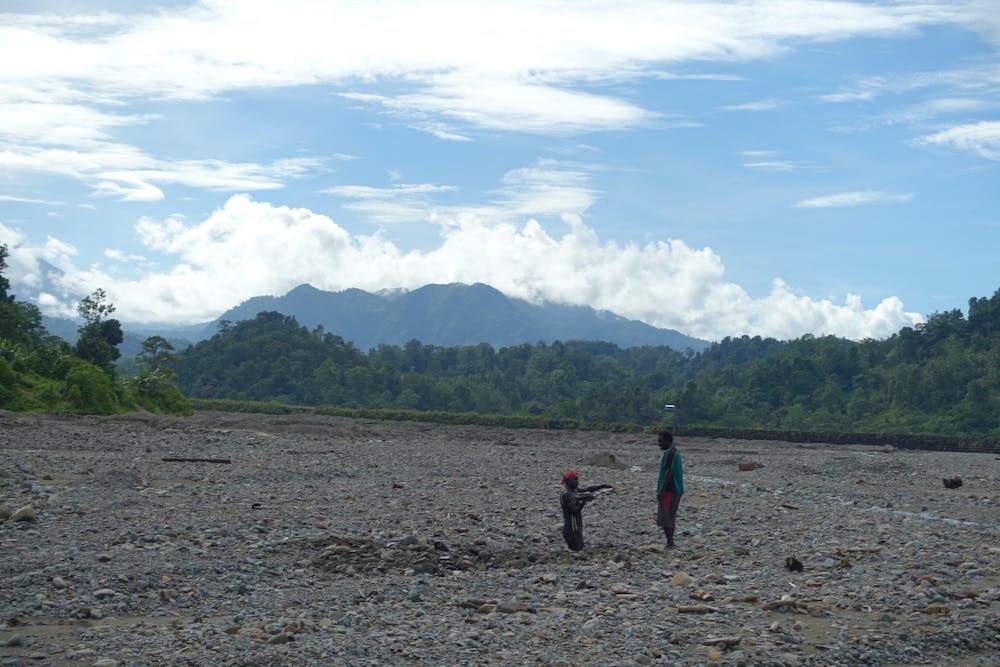 Hundreds of millions of tonnes of tailings were deposited in the rivers.
Matthew Allen, Author provided
Hundreds of millions of tonnes of tailings were deposited in the rivers.
Matthew Allen, Author provided
Taking social responsibility
This highlights the enormous challenges in seeking redress from mining companies for their operations in foreign jurisdictions, and, in this case, for “historical” impacts.
The colonial-era approach to mining when Panguna was developed in the 1960s stands in stark contrast to the corporate social responsibility paradigm supposedly governing the global mining industry today.
Read more: Be worried when fossil fuel lobbyists support current environmental laws
Indeed, Panguna — along with the socially and environmentally disastrous Ok Tedi mine in the western highlands of PNG — are widely credited with forcing the industry to reassess its “social license to operate”.
It’s clear the time has come for Rio to finally take responsibility for cleaning up the mess on Bougainville.
Authors: Matthew G. Allen, Professor of Development Studies, The University of the South Pacific

















