

La Niña will give us a wet summer. That's great weather for mozzies
- Written by Cameron Webb, Clinical Associate Professor and Principal Hospital Scientist, University of Sydney
The return of the La Niña weather pattern will see a wetter spring and summer in many parts of Australia.
We know mosquitoes need water to complete their life cycle. So does this mean Australia can expect a bumper mozzie season? How about a rise in mosquito-borne disease?
While we’ve seen more mosquitoes during past La Niña events, and we may well see more mosquitoes this year, this doesn’t necessarily mean we’ll see more related disease.
This depends on a range of other factors, including local wildlife, essential to the life cycle of disease-transmitting mosquitoes.
What is La Niña?
La Niña is a phase of the El Niño-Southern Oscillation, a pattern of ocean and atmospheric circulations over the Pacific Ocean.
While El Niño is generally associated with hot and dry conditions, La Niña is the opposite. La Niña brings slightly cooler but wetter conditions to many parts of Australia. During this phase, northern and eastern Australia are particularly likely to have a wetter spring and summer.
Australia’s most recent significant La Niña events were in 2010-11 and 2011-12.
Read more: Explainer: El Niño and La Niña
Why is wet weather important for mosquitoes?
Mosquitoes lay their eggs on or around stagnant or still water. This could be water in ponds, backyard plant containers, clogged gutters, floodplains or wetlands. Mosquito larvae (or “wrigglers”) hatch and spend the next week or so in the water before emerging as adults and buzzing off to look for blood.
If the water dries up, they die. But the more rain we get, the more opportunities for mosquitoes to multiply.
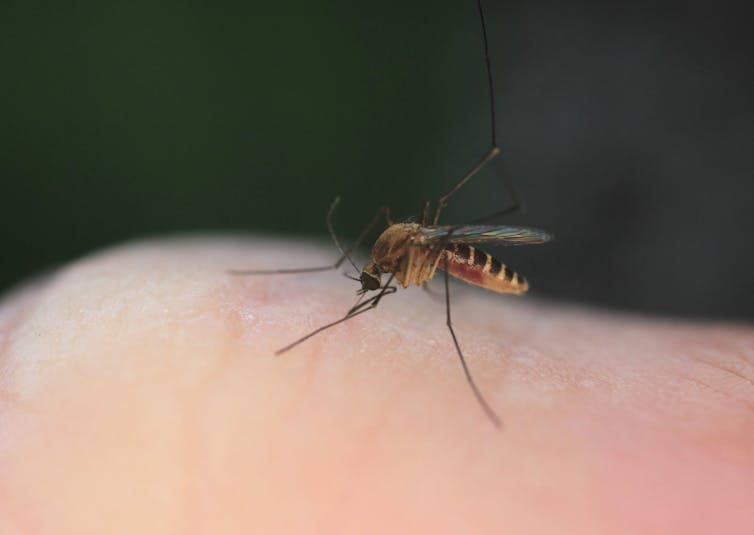 Mosquito populations often increase after wet weather.
Cameron Webb/Author provided
Mosquito populations often increase after wet weather.
Cameron Webb/Author provided
Mosquitoes are more than just a nuisance. When they bite, they can transmit viruses or bacteria into our blood to make us sick.
While Australia is free of major outbreaks of internationally significant diseases such as dengue or malaria, every year mosquitoes still cause debilitating diseases.
These include transmission of Ross River virus, Barmah Forest virus and the potentially fatal Murray Valley encephalitis virus.
Read more: Explainer: what is Murray Valley encephalitis virus?
What happens when we get more rain?
We’ve know for a long time floods provide plenty of water to boost the abundance of mosquitoes. With more mosquitoes about, there is a higher risk of mosquito-borne disease.
The amount of rainfall each summer is also a key predictor for seasonal outbreaks of mosquito-borne disease, especially Ross River virus.
Read more: Explainer: what is Ross River virus and how is it treated?
Inland regions of Queensland, New South Wales and Victoria, especially within the Murray Darling Basin, are particularly prone to “boom and bust” cycles of mosquitoes and mosquito-borne disease.
In these regions, the El Niño-Southern Oscillation is thought to play an important role in driving the risks of mosquito-borne disease.
The hot and dry conditions of El Niño aren’t typically ideal for mosquitoes.
But historically, major outbreaks of mosquito-borne disease have been associated with extensive inland flooding. This flooding is typically associated with prevailing La Niña conditions.
For instance, outbreaks of Murray Valley encephalitis in the 1950s and 1970s had significant impacts on human health and occurred at a time of moderate-to-strong La Niña events.
Read more: Our new model shows Australia can expect 11 tropical cyclones this season
Over the past decade, when La Niña has brought above average rainfall and flooding, there have also been outbreaks of mosquito-borne disease.
These have included:
Victoria’s record breaking epidemic of Ross River virus in 2016-17 after extensive inland flooding
southeast Queensland’s outbreak of Ross River virus in 2014-15, partly attributed to an increase in mosquitoes associated with freshwater habitats after seasonal rainfall
eastern Australia’s major outbreaks of mosquito-borne disease associated with extensive flooding during two record breaking La Niñas between 2010 and 2012. These included Murray Valley encaphalitis and mosquito-borne illness in horses caused by the closely related West Nile virus (Kunjin strain).
We can’t say for certain there will be more disease
History and our understanding of mosquito biology means that with the prospect of more rain, we should expect more mosquitoes. But even when there are floods, predicting outbreaks of mosquito-borne disease isn’t always simple.
This is because of the role wildlife plays in the transmission cycles of Ross River virus and Murray Valley encephalitis virus.
Read more: After the floods come the mosquitoes – but the disease risk is more difficult to predict
In these cases, mosquitoes don’t hatch out of the floodwaters carrying viruses, ready to bite humans. These mosquitoes first have to bite wildlife, which is where they pick up the virus. Then, they bite humans.
So how local animals, such as kangaroos, wallabies and water birds, respond to rainfall and flooding will play a role in determining the risk of mosquito-borne disease. In some cases, flooding of inland wetlands can see an explosion in local water bird populations.
How can we reduce the risks?
There isn’t much we can do to change the weather but we can take steps to reduce the impacts of mosquitoes.
Wearing insect repellent when outdoors will help reduce your chance of mosquito bites. But it’s also important to tip out, cover up, or throw away any water-holding containers in our backyard, at least once a week.
Local authorities in many parts of Australia also undertake surveillance of mosquitoes and mosquito-borne pathogens. This provides an early warning of the risk of mosquito-borne disease.
Read more: The worst year for mosquitoes ever? Here's how we find out
Authors: Cameron Webb, Clinical Associate Professor and Principal Hospital Scientist, University of Sydney
Read more https://theconversation.com/la-nina-will-give-us-a-wet-summer-thats-great-weather-for-mozzies-147180

















