

How COVID is widening the academic gender divide
- Written by Kirsty Duncanson, Senior Lecturer in Crime, Justice and Legal Studies, La Trobe University
From the first rumblings of its spread, COVID-19’s impact on women academics was immediate. In a sign of the gendered nature of the pandemic’s impacts, men’s research submissions to academic journals almost instantly increased by 50%, single-author articles by women dropped.
The structure of labour and reward at universities has long followed gendered lines. During the pandemic, these lines have become more entrenched.
We brought our research together to map how resources at Australian universities are distributed along gendered lines. Our work shows the impacts of the pandemic have compounded the inequities of that resource distribution.
Read more: Why degree cost increases will hit women hardest
Why resource distribution matters
Ostensibly, teaching is a central function of universities. Yet the number of publications you amass and the amount of money you earn through research grants are valued more. Year to year, these measures affect your research and teaching time allocations (many universities penalise low publication rates with increased teaching load), teaching support, applications for promotion, grants and, in this climate, keeping your job.
Academic research and publication require resources: time, money and networks.
Before COVID-19, resources were already tight. Continued cuts to research funding have led to massive financial gaps.
The resulting restructuring left fewer staff to deliver teaching and less money and time to allocate. And as revenue from international students became an economic necessity for many tertiary institutions, teaching loads did not decrease.
Unequal resources reinforce gender inequity
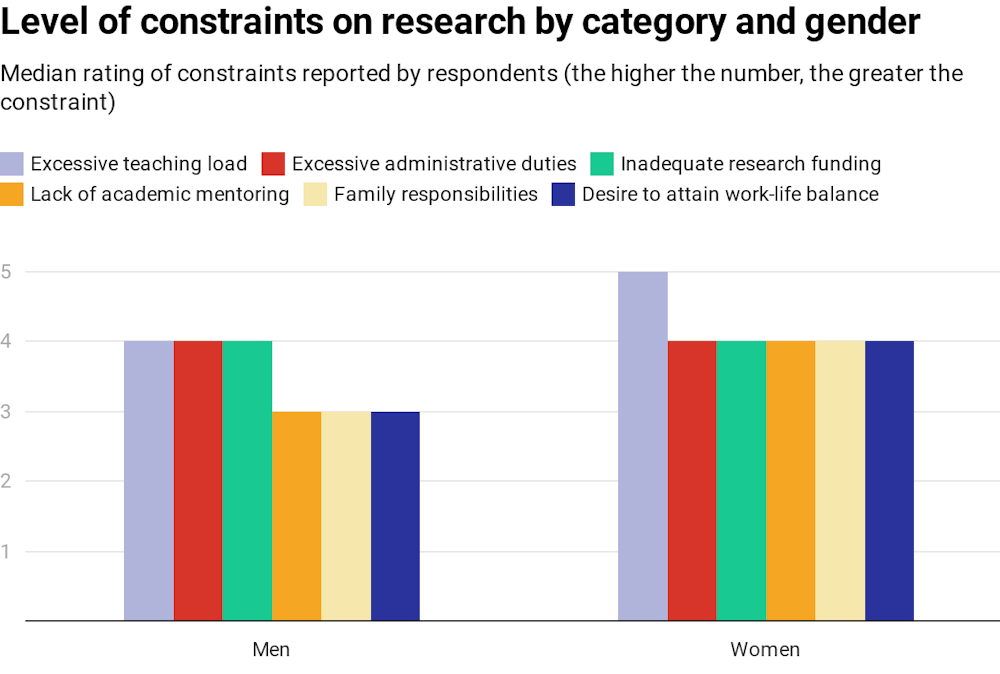
In this climate, a forthcoming research paper by two of us (Khan and Siriwardhane) shows the most important barrier to academic women’s career progression is resource distribution. Surveying over 500 academics (men 51%, women 49%) in the STEMM (science, technology, engineering, mathematics and medicine) and business disciplines across Australia, this research found these resources were unevenly spread before COVID-19.
Female researchers reported excessive workloads were the greatest constraint on undertaking research (male median rating 4, female median 5, with the higher number indicating a higher level of constraint). But lack of academic mentoring (male median 3, female median 4) and weight of family responsibilities were significant barriers to publication (male median 3, female median 4) and thus to career progression.
 Khan & Siriwardhane, Author provided
And then came the pandemic
COVID-19 hit universities at several levels.
The drop in international enrolments was instantly financially devastating.
This was followed by a mid-semester reconfiguration of face-to-face teaching for online delivery. There was no on-site access to libraries, laboratories were closed and fieldwork was halted. Academics and students were working from home.
And then the schools closed. Academics working from home now had to oversee their own children’s remote learning too.
Two of us (Weir and Duncanson) got together to track how COVID-19 policies were affecting academics across Australia. A survey of academics from all over Australia and abroad showed the impacts follow similar gendered lines. There was also a broad increase in workloads and care responsibilities across gender categories.
One woman academic told us:
The workload has been exponential since moving to teaching online. Coupled with normal workload responsibilities it has been impossible to complete in the 35 paid hours per week.
In this survey, academics reported that, while they already worked more hours than they were being paid, their hours increased greatly due to COVID-19. They reported workloads of at least 50 hours a week, working nights and weekends.
The transition to online teaching was the main factor. And because women delivered the majority of teaching they felt this impact more acutely. One said:
We have been asked to redesign the course I co-ordinate to fit the new course architecture. Meetings are often on days when I don’t work. I can probably get my co-ordination role done in the time I am paid for but if I want to do research then that is often on my own time – even though I am supposed to have a 50% research role.
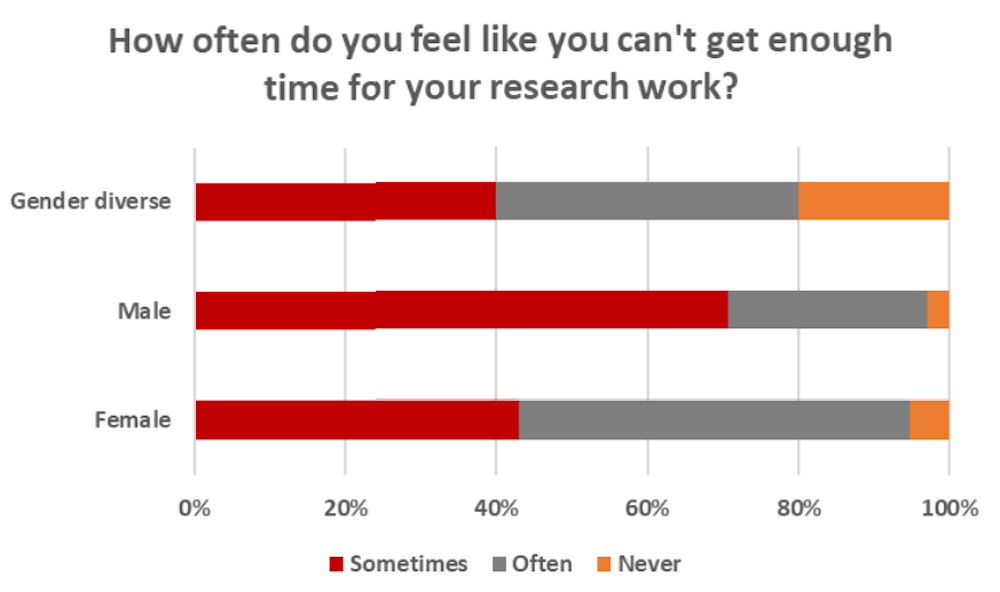
Despite working more hours, the majority of respondents reported having less time for research. Again, women felt this most acutely. Many women reported their research was suffering due to increased teaching and service workloads.
Khan & Siriwardhane, Author provided
And then came the pandemic
COVID-19 hit universities at several levels.
The drop in international enrolments was instantly financially devastating.
This was followed by a mid-semester reconfiguration of face-to-face teaching for online delivery. There was no on-site access to libraries, laboratories were closed and fieldwork was halted. Academics and students were working from home.
And then the schools closed. Academics working from home now had to oversee their own children’s remote learning too.
Two of us (Weir and Duncanson) got together to track how COVID-19 policies were affecting academics across Australia. A survey of academics from all over Australia and abroad showed the impacts follow similar gendered lines. There was also a broad increase in workloads and care responsibilities across gender categories.
One woman academic told us:
The workload has been exponential since moving to teaching online. Coupled with normal workload responsibilities it has been impossible to complete in the 35 paid hours per week.
In this survey, academics reported that, while they already worked more hours than they were being paid, their hours increased greatly due to COVID-19. They reported workloads of at least 50 hours a week, working nights and weekends.
The transition to online teaching was the main factor. And because women delivered the majority of teaching they felt this impact more acutely. One said:
We have been asked to redesign the course I co-ordinate to fit the new course architecture. Meetings are often on days when I don’t work. I can probably get my co-ordination role done in the time I am paid for but if I want to do research then that is often on my own time – even though I am supposed to have a 50% research role.
Despite working more hours, the majority of respondents reported having less time for research. Again, women felt this most acutely. Many women reported their research was suffering due to increased teaching and service workloads.
 Academic Life in the Time of COVID-19, Duncanson & Weir, Author provided
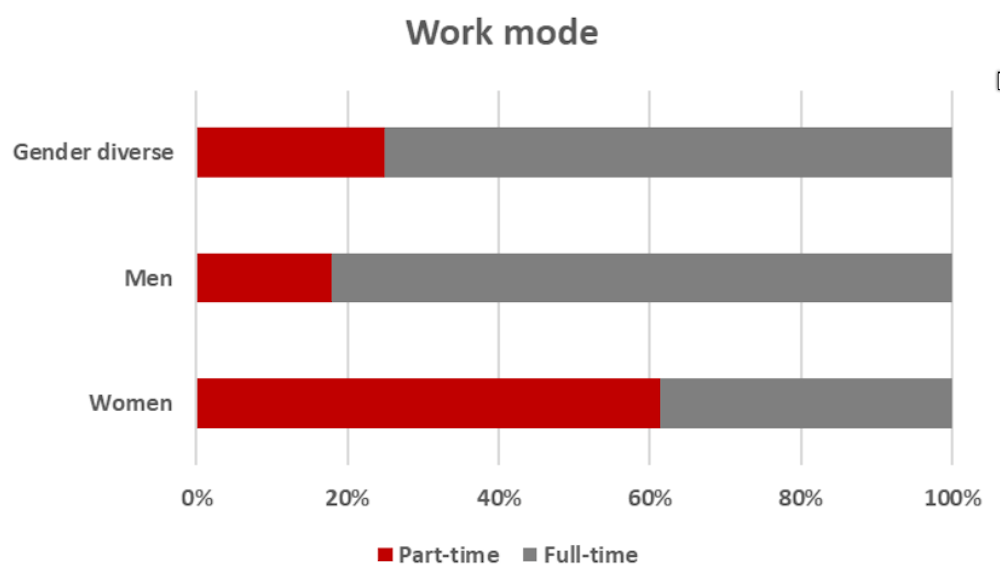
Gender non-binary participants are mainly employed in the teaching-heavy, casualised levels of the academic hierarchy. Thus, they were more vulnerable to non-research focused increases in workload. One-third of these respondents were providing care for people in need of support.
Academic Life in the Time of COVID-19, Duncanson & Weir, Author provided
Gender non-binary participants are mainly employed in the teaching-heavy, casualised levels of the academic hierarchy. Thus, they were more vulnerable to non-research focused increases in workload. One-third of these respondents were providing care for people in need of support.
 Academic Life in the Time of COVID-19, Duncanson & Weir, Author provided
Women with caring responsibilities are suffering the most. Although over 50% of academics with primary-school-aged children recorded that they share home-schooling responsibilities, over 50% of women respondents with caring obligations reported being solely responsible for home schooling and the care of adults requiring support. One told us:
Children simply can’t/won’t stay out of the room while I’m teaching. I have just incorporated their presence into my delivery of material. In meetings, I can often go off-screen and mute to manage.
Academic Life in the Time of COVID-19, Duncanson & Weir, Author provided
Women with caring responsibilities are suffering the most. Although over 50% of academics with primary-school-aged children recorded that they share home-schooling responsibilities, over 50% of women respondents with caring obligations reported being solely responsible for home schooling and the care of adults requiring support. One told us:
Children simply can’t/won’t stay out of the room while I’m teaching. I have just incorporated their presence into my delivery of material. In meetings, I can often go off-screen and mute to manage.
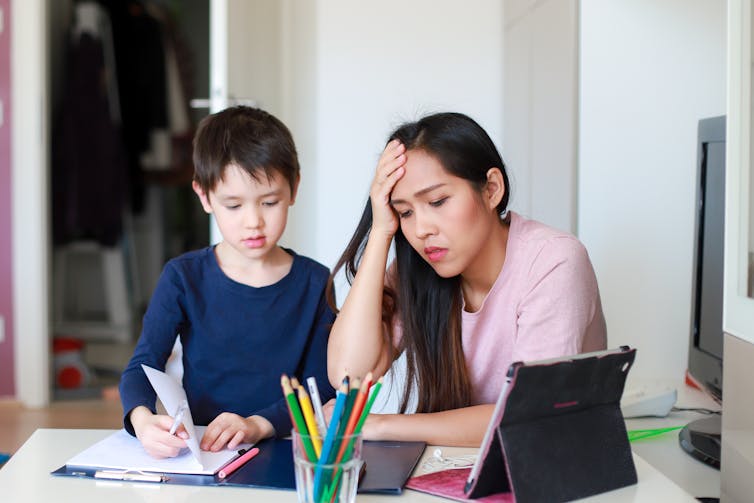 Women shouldered most of the responsibility of helping children with remote learning when schools closed.
Onjira Leibe/Shutterstock
In contrast, 8% of male respondents were solely responsible for home-schooling.
What work-life balance?
Many women academics are working around the clock to meet the needs of their work and their families.
The survey during the pandemic found women are also less likely to have a dedicated workspace. They work at dining room and kitchen tables, in living rooms and even garages. Women academics report being unable to dedicate even 20-minute periods to teaching, let alone research.
COVID-19 restrictions are laying bare structural discrimination at the heart of universities across Australia and making it worse.
Universities represent a microcosm of middle-class society. Academic life is understood to be comfortable and progressive. The heavily gendered structure of labour and reward even in this environment indicates how entrenched structural disadvantage and privilege are. And these conditions are calcifying as a result of COVID-19 restrictions.
Women shouldered most of the responsibility of helping children with remote learning when schools closed.
Onjira Leibe/Shutterstock
In contrast, 8% of male respondents were solely responsible for home-schooling.
What work-life balance?
Many women academics are working around the clock to meet the needs of their work and their families.
The survey during the pandemic found women are also less likely to have a dedicated workspace. They work at dining room and kitchen tables, in living rooms and even garages. Women academics report being unable to dedicate even 20-minute periods to teaching, let alone research.
COVID-19 restrictions are laying bare structural discrimination at the heart of universities across Australia and making it worse.
Universities represent a microcosm of middle-class society. Academic life is understood to be comfortable and progressive. The heavily gendered structure of labour and reward even in this environment indicates how entrenched structural disadvantage and privilege are. And these conditions are calcifying as a result of COVID-19 restrictions.
Authors: Kirsty Duncanson, Senior Lecturer in Crime, Justice and Legal Studies, La Trobe University
Read more https://theconversation.com/how-covid-is-widening-the-academic-gender-divide-146007

















