

does building and expanding motorways really reduce congestion and emissions?
- Written by Simon Kingham, Professor, University of Canterbury
 CC BY-ND
Climate Explained is a collaboration between The Conversation, Stuff and the New Zealand Science Media Centre to answer your questions about climate change.
If you have a question you’d like an expert to answer, please send it to climate.change@stuff.co.nz
Q: Does building and expanding motorways really reduce congestion and emissions, or does it increase it?
Historically, building more and wider roads, including motorways, was seen as a way of reducing congestion. This in turn is supposed to lower emissions.
The new motorways of the future.Fuel efficiency is optimised for driving at around 80kmh and it decreases the faster you go above that. But with speed limits up to 110kmh, people are likely to drive above 80kmh on motorways — and this means building and expanding motorways will actually increase emissions.
Many countries, especially in Europe, are now looking to lower speed limits partly to reduce emissions.
Read more:
Remove car lanes, restrict vehicles and improve transit to reduce traffic congestion
In addition to speeding, rapid acceleration and braking can lower mileage by 15-30% at highway speeds and 10-40% in stop-and-go traffic. If building or expanding motorways did reduce congestion, the smoother driving would be a benefit.
But this assumption is not backed by evidence. Research shows even on roads with no impediments drivers brake and accelerate unnecessarily, increasing congestion and emissions.
One of the arguments for future autonomous vehicles is that such braking and accelerating should not occur and emissions should reduce.
New roads, new drivers
The most significant impact new and expanded motorways have on congestion and emissions is the effect on the distance people travel.
Historically, engineers assumed cars (and more pertinently their drivers) would behave like water. In other words, if you had too much traffic for the road space provided, you would build a new road or expand an existing one and cars would spread themselves across the increased road space.
CC BY-ND
Climate Explained is a collaboration between The Conversation, Stuff and the New Zealand Science Media Centre to answer your questions about climate change.
If you have a question you’d like an expert to answer, please send it to climate.change@stuff.co.nz
Q: Does building and expanding motorways really reduce congestion and emissions, or does it increase it?
Historically, building more and wider roads, including motorways, was seen as a way of reducing congestion. This in turn is supposed to lower emissions.
The new motorways of the future.Fuel efficiency is optimised for driving at around 80kmh and it decreases the faster you go above that. But with speed limits up to 110kmh, people are likely to drive above 80kmh on motorways — and this means building and expanding motorways will actually increase emissions.
Many countries, especially in Europe, are now looking to lower speed limits partly to reduce emissions.
Read more:
Remove car lanes, restrict vehicles and improve transit to reduce traffic congestion
In addition to speeding, rapid acceleration and braking can lower mileage by 15-30% at highway speeds and 10-40% in stop-and-go traffic. If building or expanding motorways did reduce congestion, the smoother driving would be a benefit.
But this assumption is not backed by evidence. Research shows even on roads with no impediments drivers brake and accelerate unnecessarily, increasing congestion and emissions.
One of the arguments for future autonomous vehicles is that such braking and accelerating should not occur and emissions should reduce.
New roads, new drivers
The most significant impact new and expanded motorways have on congestion and emissions is the effect on the distance people travel.
Historically, engineers assumed cars (and more pertinently their drivers) would behave like water. In other words, if you had too much traffic for the road space provided, you would build a new road or expand an existing one and cars would spread themselves across the increased road space.
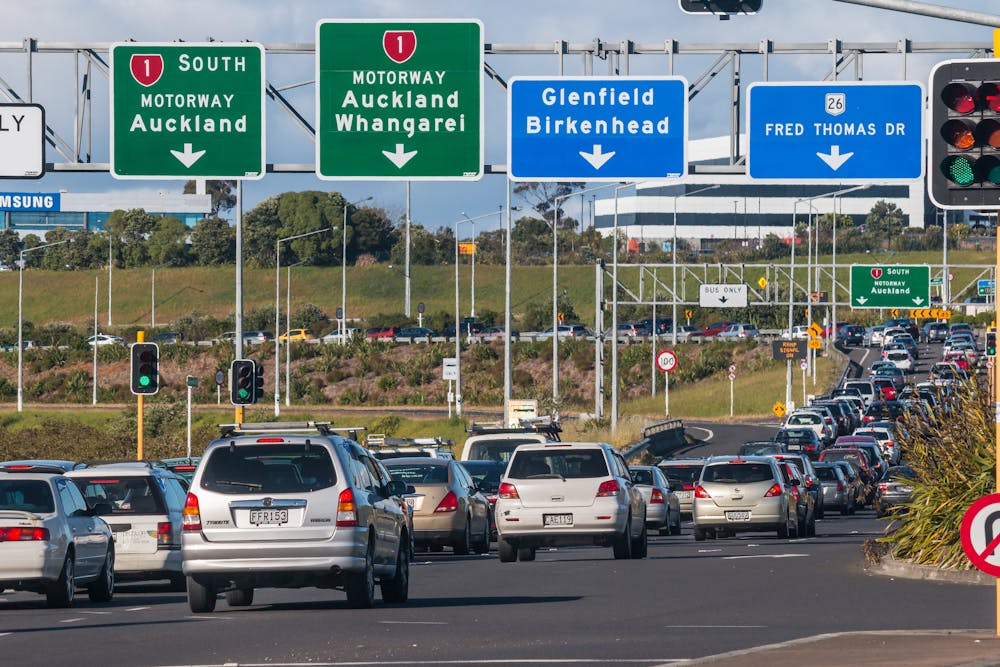 Congested traffic on a motorway into the centre of Auckland.
patjo/Shutterstock
Unfortunately, this is not what happens. New road capacity attracts new drivers. In the short term, people who had previously been discouraged from using congested roads start to use them.
In the longer term, people move further away from city centres to take advantage of new roads that allow them to travel further faster.
This is partly due to the “travel time budget” — a concept also known as Marchetti’s constant — which suggests people are prepared to spend around an hour a day commuting. Cities tend to grow to a diameter of one-hour travel time.
City sprawl
The concept is supported by evidence that cities have sprawled more as modes of transport have changed. For example, cities were small when we could only walk, but expanded along transport corridors with rail and then sprawled with the advent of cars. This all allows commuters to travel greater distances within the travel time budget.
Building or expanding roads releases latent demand — widely defined as “the increment in new vehicle traffic that would not have occurred without the improvement of the network capacity”.
This concept is not new. The first evidence of it can be found back in the 1930s. Later research in 1962 found that “on urban commuter expressways, peak-hour traffic congestion rises to meet maximum capacity”.
A considerable body of evidence is now available to confirm this. But, despite this indisputable fact, many road-improvement decisions continue to be based on the assumption that extra space will not generate new traffic.
If you build it, they will drive
A significant change occurred in 1994 when a report by the UK Advisory Committee on Trunk Road Appraisal confirmed road building actually generates more traffic.
In New Zealand, this wasn’t acknowledged until the Transport Agency’s 2010 Economic Evaluation Manual, which said:
[…] generated traffic often fills a significant portion (50–90%) of added urban roadway capacity.
Congested traffic on a motorway into the centre of Auckland.
patjo/Shutterstock
Unfortunately, this is not what happens. New road capacity attracts new drivers. In the short term, people who had previously been discouraged from using congested roads start to use them.
In the longer term, people move further away from city centres to take advantage of new roads that allow them to travel further faster.
This is partly due to the “travel time budget” — a concept also known as Marchetti’s constant — which suggests people are prepared to spend around an hour a day commuting. Cities tend to grow to a diameter of one-hour travel time.
City sprawl
The concept is supported by evidence that cities have sprawled more as modes of transport have changed. For example, cities were small when we could only walk, but expanded along transport corridors with rail and then sprawled with the advent of cars. This all allows commuters to travel greater distances within the travel time budget.
Building or expanding roads releases latent demand — widely defined as “the increment in new vehicle traffic that would not have occurred without the improvement of the network capacity”.
This concept is not new. The first evidence of it can be found back in the 1930s. Later research in 1962 found that “on urban commuter expressways, peak-hour traffic congestion rises to meet maximum capacity”.
A considerable body of evidence is now available to confirm this. But, despite this indisputable fact, many road-improvement decisions continue to be based on the assumption that extra space will not generate new traffic.
If you build it, they will drive
A significant change occurred in 1994 when a report by the UK Advisory Committee on Trunk Road Appraisal confirmed road building actually generates more traffic.
In New Zealand, this wasn’t acknowledged until the Transport Agency’s 2010 Economic Evaluation Manual, which said:
[…] generated traffic often fills a significant portion (50–90%) of added urban roadway capacity.
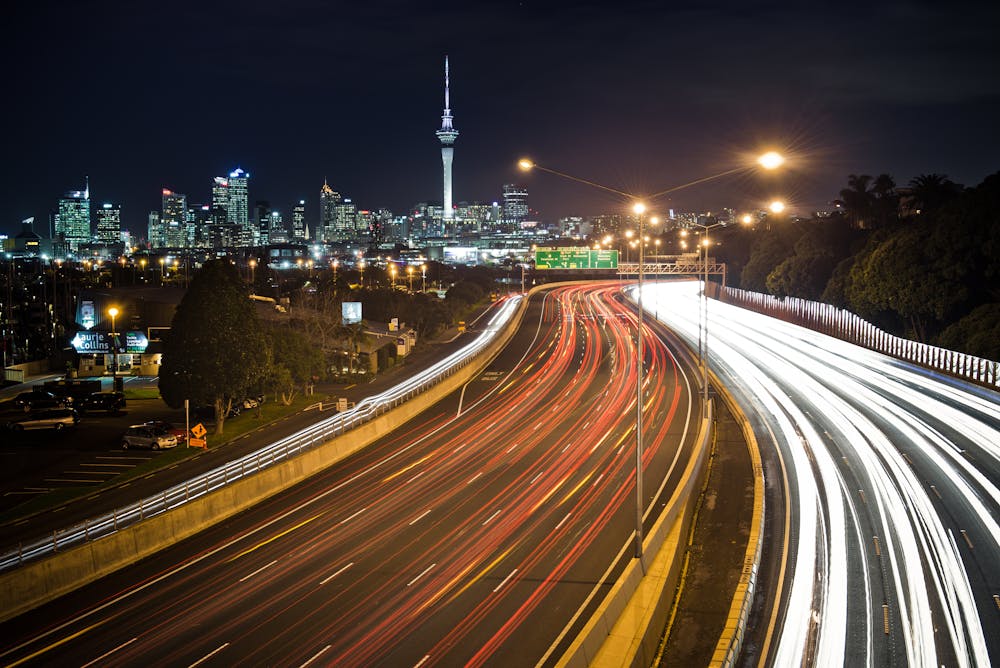 Traffic increases as motorways expand.
Shaun Jeffers/Shutterstock
Some congestion discourages people from driving (suppresses latent demand), but with no congestion traffic will fill road space over time, particularly in or near urban areas.
Interestingly, the opposite can also work. Where road space is removed, demand can be suppressed and traffic reduces without other neighbouring roads becoming overly congested.
Read more:
Climate explained: could electric car batteries feed power back into the grid?
One of the best examples of this is the closure of the Cheonggyecheon Freeway in the middle of Seoul, South Korea.
When the busy road was removed from the city, rather than the traffic moving to and congesting nearby roads, most of the traffic actually disappeared, as Professor Jeff Kenworthy from Curtin University’s Sustainable Policy Institute notes.
This suppression of latent demand works best when good alternative ways of travel are available, including high-quality public transport or separated cycle lanes.
The short answer to the question about road building and expansion is that new roads do little to reduce congestion, and they will usually result in increased emissions.
Traffic increases as motorways expand.
Shaun Jeffers/Shutterstock
Some congestion discourages people from driving (suppresses latent demand), but with no congestion traffic will fill road space over time, particularly in or near urban areas.
Interestingly, the opposite can also work. Where road space is removed, demand can be suppressed and traffic reduces without other neighbouring roads becoming overly congested.
Read more:
Climate explained: could electric car batteries feed power back into the grid?
One of the best examples of this is the closure of the Cheonggyecheon Freeway in the middle of Seoul, South Korea.
When the busy road was removed from the city, rather than the traffic moving to and congesting nearby roads, most of the traffic actually disappeared, as Professor Jeff Kenworthy from Curtin University’s Sustainable Policy Institute notes.
This suppression of latent demand works best when good alternative ways of travel are available, including high-quality public transport or separated cycle lanes.
The short answer to the question about road building and expansion is that new roads do little to reduce congestion, and they will usually result in increased emissions.
Authors: Simon Kingham, Professor, University of Canterbury

















