

The budget assumes a COVID-19 vaccine becomes available next year. Is this feasible?
- Written by Holly Seale, Senior Lecturer, UNSW
The Australian federal budget, unveiled on Tuesday, bases several assumptions on Australians having access to a COVID-19 vaccine in 2021.
This timeline is possible, according to researchers on the frontline of vaccine development. A survey published in early October asked 28 US and Canadian experts when they thought a COVID-19 vaccine would be available.
They weren’t optimistic a vaccine would be available before mid-2021, but on average thought September or October 2021 was achievable. However, several thought it could take until July 2022.
They also thought a vaccine could be available by March or April 2021 to people with a high risk of either contracting the disease or having serious consequences, such as health-care workers.
But in this scenario, it’s likely healthy adults will have to wait a while longer.
Even if we do get a successful vaccine, it won’t necessarily mark the immediate end of COVID-19. It might only be 60-70% effective, which means it won’t stop transmission completely, and spot fires of infection will continue to crop up.
Unfortunately, this means we have to accept the fact public health measures aren’t going away soon. Social distancing, mask-wearing, contact tracing, and limits on gatherings and workplaces will remain part of our lives for some time to come.
Governments and the media need to start communicating this to the public, rather than relying on the idea of a vaccine as a silver bullet.
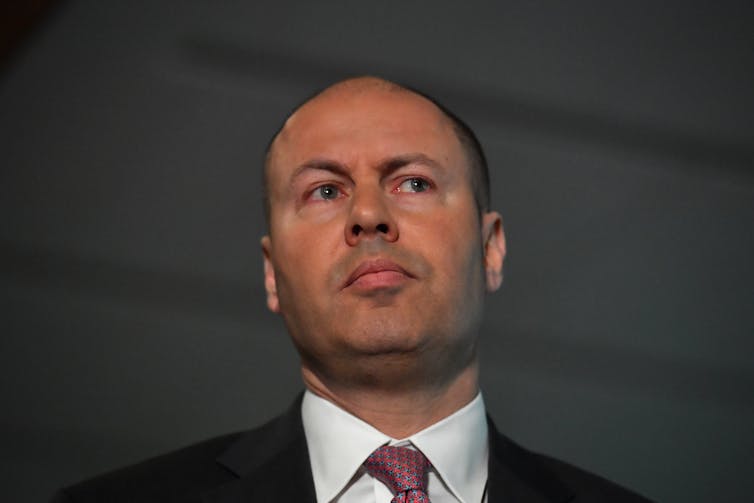 Treasurer Josh Frydenberg said ‘The budget takes into account the possibility that (the development of a vaccine next year) is the case.’
Mick Tsikas/AAP
Treasurer Josh Frydenberg said ‘The budget takes into account the possibility that (the development of a vaccine next year) is the case.’
Mick Tsikas/AAP
The political will is unprecedented
Traditionally, vaccines can take five to ten years from the lab to your arm. One of the fastest vaccines ever developed was for a viral infection called mumps, which took less than five years. A vaccine for ebola was also created in about five years. On face value, these may dampen expectations for our ability to make a successful COVID-19 vaccine in just one or two years.
However, unprecedented resources are being poured into the development of a COVID-19 vaccine. The funding available, the number of candidates, and the amount of researchers involved in development are greater than any vaccine previously. The World Health Organisation is tracking more than 190 candidate vaccines in varying stages of development.
There were vaccine candidates in the pipeline for other coronaviruses including SARS and MERS, but the dwindling nature of those outbreaks meant there wasn’t overwhelming political will to see those completed. But COVID-19 is still at pandemic status, meaning a vaccine is seen as vital.
Read more: Creating a COVID-19 vaccine is only the first step. It'll take years to manufacture and distribute
An approved vaccine is only one step
There are many things we still don’t know about potential COVID-19 vaccines. Successful candidates might require two or more doses, separated by an as yet unknown interval.
Manufacturing is another issue. Many of us might think once a vaccine is approved, the pandemic is over. But there needs to be enough produced to vaccinate everyone in Australia, which takes time.
What’s more, to reduce the risk of importing the virus, or if we want to travel overseas again, there may be a need to ensure robust COVID-19 vaccine programs have been implemented globally. If we’re looking at a two-shot vaccine, global coverage would require almost 16 billion doses, and probably more when accounting for loss of stock, logistical problems and so on. It will also take time to consistently test new batches and conduct safety monitoring of those who’ve received a shot.
Australians may need to rein in their love of travel for a few years yet. We should think about travelling locally and supporting local businesses, rather than jetting off to another continent.
Read more: The travel bubble with New Zealand includes NSW and the NT. Why have other states missed out?
Getting everyone vaccinated is another challenge
Once we have an approved vaccine, and have made enough of it, there are still hurdles to overcome.
We have a great system of childhood immunisation in Australia, but it’s a very different thing to get healthy adults vaccinated en masse. We don’t necessary have the same strong culture of immunisation towards healthy adults in this country. Public health officials are still battling to increase uptake of yearly flu vaccines.
Although vaccine coverage has surged this year, historically Australia has recorded less than optimal uptake for influenza vaccination for adults who are medically at-risk. And, our vaccine coverage for other recommend vaccines including for shingles, pneumococcal and whooping cough also needs improving.
In a study I led (yet to be peer-reviewed), my colleagues and I found 80% of the Australian residents surveyed agreed “getting myself vaccinated for COVID-19 would be a good way to protect myself against infection”. Another challenge, therefore, is there may be some people who have misgivings about receiving a vaccine.
To support future uptake to the required levels, we may need to focus on the factors that motivate people to get vaccinated. It may be necessary to highlight that getting immunised isn’t just to protect ourselves, but to protect our family, friends, colleagues, and community at large. This is particularly crucial given evidence COVID-19 can spread asymptomatically.
Read more: Young men are more likely to believe COVID-19 myths. So how do we actually reach them?
Beyond ensuring we promote acceptance of a vaccine to the public, we also need to minimise practical barriers. To improve access, we may need to offer the vaccine at multiple locations and times. For example, we could convert existing drive-through testing centres into drive-through immunisation clinics. We could also look to deliver people the vaccine via pharmacies, workplaces or community centres, or in other environments that make sense to them, like their local church, mosque, synagogue or temple.
Ultimately, the federal government’s belief that a vaccine will be available next year is plausible. But it’s not the full picture. The hurdles that exist in ending the pandemic go beyond the approval of a vaccine candidate.
Read more: Australia's just signed up for a shot at 9 COVID-19 vaccines. Here's what to expect
Authors: Holly Seale, Senior Lecturer, UNSW

















