

funding a shift from commuting to living locally
- Written by Benjamin Kaufman, PhD Candidate, Cities Research Institute, Griffith University
Long-term planning has delivered mass transit systems to cater for high-patronage, hub-and-spoke transport systems. Unfortunately, this has left many city residents without basic access to public transport services. And we could never have planned for the impacts of COVID-19.
Our previous plans were based on the best available data at the time. Today, these plans must be critically reviewed using new data that properly represent the world and our transport needs as they are now.
Read more: If more of us work from home after coronavirus we'll need to rethink city planning
Important facts to keep in mind
1: Fewer people commute to work.
The work-from-home transition is well under way. Our current transport networks (except for roads, which have rebounded to traffic equal to or above pre-pandemic levels in some cities) are operating far below previous levels, even allowing for social distancing. This may not be the best time to break ground on major infrastructure projects planned under previous assumptions of population and demand growth.
Read more: With management resistance overcome, working from home may be here to stay
2: Disadvantaged populations lack access to opportunities.
Public transport is key to enabling everyone in a population to be a productive member of society. Many disadvantaged groups cannot drive or afford car ownership. However, they also lack access to public transport, particularly in the outer suburbs.
Unfortunately, coronavirus impacts will hit the disadvantaged the hardest. If we want everyone to be able to participate in the economic recovery, we need to promote basic levels of access regardless of an individual’s circumstance.
Read more: Why coronavirus will deepen the inequality of our suburbs
3: Population growth will not meet projections.
Migration bans will greatly reduce short-term growth. Current projections show a population up to 4% smaller in 2040 than it would have been in a non-COVID world. This will further decrease demand for urban transit services as well as demand across many sectors of our society. These trends are important because much of our planning is based around these population growth metrics.
However, our suburbs still lack basic public transport services. If we want to increase patronage, we need to bring services to more people by improving coverage of our sprawling, low-density cities.
Over 80% of the population of our biggest cities live in the outer and middle suburbs, yet this massive majority have limited to no basic public transport service. Across our five largest cities, Infrastructure Australia reports, “public transport disadvantage in outer suburbs is significant”.
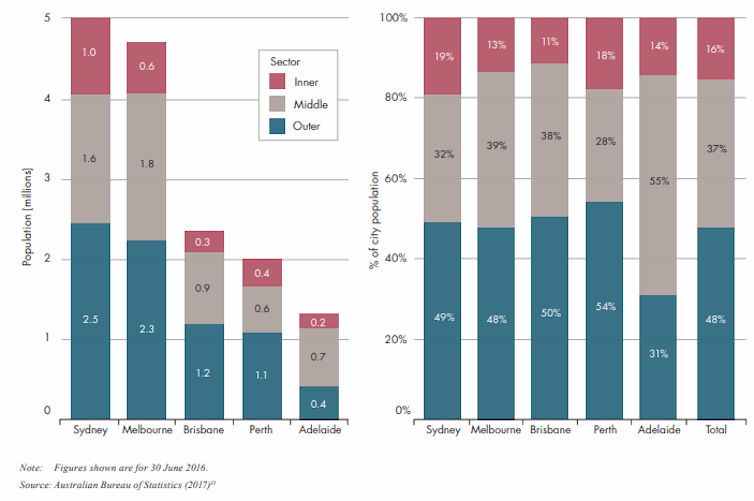 Estimated resident population by suburban classification, as count and proportion of city population.
Infrastructure Australia: Outer Urban Public Transport: Improving accessibility in lower-density areas
Estimated resident population by suburban classification, as count and proportion of city population.
Infrastructure Australia: Outer Urban Public Transport: Improving accessibility in lower-density areas
Households’ access to jobs and services gets much worse with increasing distance from the city centre. Development of suburban and regional mobility-as-a-service (MaaS) offerings could promote better access in these “harder to serve” areas.
Read more: For Mobility as a Service (MaaS) to solve our transport woes, some things need to change
Moving the country forward
Job creation will be an important aspect of economic recovery. Yet too often we look to large construction projects as the answer. There is plenty of other job-creating work to be done in our communities.
We could, for example, increase the miserly funding for our piecemeal walking and cycling networks.
We could also expand on-demand services to suburban and rural residents who lack basic public transport access. On-demand transit does not follow fixed routes or timetables. Riders book a trip for a cost similar to a bus fare.
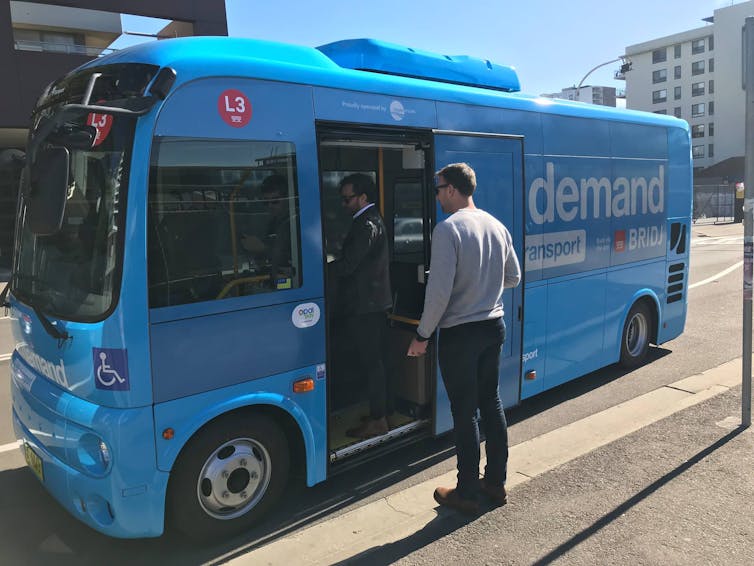 Bridj is one of the operators that is expanding on-demand services in Sydney and other cities.
Bridj Transit Systems/Facebook
Bridj is one of the operators that is expanding on-demand services in Sydney and other cities.
Bridj Transit Systems/Facebook
Read more: 1 million rides and counting: on-demand services bring public transport to the suburbs
These options will encourage local spending to support small businesses. These are an important piece of our social fabric and improve livability in our communities.
We need to look locally
A focus on localised investment in the many neglected communities across the country will deliver major benefits. Money already committed to large projects that are under way represents sunk costs that may be too deep to renegotiate. However, future plans using public funds must be re-examined.
Investments should target disadvantaged groups and broaden access to transport networks, encouraging new potential users. For many, assistance in gaining access to the necessities of life will be invaluable during the coming economic recovery. Guaranteed access to groceries, medical services, work opportunities and recreational activities must not be reserved for the elite.
We need better localised public transport and we need it for the majority of citizens, not just those who live in the inner suburbs of our capital cities. Most regional populations lack even rudimentary public transport coverage at reasonable frequency.
Increasing services in these areas will create valuable jobs that will stick around, unlike large one-off construction projects. The money will stay local, going into the pockets of operators who live and work in their own community.
While our long-term planning is not to blame for our current situation, we need to develop for the future, not the past. The financial costs of building and maintaining our current infrastructure are not going away. However, we can no longer refuse to invest in many of our underserved communities.
It is time to ensure everyone, regardless of their income or where they grow up, has the basic services they need to be a productive member of society.
Authors: Benjamin Kaufman, PhD Candidate, Cities Research Institute, Griffith University

















