

Millions of face masks are being thrown away during COVID-19. Here's how to choose the best one for the planet
- Written by Mayuri Wijayasundara, Lecturer, Deakin University
Face masks are part of our daily lives during the pandemic. Many are made from plastics and designed to be used just once, which means thousands of tonnes of extra waste going to landfill.
Masks may help stop the spread of the coronavirus. But according to one estimate, if everyone in the United Kingdom used a single-use mask each day for a year, it would create 66,000 tonnes of contaminated waste and 57,000 tonnes of plastic packaging.
Evidence also suggests masks may be a source of harmful microplastic fibres on land and in waterways and litter.
So let’s look at how face masks might be designed to cause minimal harm to the environment, while still doing their job – and which type is best for you.
 N95 masks are used in hospital settings.
Shutterstock
N95 masks are used in hospital settings.
Shutterstock
Circular thinking
China is the world’s biggest face mask manufacturer. Its daily output of face masks reportedly reached 116 million units in February this year. That creates a big waste management problem around the world.
One way to address this is to adopt “circular design” principles. This thinking seeks to reduce waste and pollution through product design, keep products and materials in use, and regenerate natural systems.
Read more: Which face mask should I wear?
When it comes to face masks, the three common types are cloth, surgical and N95. N95 masks offer the highest level of protection, blocking about 95% of airborne particles. Cloth masks are designed to be used more than once, while surgical and N-95 masks are usually intended for single use.
Face masks may consist of one or more layers, each with different functions:
- an outermost layer, designed to repel liquids such as water
- the innermost layer, which absorbs moisture and allows comfort and breathability
- a non-absorbent middle layer, to filter particles.
 Surgical masks are generally intended as single-use items.
BrendanThorne/AAP
Surgical masks are generally intended as single-use items.
BrendanThorne/AAP
Each type of mask is made of different materials and used in varying settings:
- N95 masks: These are designed to protect the wearer from 95% of airborne particles and are largely worn by health workers. N95 masks are designed to fit closely to the face and are usually worn only once. N95 masks comprise:
- a strap (polyisoprene)
- staples (steel)
- nose foam (polyurethane)
- nose clip (aluminum)
- filter (polypropylene)
- valve diaphragm (polyisoprene).
- Surgical masks: These are designed to protect sterile environments from the wearer, acting as barrier to droplets or aerosols. Generally intended as single-use items, they comprise mostly polypropylene between two layers of non-woven fabric.
- Cloth masks: These types of masks are worn by the general public. Some are homemade from fabric scraps or old clothing. They may be wholly reusable, or partially reusable with replaceable filters that must be disposed of.
These masks typically comprise an outer layer of polyester or polypropylene (or in some cases, cotton), and an inner layer designed for breathability and comfort – usually cotton or a cotton-polyester blend.
Research suggests cloth masks are less effective at filtering particles than medical masks, but may may give some protection if well-fitted and properly designed. Health advice is available to help guide their use.
 Many cloth masks are handmade, and can be reused.
Shutterstock
Many cloth masks are handmade, and can be reused.
Shutterstock
Designing for a healthier environment
It’s important to note that any attempt to redesign face masks must ensure they offer adequate protection to the wearer. Where masks are used in a medical setting, design changes must also meet official standards such as barrier efficiency, breathing capacity and fire resistance.
With this in mind, reducing the environmental harm caused by masks could be done in several ways:
- Design with more reusable parts
Evidence suggests reusable cloth masks perform almost as well as single-use masks, but without the associated waste. Once life cycle assessment conducted in the UK found masks that could be washed and reused were the best option for the environment. Reusable masks with replaceable filters were the second-best option.
The study also found having a higher number of masks in rotation to allow for machine washing was better for the environment than manual washing.
- Make masks easier to dispose of or recyle
In high-risk settings such as hospitals and clinics, the reuse of masks may not be possible or desirable, meaning they must be disposed of. In medical settings, there are systems in place for disposal of such protective gear, which usually involves segregation and incineration.
But the general public must dispose of masks themselves. Because masks usually comprise different materials, this can be complicated. For example, recovering the components of a N-95 mask for recycling would involve putting the straps, nose foam, filter and valve in one bin and the metal staples and nose clip in another. And some recyclers may see mask recycling as a health risk. These difficulties mean masks often end up in landfill.
Masks would be easier to recycle if the were made of fewer materials and were easy to disassemble.
- Use biodegradable materials
For single-use items, placing synthetics with biodegradable materials would be a first step in circular design thinking.
The abaca plant, a relative of the banana tree, offers one potential option. Its leaf fibre reportedly repels water better than traditional face masks, is as strong as polymer and decomposes within two months. Most abaca is currently produced in the Philippines.
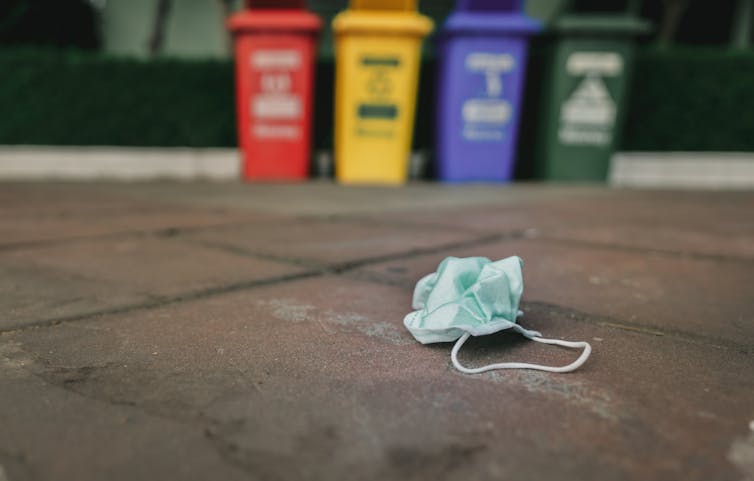 Recycling of face masks can be complicated.
Shutterstock
Recycling of face masks can be complicated.
Shutterstock
Which mask should you choose?
From a purely environmental perspective, research suggests owning multiple reusable face masks, and machine-washing them together, is the best option. Using filters with reusable face masks is a second-best option.
But when choosing a mask, consider where you will wear it. Unless cloth masks are shown to be as effective as other masks, health-care workers should not use them. But they may be suitable in low-risk everyday settings.
In the longer term, governments and manufacturers must make every effort to design masks that will not harm the planet – and consumers should demand this. Face masks will probably be ubiquitous on our streets for months to come. But once the pandemic is over, the environmental legacy may last for decades, if not centuries.
Read more: Cloth masks do protect the wearer – breathing in less coronavirus means you get less sick
Authors: Mayuri Wijayasundara, Lecturer, Deakin University

















